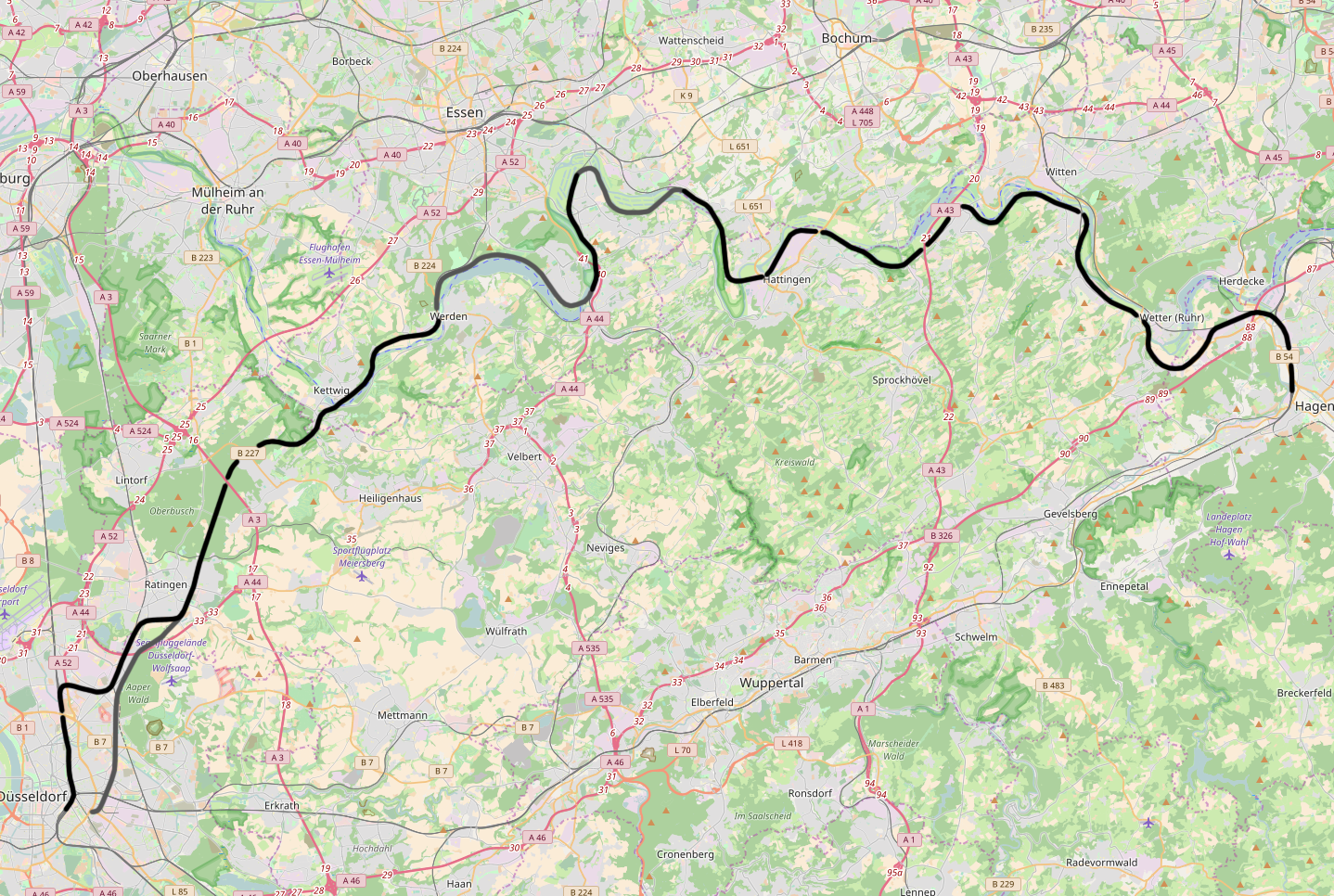
Ruhr Valley Railway
Walk the *Von-Ruhr-zur-Ruhr-Radweg* - the From Ruhr to Ruhr bike trail - and you are riding on the ghost of a track. Where you are pedaling, between Herbede and Wengern, used to be the second rail of the Middle Ruhr Valley Railway. The first rail still carries trains. The second rail was torn up and the gravel laid over with asphalt, and now cyclists trace the same gentle grade that the coal trains of the 1870s used to grind along, river on one side, beech-covered hills on the other. The valley made the railway possible, the railway made the coal economy possible, and the bike trail is the polite epilogue.
The Bergisch-Maerkische Build
The Ruhr Valley Railway - *Ruhrtalbahn* - went up in pieces between 1869 and 1876, built by the Bergisch-Maerkische Eisenbahn-Gesellschaft, one of the three big private railway companies that carved up the Ruhrgebiet in the mid-19th century. The strategic point was simple. The river ran along a gentle, uniform grade through the southern Ruhr, dropping smoothly from Hagen to its mouth near Duisburg. Steam locomotives in the 1870s could not climb steep grades while pulling heavy coal loads. A railway laid along the riverbank could carry tonnage that a railway over the hills could not. So the BME built one, in four sections: an Upper section from Schwerte to Warburg (opened 1870-1873), a Middle section from Dahlhausen to Herdecke (1869, extended 1874), a Trunk line from Duesseldorf to Dahlhausen (1872, extended 1874), and a Lower section from Kettwig to Styrum (1876). Together, roughly 150 kilometers of river-following rail.
Coal to Ruhrort
The job was coal. The line collected production from the mines along its route and pushed it westward toward the port of Ruhrort on the Rhine, bypassing the Heissen hills that would have crippled a more direct railway. At the peak of Ruhr coal mining, sidings branched off the main line every few kilometers, each one tied to a specific colliery. The Henrichshuette steel works at Hattingen sat directly on the track, fed by it for over a century. The trains were endless: black wagons full of bituminous coal heading west, empty wagons heading east, occasional passenger trains threading the gaps. The whole landscape of the southern Ruhr - the smoke, the soot on the windowsills, the narrow river-side towns whose main streets ran parallel to the tracks - was shaped by what this railway carried.
The Bridges, Blown
At the end of the Second World War, the retreating Wehrmacht dynamited the railway bridges across the Ruhr to slow the Allied advance. The two adjacent bridges at Kettwig Stausee - one for the Ruhr Valley line, one for the Lower Ruhr Valley line - went down together, along with the Styrum bridge further downstream. Only the upstream Kettwig bridge was rebuilt. The other became a single pillar standing in the Kettwig reservoir, and it is still there: a stubby concrete remnant in the middle of the lake, holding nothing up. The destroyed Styrum bridge cut the Lower Ruhr Valley line in half permanently. Speldorf station, which had been a connecting curve, became the new terminus. War damage stitched into the regional rail map - some of it still visible 80 years later.
Closures, Slow
Post-war, the line was operationally complete but economically doomed. Coal output peaked in the 1950s and then declined relentlessly as cheaper foreign coal arrived and Ruhr mines closed. Passenger services along the Ueberruhr-Dahlhausen stretch ended in 1959. Werden-Kupferdreh closed to passengers in 1965. Muelheim-Stausee ended in 1968. Freight followed in slow stages through the 1960s and 1970s. The Hattingen-Wengern Ost stretch lost its passengers on 23 May 1971 and its freight when the Henrichshuette steel works in Hattingen shut down. Today, three S-Bahn lines still run on surviving sections of the original Ruhr Valley line: S 6 from Duesseldorf to Essen-Werden, S 9 from Essen-Ueberruhr to Essen-Kupferdreh, and S 3 from Bochum-Dahlhausen to Hattingen. The rest sits as cycle trail or quiet right-of-way.
Steam, Returned
Since 2005, the Middle Ruhr Valley Railway - Bochum-Dahlhausen to Hattingen, Herbede, Wengern Ost, Hagen-Vorhalle, Hagen Hauptbahnhof - has been a tourist line. The track is owned by the Ruhr Regional Association (Regionalverband Ruhr), and the trains are operated by TouristikEisenbahn Ruhrgebiet GmbH, an RVR subsidiary. The Bochum-Dahlhausen Railway Museum has been running steam excursions on the Herbede-Wengern Ost section since 1981. On the first Sunday of each summer month, a Prussian P 8 locomotive built in 1918 fires up at Dahlhausen, takes on coal and water at the historic depot, and pulls a string of restored carriages south along the river. Passengers see exactly what their great-grandparents saw - the same beech woods, the same river bends, the same gradient - except the locomotive is now an artifact and the coal in the firebox is purely ceremonial.
From the Air
Located at 51.40 N, 7.17 E, midway along the Middle Ruhr Valley Railway, which traces the southern bank of the Ruhr River through the wooded valley between Bochum-Dahlhausen and Hattingen. From altitude, the line is visible as a thin steel-and-gravel ribbon following the river's meander. Look for steam plumes on first Sundays in summer - the heritage train is the most photogenic moving object in the valley. Nearest major airport: Dortmund (EDLW), 25 km northeast. The forested Ruhr valley itself makes a striking visual contrast with the dense urban Ruhrgebiet to the north.