Ruhyýet Palace
A carpet weighing more than a tonne lies inside the Ruhyýet Palace, handwoven by Turkmen artisans in 1998 and stretching 294 square meters across the floor. They named it "President." In a country where the national flag already features five carpet guls, where the carpet is so central to identity that it has its own holiday, this seems almost inevitable. But the carpet is just the beginning of what makes Ashgabat's Palace of Congresses and Arts one of the strangest seats of government on Earth.
Marble, Bouygues, and Niyazov's Vision
President Saparmurat Niyazov commissioned the palace in 1995, entrusting the French construction giant Bouygues with the project. It was not the company's first assignment in Turkmenistan, nor its last — Bouygues has built much of modern Ashgabat, a city that rose from the rubble of the devastating 1948 earthquake into something no one quite expected. The palace was completed in 1999 and inaugurated the following year. Its white marble facade matches everything else in the capital. Ashgabat holds the Guinness World Record for the highest concentration of white marble-clad buildings: 543 structures across 22 square kilometers, a cityscape that gleams under the desert sun like a fever dream of civic ambition.
Where Power Changes Hands
The Ruhyýet serves as the traditional venue for presidential inaugurations — events that, in Turkmenistan, carry particular weight. Gurbanguly Berdimuhamedow was inaugurated here for his third term on 17 February 2017. Five years later, on 19 March 2022, his son Serdar Berdimuhamedow took the oath in the same hall, marking a transfer of power from father to son that Turkmen state media presented as the will of the people. The palace also served as a diplomatic venue during the June 2022 visit by heads of state attending the sixth Caspian Summit, which was held at the nearby Arkadag Hotel. Regional Ruhyýet Palaces in Türkmenbaşy, Daşoguz, Türkmenabat, and Mary connect via digital systems to participate in national forums broadcast from the main hall — a web of marble and fiber optic cable stretching across the Karakum Desert.
Woven Into the Currency
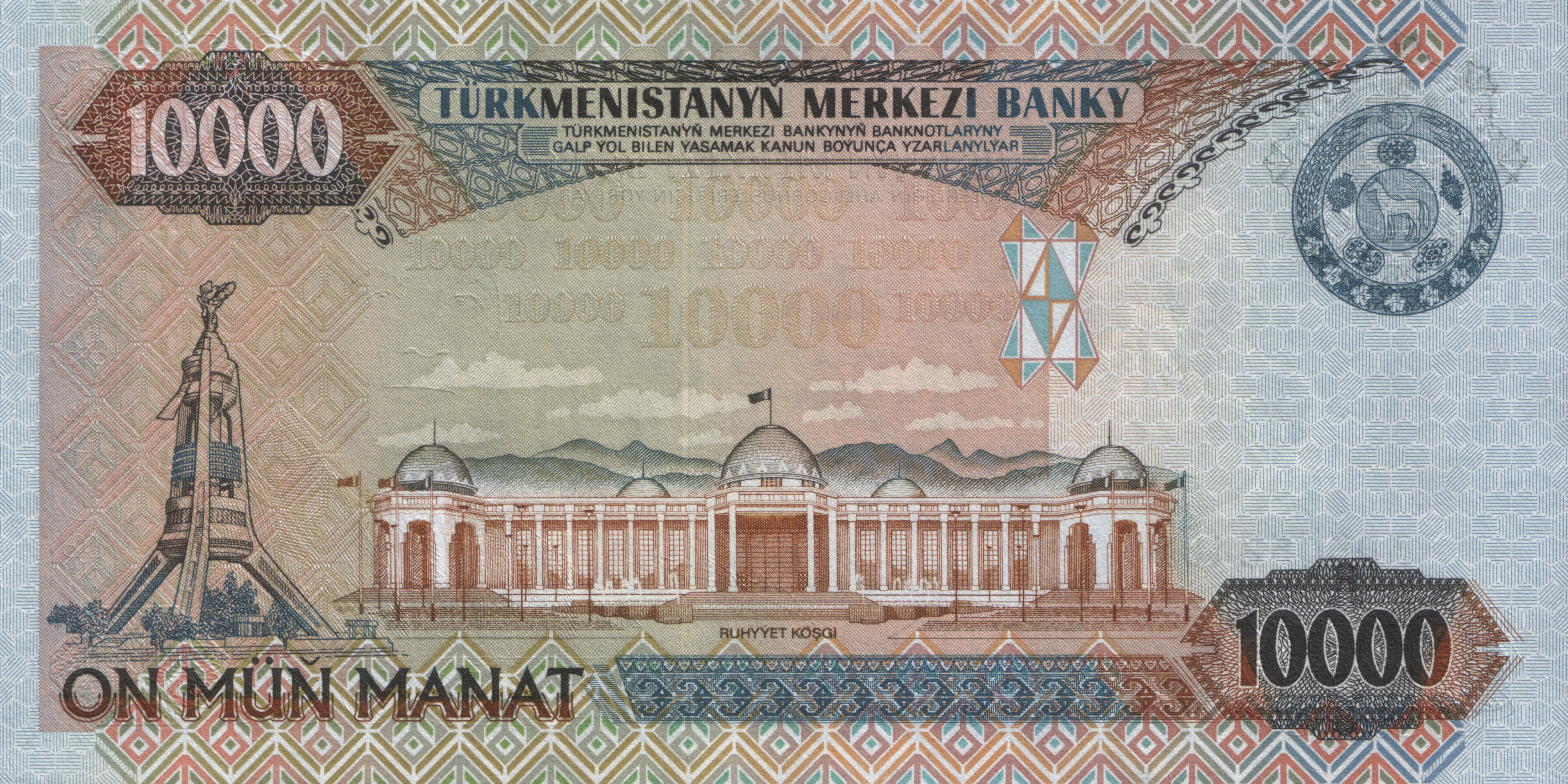
The palace appears on multiple Turkmenistani manat banknotes. The 10,000 manat note from the 2000 series depicts it alongside the Neutrality Monument, while the 20 manat note from the 2009 series pairs it with Gorogly, the hero of Turkmen epics. In a country where architecture and national mythology blur together, putting the palace on the currency was less a commemorative gesture than a statement of identity. The building combines traditional Turkmen motifs with modern engineering, its dome and colonnades drawing from Islamic architectural traditions while its marble-and-glass construction speaks a different language entirely. In 2008, Turkmenistan's largest fountain complex was added in front of the palace, because in Ashgabat, more is always the appropriate amount.
A Capital Like No Other
To approach the Ruhyýet Palace from the air is to see it in context — one white building among hundreds, arrayed along broad empty boulevards in a city of nearly one million people where foot traffic remains curiously scarce. Ashgabat does not invite casual exploration. It performs. The Ruhyýet is part of that performance: a palace built not for comfort but for projection, where the handwoven carpet on the floor and the marble on the walls say the same thing in different registers. Turkmenistan's identity is threaded through every square meter of this building, from the guls in the carpet to the presidential seals on the doors. Whether that identity belongs to its people or to the state that claims to speak for them is a question the marble does not answer.
From the Air
Coordinates: 37.9325°N, 58.3778°E. The palace sits in central Ashgabat amid a sea of white marble buildings. Approach from the south to see the full sweep of Ashgabat's marble cityscape against the Kopet Dag mountains. Ashgabat International Airport (UTAA) lies 10 km northwest. The entire city gleams white from cruising altitude in clear conditions.