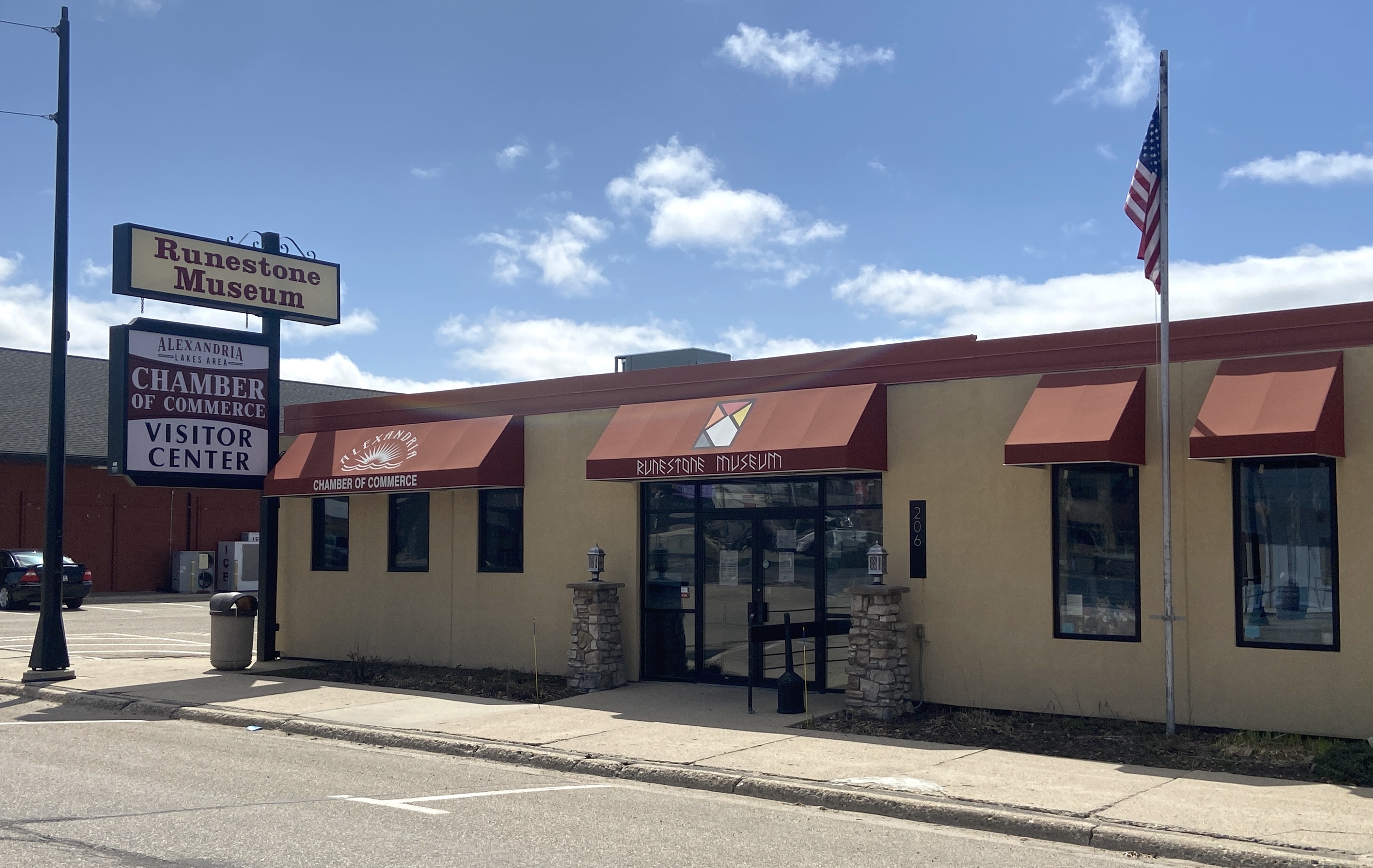
Runestone Museum
A 28-foot fiberglass Viking named Big Ole stands guard in downtown Alexandria, Minnesota, his shield inscribed with a question that has haunted this lake-country town for over a century: "Minnesota Birthplace of America?" The question mark is the honest part. Inside the Runestone Museum a few blocks away sits the artifact that inspired Ole and the slogan -- a 202-pound slab of greywacke stone covered in runic inscriptions, allegedly unearthed from the roots of an aspen tree on a farm near Kensington in 1898. The Kensington Runestone claims that Norse explorers reached central Minnesota in 1362. Most scholars say someone carved those runes in the nineteenth century. Alexandria has built an identity around the debate itself, and the Runestone Museum is where that identity lives.
Tangled in the Roots
On a November day in 1898, Swedish immigrant farmer Olof Ohman was clearing trees on his property near the village of Kensington, about fifteen miles southwest of Alexandria. According to his account, he found a flat stone slab entwined in the roots of an aspen tree, its face covered in unfamiliar markings. The inscriptions turned out to be runes -- the alphabetic characters used by medieval Scandinavians. Translated, the text described a party of thirty men, Goths and Norwegians, on an exploration journey from Vinland westward in the year 1362. Ten members of the party, the inscription claimed, were found dead upon the explorers' return to their camp. If genuine, the stone would rewrite the history of European contact with North America, placing Scandinavian explorers deep in the continent's interior more than a century before Columbus.
A Hoax That Refuses to Die
The first scientific examination in 1910 set the tone for what would become a drawn-out academic battle. Scandinavian linguists and historians examined the inscription and unanimously pronounced it a fraud of recent date, noting anachronistic rune forms and language that did not match fourteenth-century usage. Some critics directly charged Ohman with fabrication, pointing out that the National Romanticism movement sweeping Scandinavia at the time had stirred intense popular interest in Viking exploration -- and that Ohman, a Swedish immigrant, would have been immersed in that cultural moment. Yet the stone has its defenders. A succession of amateur historians, geologists, and even some academics have argued for authenticity, pointing to weathering patterns, mineral deposits in the carved grooves, and the presence of rare runic characters. The debate has generated hundreds of books, articles, and television specials over the decades.
More Than One Stone
The Runestone Museum, established in 1958, wisely frames its centerpiece artifact within a much broader story. Beyond the famous stone, the museum's galleries explore the deep history of the people who actually did live in this landscape for millennia -- the Dakota and Ojibwe peoples whose presence predates any European contact by thousands of years. Exhibits on Minnesota's homesteading era document the waves of German, Norwegian, and Swedish immigrants who transformed the prairies in the nineteenth century. Fort Alexandria, a replica frontier settlement on the museum grounds, features authentic log buildings from the 1860s through 1910s. And then there is Snorri, a 40-foot Viking ship replica that sits on the grounds, named for Snorri Thorfinnson, traditionally considered the first European child born in North America. A Children's Discovery Room rounds out the collection with hands-on exhibits. The museum treats the Runestone as a starting point for conversation rather than a settled conclusion.
Viking Country, Lake Country
Alexandria sits in the heart of Minnesota's lake district, surrounded by more than a thousand lakes carved by glaciers during the last ice age. Douglas County alone contains over 200 of them, and the town has long marketed itself as a vacation destination for fishing, boating, and cabin life. The Viking identity grafted onto this landscape through the Runestone controversy has proved remarkably durable. Big Ole, the fiberglass Viking statue sculpted by Gordon Schumaker, was built in 1965 for the New York World's Fair and returned to Alexandria that December, where he has stood ever since -- four tons of steel and fiberglass towering over the downtown. The high school teams are the Cardinals, but the town's cultural allegiance belongs to Norse mythology. Whether the Kensington Runestone is a genuine medieval artifact or an elaborate nineteenth-century creation, it has given Alexandria something most small towns never achieve: a story that the world keeps coming back to hear.
From the Air
Located at 45.89°N, 95.38°W in the heart of Minnesota's lake district, elevation approximately 1,400 feet MSL. Alexandria Regional Airport/Chandler Field (KAXN) is 2 nautical miles southwest of downtown. The museum sits in the town center, identifiable from the air by the nearby lake-studded landscape -- Douglas County contains over 200 lakes visible on approach. Lake Le Homme Dieu and Lake Geneva are prominent features east and south of town. Best viewed at 3,000-5,000 feet AGL. Nearest alternate airports include St. Cloud Regional (KSTC) 60nm southeast and Brainerd Lakes Regional (KBRD) 65nm east-northeast.