Runestones of Hogby
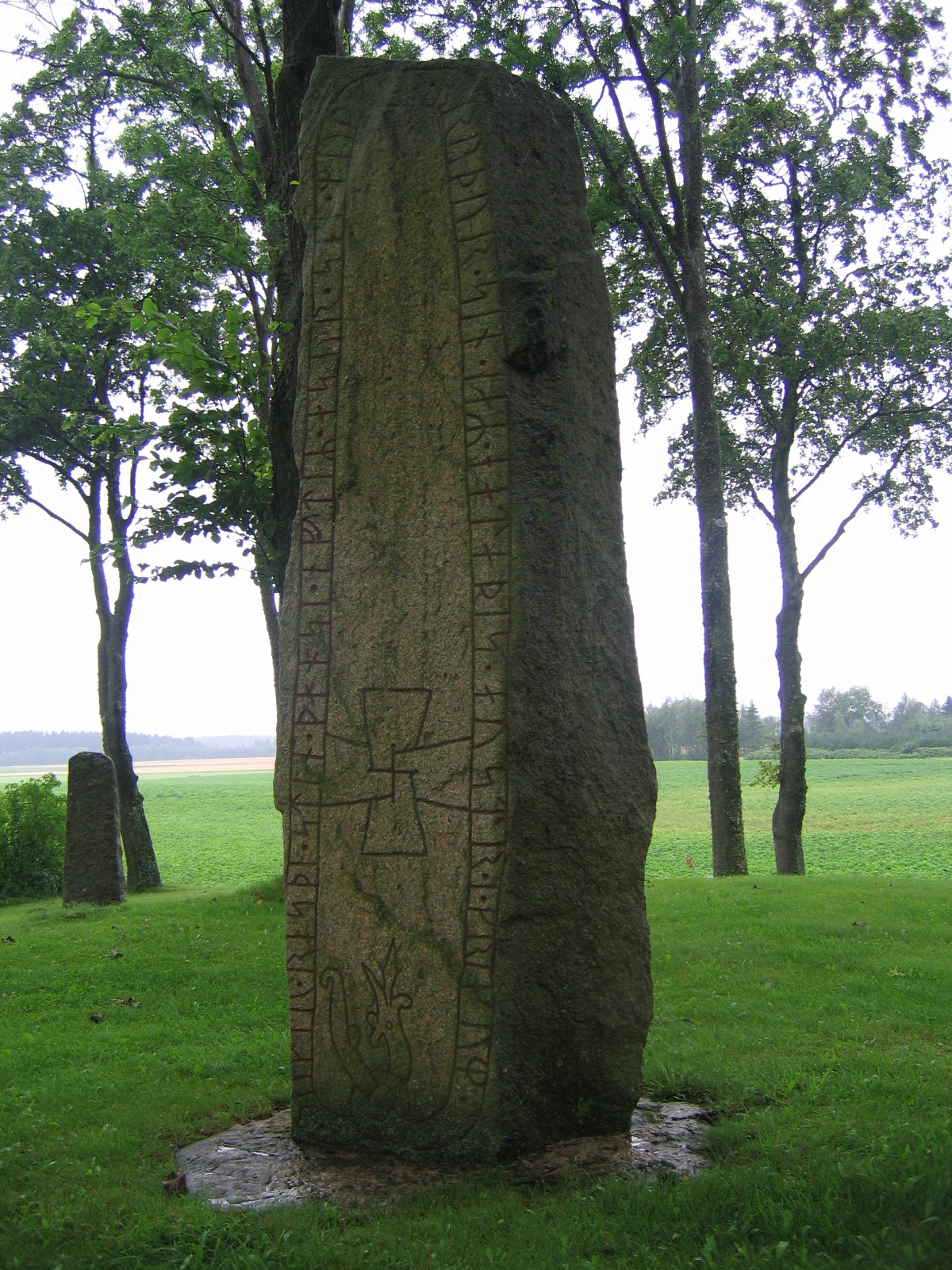
Good man Gulli had five sons. All of them died far from home. The runestone that records their fates stood hidden for centuries, built into the walls of a church that was demolished in 1874. When workers found it in the rubble, they uncovered one of the most eloquent Viking Age epitaphs ever carved in stone. The Hogby runestone, catalogued as Og 81, tells the story of a family scattered by the ambitions of the age, brothers who sought fortune and found death in Greece, in Denmark, and in places whose names have blurred with time.
Five Brothers, Five Fates
The inscription on the Hogby runestone reads like a saga compressed into stone. A woman named Thorgerd raised this monument for her uncle Assur, who ended his days in Grikkium, the Old Norse name for the Byzantine Empire. But the reverse side of the stone expands the tragedy. It records the deaths of all five sons of Gulli in the ancient poetic meter called fornyrdislag. Asmund fell in Fori, possibly an island in the Baltic. Assur died serving the Byzantine Emperor. Halfdan was killed on Holm, perhaps Bornholm or perhaps in a holmgang, the ritualized Viking duel. Kari perished at a place called Odd, likely the northwestern cape of Zealand. And Bui died too, though the stone does not say where or how, suggesting perhaps a death less glorious than his brothers.
Varangians in the East
Assur's fate places him among the Varangians, the Scandinavian warriors who served the Byzantine emperors as elite mercenaries and personal guards. The Rundata project dates the Hogby stones to the late 10th century, making Assur one of the earliest Varangians known to have died in imperial service. These Northmen traveled the river routes from the Baltic to Constantinople, trading amber and furs, fighting in Byzantine campaigns across Anatolia and the Mediterranean. The inscription says simply that Assur ended in Greece, but behind those words lies a journey of thousands of miles, from a village in Ostergotland to the marble palaces of Constantinople.
Poetry in Stone
What sets the Hogby runestone apart is its literary quality. The epitaph for Gulli's sons is composed in fornyrdislag, the oldest Norse poetic meter, the same form used in the great heroic poems of the Edda. Carving poetry into stone required skill and cost. Someone, perhaps Thorgerd herself, wanted these deaths remembered not just as facts but as verses worthy of heroes. The rune carver Thorkell added his signature at the end, claiming authorship of the work. The result is both memorial and literature, a thousand-year-old poem standing in a Swedish village churchyard.
The Other Stones
When the Hogby church came down in 1874, workers found fragments of additional runestones in the rubble. Og 82, in the simpler RAK style, commemorates Oyvind, son of Tosti, who owned or commanded the settlement at Hogby. Og 83, tentatively dated to the same period, was raised by a woman named Thora for her son Svein, who died somewhere in the west, the inscription breaking off before revealing the location. These stones suggest that Hogby was a place of some importance in the Viking Age, home to families wealthy enough to commission carved memorials and connected enough to send their sons across the known world.
Voices Across a Millennium
Today the Hogby runestone stands where it was meant to stand, in the village that bore witness to a family's dispersal and loss. The Latin transliterations of the Old East Norse inscription can be read by scholars. The English translations make the meaning clear. But something remains that no translation captures: the weight of carved granite, the permanence of grief rendered in runes. Flying over Ostergotland, you see a landscape of farms and forests that has changed little in its essentials since Gulli lived here. His sons traveled to the edges of the Viking world and beyond. They never came home. A stone in Hogby makes sure we remember.
From the Air
Located at 58.36N, 15.10E in the village of Hogby, Ostergotland, Sweden. The runestones are situated near the site of the former medieval church. Nearest airport is Linkoping City Airport (ESSL), approximately 35km south. The landscape is typical central Swedish agricultural country with scattered villages and forests. Best viewed at 2,000-4,000 feet to appreciate the rural setting, though the stones themselves are not visible from altitude.