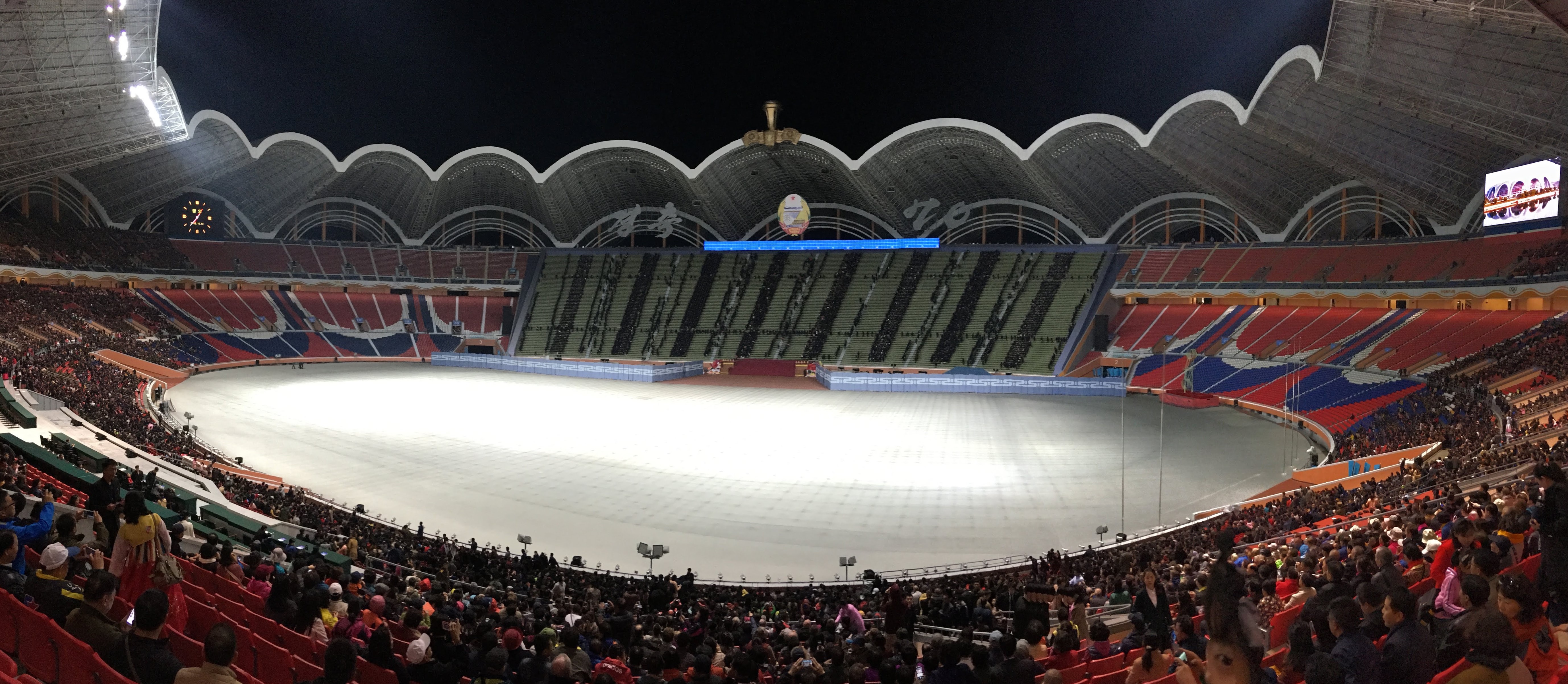
Rungrado 1st of May Stadium
When Seoul won the right to host the 1988 Summer Olympics, Pyongyang answered with concrete and ambition. On Rungrado Island, in the middle of the Taedong River, North Korea built a stadium so enormous that it could swallow 150,000 spectators whole. The Rungrado 1st of May Stadium opened on May 1, 1989, and at the time it was the largest stadium ever constructed in Asia. It remains the second largest in the world by seating capacity. The structure was not merely a response to Seoul's Olympic moment -- it was a declaration, poured in 207,000 square meters of land, that Pyongyang intended to be seen as the legitimate capital of the Korean peninsula.
A Festival's Cathedral
The stadium's reason for being was the 13th World Festival of Youth and Students, a gathering of leftist youth organizations that Pyongyang hosted in 1989. The regime treated the festival as a showcase, initiating massive construction projects across the capital. Rungrado was the crown jewel. Its scalloped roof, designed to resemble a magnolia blossom, rises above the island like a vast parachute frozen mid-descent. Inside, the sheer scale overwhelms: tier after tier of seating climbing toward the open sky, surrounding a field that can accommodate not just football matches but spectacles involving tens of thousands of performers simultaneously. The stadium set the template for what Pyongyang would become known for -- events where the audience and the performance blur together in displays of choreographed unanimity.
The Greatest Show on Earth
What happens inside Rungrado defies easy categorization. The Arirang Festival, a mass gymnastics and artistic performance first held here in 2002, involved over 100,000 participants -- double the number of spectators watching them. The Guinness Book of Records recognized it in 2007 as the largest gymnastics display ever staged. Performers flip cards in perfect synchronization to create stadium-sized mosaics while gymnasts, dancers, and acrobats perform choreography so precisely coordinated it appears mechanical. The event became an annual fixture, usually running through August and September, and was one of the few experiences open to foreign tourists. Behind the spectacle, as The Guardian reported in 2002, lies a country where despair and hunger coexist with the defiance of mounting the greatest show on earth.
Collision Course
Perhaps the stadium's most surreal chapter came on April 28-29, 1995, when Rungrado hosted Collision in Korea -- the largest professional wrestling pay-per-view event in history. The promotion brought together stars from the rival wrestling empires of Japan and the United States for two nights of matches before audiences of 150,000 and 190,000, according to local authorities. The image of American and Japanese wrestlers performing choreographed combat inside the world's largest stadium, in a country technically still at war with its southern neighbor, remains one of the Cold War era's stranger cultural footnotes.
Stages of Diplomacy
In September 2018, the stadium took on a different role entirely. During the inter-Korean summit in Pyongyang, South Korean President Moon Jae-in stood alongside Chairman Kim Jong Un and addressed 150,000 North Korean spectators -- themes of unification, peace, and cooperation filling the vast bowl of seats. The following year, Kim hosted Chinese leader Xi Jinping for a special Grand Mass Gymnastics performance celebrating seventy years of China-North Korea relations. After a two-year renovation completed in 2015, the stadium entered yet another phase. Since 2022, Rungrado has served as Pyongyang's primary venue for New Year's Eve celebrations, its immense capacity turning the calendar's turn into a collective experience on a scale few other structures on Earth could contain.
From the Air
Located at 39.05N, 125.78E on Rungrado Island in the Taedong River, Pyongyang. The stadium's distinctive scalloped roof is visible from altitude as a large oval structure on the island. Nearest airport is Pyongyang Sunan International Airport (ZKPY), approximately 20 km to the north. The island setting in the river makes it easily identifiable from the air. Recommended viewing altitude: 3,000-5,000 feet for structural detail.