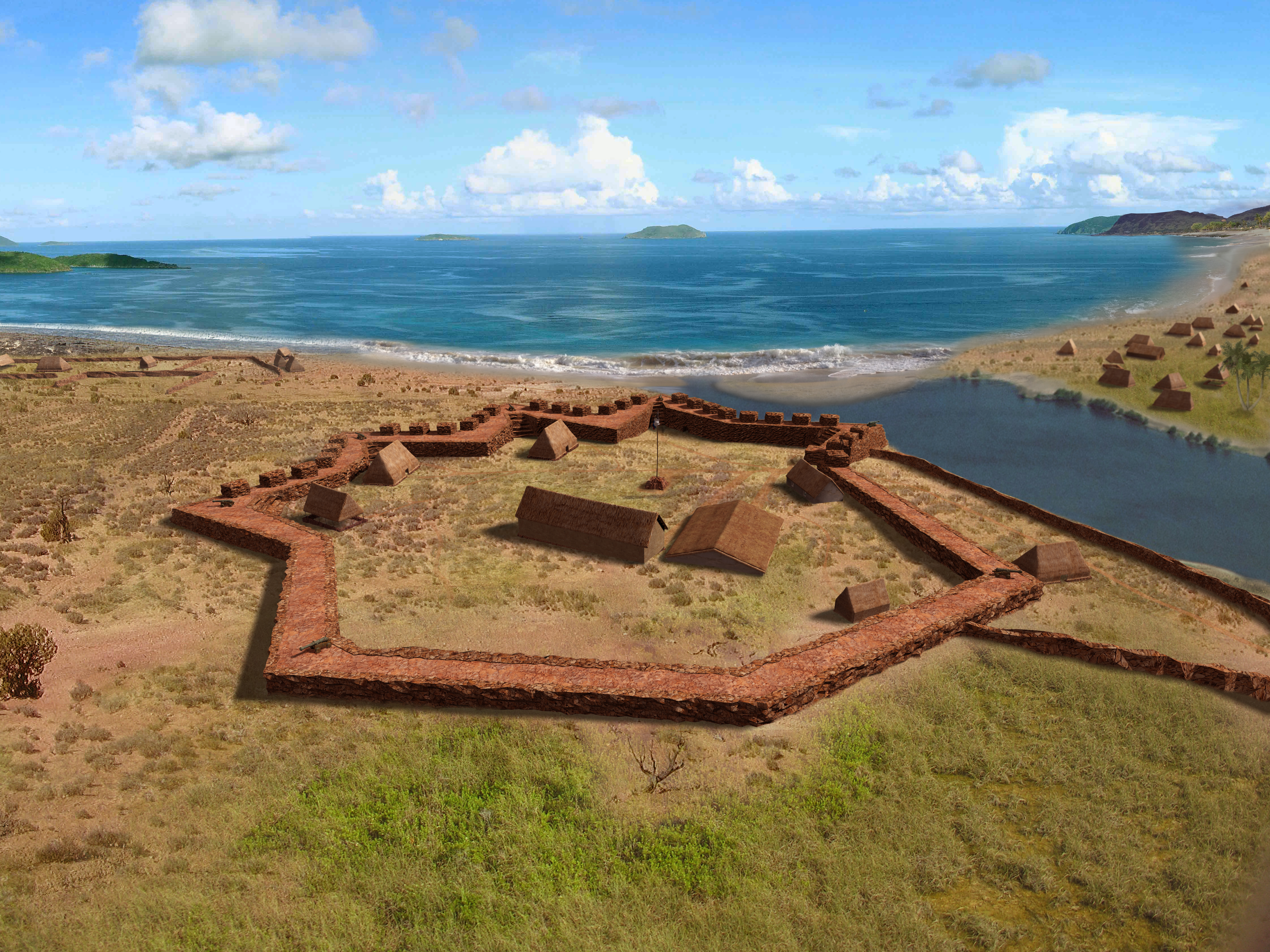
Russian Fort Elizabeth
A Russian fort in Hawaii sounds like the setup for a joke, but the stone walls along the Waimea River are real. Fort Elizabeth -- named for Empress Elizabeth, wife of Tsar Alexander I -- was built in 1817 by a German doctor working for the Russian-American Company, on an island belonging to a Hawaiian king who was playing the Russians against his own sovereign. Neither man had the authority to make the promises he was making. The fort lasted longer than the scheme that created it, and its ruins remain the most striking physical evidence of Russia's brief, improbable attempt to plant a flag in the Hawaiian archipelago.
A Shipwreck Sets the Stage
The story begins with a cargo vessel. In 1815, a Russian-American Company ship wrecked at Waimea, Kauai, and its goods were seized by locals. Alexander Baranov, the company's governor in Sitka, Alaska, sent Georg Anton Schaffer -- a German-born physician with more ambition than diplomatic standing -- to recover the cargo and, almost certainly, to explore the possibility of a permanent Russian presence in the islands. Schaffer arrived and quickly ingratiated himself with Kamehameha I, the king who had unified most of the Hawaiian Islands through conquest. Schaffer's medical skills earned Kamehameha's respect, but the king refused to help the Russians move against Kauai, which was nominally under his control but practically governed by its own chief, Kaumualii. Rebuffed by Kamehameha, Schaffer sailed to Kauai on his own.
A Treaty Built on Bluff
To Schaffer's surprise, Kaumualii was delighted to see him. The Kauai chief had pledged allegiance to Kamehameha in 1810 to avoid invasion, but he had never stopped wanting his independence back. Here was a European power offering protection. Kaumualii eagerly signed a treaty granting Tsar Alexander I a protectorate over Kauai. He told Schaffer the Russians could capture the entire archipelago if they wanted. Schaffer, in turn, promised that the Tsar would help Kaumualii break free of Kamehameha's rule. Neither man could deliver on his side of the bargain. The Tsar had never authorized any of this, and Kaumualii likely never intended to surrender real sovereignty -- he was using the Russians as leverage. But the paperwork was signed, and Schaffer had permission to build. He constructed Fort Elizabeth in 1817 on the east bank of the Waimea River, an irregular octagon about 300 to 450 feet across, with stone walls 20 feet high. Inside, he built barracks, a magazine, and a small Russian Orthodox chapel -- Hawaii's first Orthodox Christian church.
The Fortress That Outlived Its Purpose
Schaffer also built two smaller fortifications near Hanalei on Kauai's north shore: Fortress Alexander and Fort Barclay-de-Tolly, named for the Tsar and his field marshal. His Waimea establishment was substantial -- quarters for troops, a trading house, gardens, and housing for about 30 families. But Schaffer's overbearing conduct alienated the Hawaiians, and when word reached Kauai that the Tsar had never backed any of this, the game was over. Acting on Kamehameha's orders, Kaumualii expelled the Russians in the fall of 1817. Captain Alexander Adams hauled down the Russian flag and replaced it with the Kingdom of Hawaii's own banner. Hawaiian troops occupied Fort Elizabeth. In 1820, its cannons fired a 21-gun salute when Kaumualii's son Humehume arrived aboard the brig Thaddeus, returning from schooling in the United States with American missionaries. Humehume later tried to stage a rebellion against Kamehameha's successors in 1824 by attacking the fort -- the same walls the Russians had built became the base from which he was captured.
Cannons in the Bay
The fort was abandoned around 1853 when its Hawaiian garrison was withdrawn. In 1862, Kauai pioneer Valdemar Knudsen surveyed its armaments: 60 flintlock muskets, 16 swords, 12 eighteen-pound cannons, 26 smaller cannons, six heavy guns, and 24 little guns. He was tasked with removing and selling the hardware as scrap metal. During the 1864 decommissioning, as Knudsen loaded ordnance onto a schooner in Waimea Bay, one or two cannons slipped and fell into the water, where they presumably remain. Today the fort is preserved as Pa'ula'ula State Historical Park. The outer walls, built of piled stone 25 to 45 feet thick and about 20 feet high, remain in good condition. Foundations of the magazine, barracks, and other buildings are visible inside. An interpretive walking path guides visitors through the ruins. From inside the octagonal walls, looking out over the mouth of the Waimea River, it is possible to imagine the improbability of what happened here: a German doctor, a Hawaiian rebel king, and a distant Russian empire, briefly colliding on a Pacific shore none of them would hold.
From the Air
Russian Fort Elizabeth is located at approximately 21.95N, 159.66W, on the southeastern shore at the mouth of the Waimea River on Kauai's southwestern coast. The octagonal fort ruins are visible from low altitude. The Cook Landing Site is directly across the river to the northwest. Nearest airport is Lihue Airport (PHLI), about 20 nm east. Pacific Missile Range Facility (PHBK/Barking Sands) is approximately 6 nm northwest along the coast. Best viewed at 1,000-2,000 feet for the clearest view of the octagonal wall structure. The red sediment plume of the Waimea River entering the bay is a helpful visual reference.