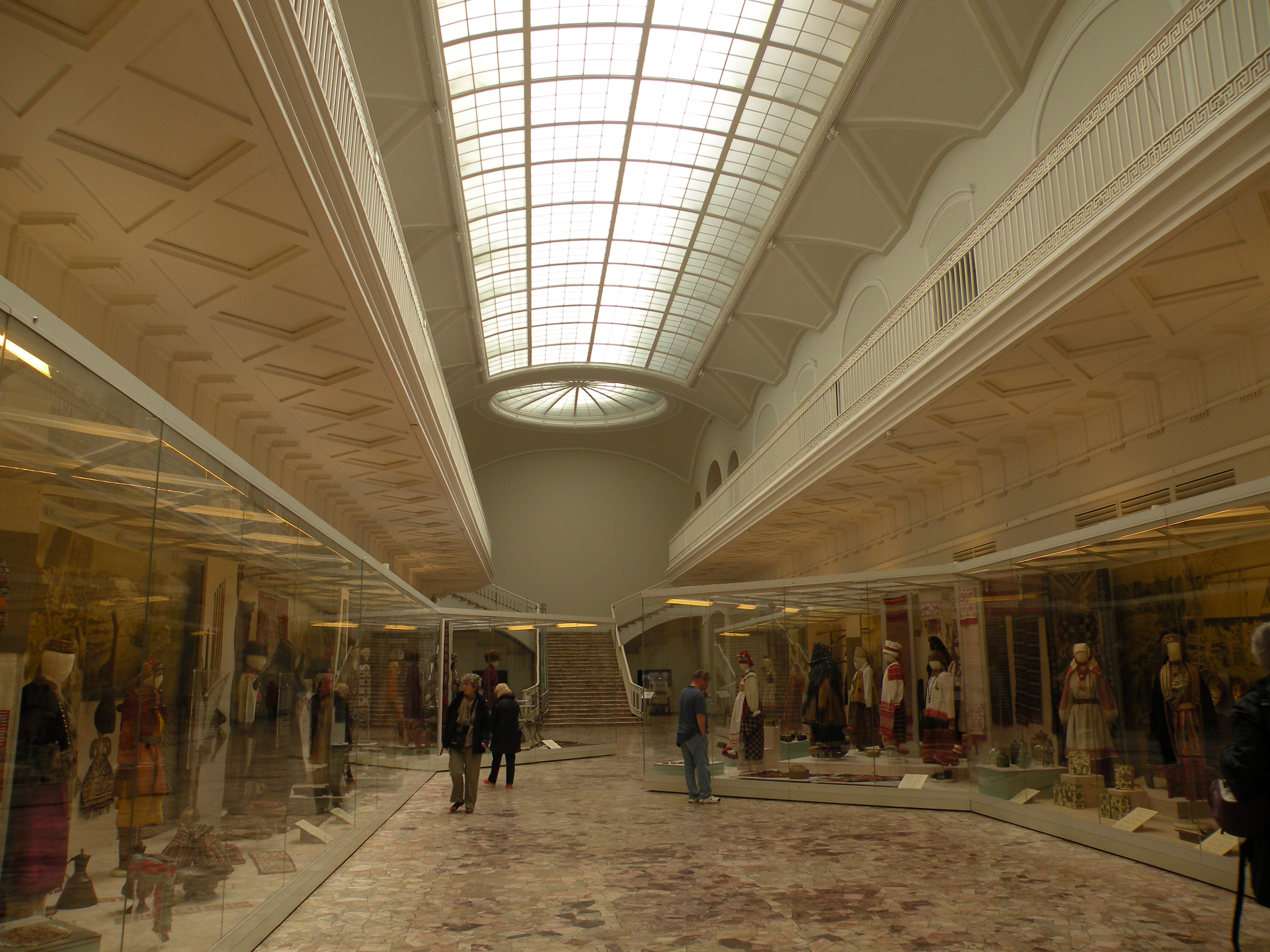
Russian Museum of Ethnography
Imagine an empire that stretched from the Baltic to the Pacific, that contained more than 130 distinct peoples speaking more than 130 distinct languages, and that decided in 1895 to start collecting their everyday objects - their wedding clothes and their cooking pots and their amulets and their wooden toys - before the world that produced them disappeared. The collection that resulted is now 500,000 objects strong. It lives in a heavy Doric-columned building behind the Mikhailovsky Palace in central Saint Petersburg, and it is, in a quiet but absolute way, one of the great ethnographic archives on earth.
The Tsar's Personal Collection
The museum began as the Ethnographic Department of the Russian Museum, established by Nicholas II in 1895 to honor his father Alexander III. The first holdings were the gifts the imperial family had received over generations from delegations representing the empire's far-flung peoples - silver, embroidery, ceremonial weapons, religious objects from peoples the court at Saint Petersburg knew mostly through such tribute. Then in 1901 the museum began organized expeditions. Anthropologists fanned out through the Caucasus, Central Asia, Siberia, the Russian Far East, recording, photographing, and acquiring. State funding was insufficient; Nicholas II personally bought objects with his own money to fill the collection. Prince Esper Ukhtomsky, the diplomat-Orientalist, donated a large collection of Buddhist religious objects from his travels in Mongolia and Tibet. Prince Tenishev, the railway industrialist, gave the archives of his private bureau that had been documenting Russian peasant life since the 1880s.
The Building
Vladimir Svinyin designed the museum's home as an extension wing to the Mikhailovsky Palace, completed in 1902. From the outside it is a long Doric colonnade in pale stone facing Inzhenernaya Ulitsa, monumental but deliberately restrained next to the Mikhailovsky's neoclassical drama. Inside, the central Marble Hall is faced with rose-colored marble from the Urals and lined with bas-reliefs depicting the empire's many peoples in ethnographic costume - a visual catalog of difference, executed in stone before the Russian Revolution would attempt to flatten that difference under the rhetoric of Soviet brotherhood. The collection was not officially opened to the public until 1923, after the revolution. The Ethnographic Department became fully independent of the Russian Museum in 1934.
An Archive of Vanished Worlds
The collection's strength is the breadth of what it touches. There are Ingush silver belts and Karakalpak yurts, Bukharian Jewish wedding garments and Yakut shaman drums, Karelian birch-bark baskets and Tajik silk embroideries that took years to weave. There are puppet theater dolls from Tashkent that were donated by an engineer named Komarov. There are objects collected by S. M. Dudin in Uzbekistan in 1900-1902 - more than 2,000 items of everyday Uzbek culture, alongside hundreds of his photographs of cities and people that no longer look anything like they did. Many of the cultures represented have been transformed beyond recognition by Soviet collectivization, by post-Soviet migration, by globalization. The objects sit in temperature-controlled storage and rotating exhibition cases as residue of a world that often exists nowhere else.
Soviet Inheritance
When the Museum of the Peoples of the USSR in Moscow was shut down in 1948, its collections were transferred to Leningrad - more than a hundred thousand more objects to absorb. Throughout the Soviet period the museum was both ideological tool and quiet sanctuary: officially celebrating the friendship of Soviet nations, in practice preserving the material evidence of pre-Soviet, often religious, often nationalist cultures the regime was simultaneously trying to erase. Curators built collections through the worst years - E. N. Studenetskaya gathering Ingush household items in 1934, F. Fielstrup documenting Kyrgyz nomadic life in the 1920s before the great famines, A. S. Morozova studying the Turkmen Igdyr tribe in 1937, the same year as the Great Terror. Many of these collectors are now footnotes. The objects they brought back are not.
Visiting
The museum sits in the heart of imperial Petersburg, between the Russian Museum and the Field of Mars, a few minutes' walk from the Hermitage. It draws far fewer crowds than its more famous neighbors, which means you can usually have whole halls to yourself - the Caucasus rooms, the Central Asia gallery, the Siberia exhibition with its shaman cloaks and tools of bone. There is no glossy storyline. There are objects, labels, and the slow accumulation that happens when you spend an hour in a room with the intimate things of someone else's grandmother. It is the kind of place you leave humbled by the size and the complexity of the world the Russian Empire briefly held and then, like all empires, lost.
From the Air
The museum is at 59.94 degrees north, 30.33 east, in central Saint Petersburg on Inzhenernaya Ulitsa, immediately behind the Mikhailovsky Palace and just north of the Catherine Garden. From the air it reads as the eastern wing of the Russian Museum complex, distinguished by its Doric portico facing the smaller side street. Pulkovo (ULLI) is 15 km south. Best appreciated from low altitude over central Petersburg in early morning or late afternoon light, when the city's pastel facades and gilded spires catch the long northern sun. The neighborhood includes the Field of Mars (large open ceremonial space) and the Church of the Savior on Spilled Blood, both useful navigation references.