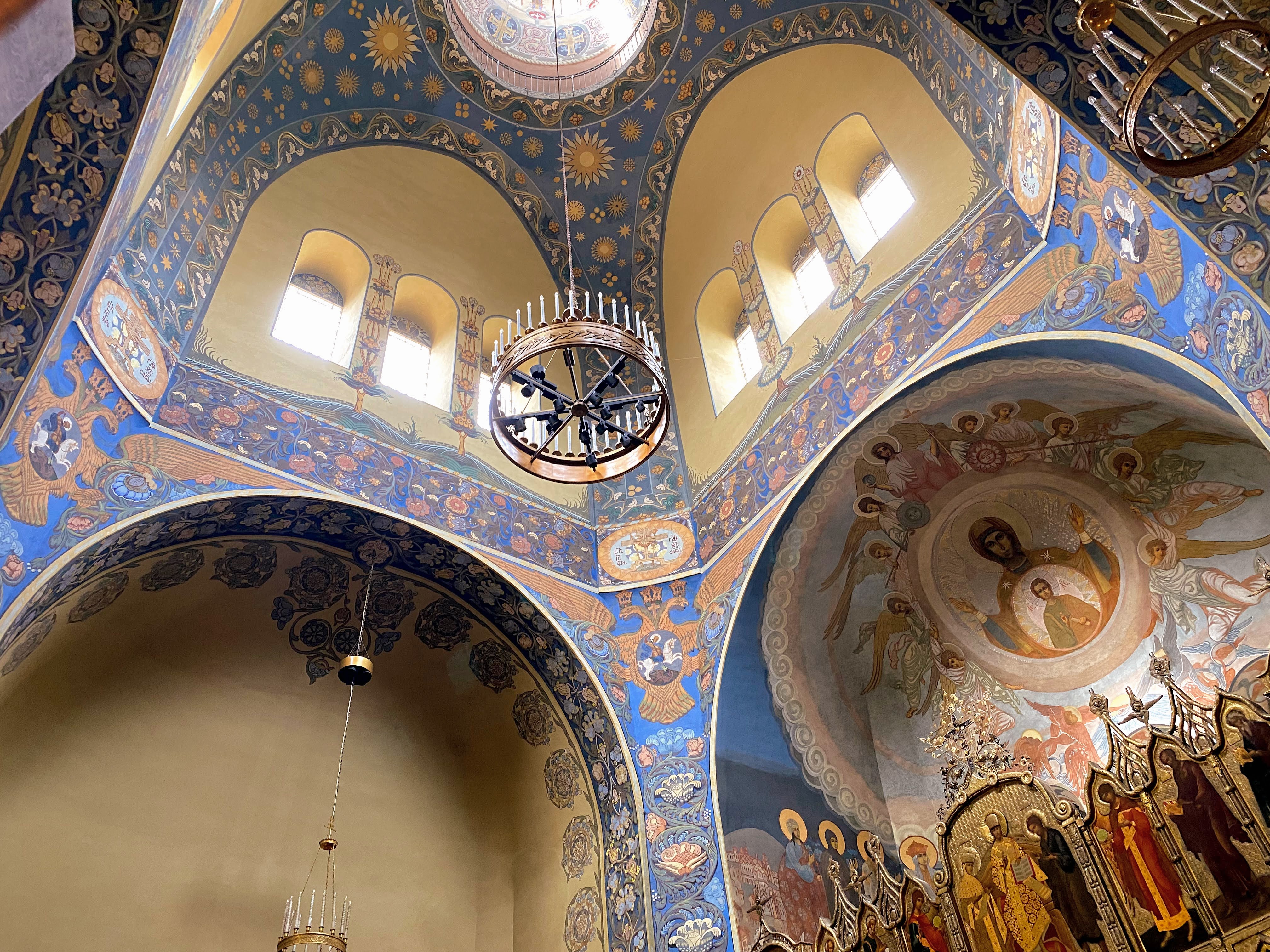
Russian Orthodox Cathedral, Nice
Five onion domes shimmer above the rooftops of Nice, their glazed tiles catching the Mediterranean light in colors that belong to Moscow or St. Petersburg, not the Cote d'Azur. The St. Nicholas Orthodox Cathedral is the largest Eastern Orthodox cathedral in Western Europe, and it stands here because of a love affair between Russian aristocracy and the French Riviera that began in the 1860s and, in certain complicated ways, has never ended.
When the Tsar Came South
The Russian connection to Nice began in 1864, when Tsar Alexander II arrived by the newly completed railway and fell for the mild Riviera climate. Russian nobility followed, establishing a community that would grow to become one of Nice's most influential expatriate populations. The cathedral was consecrated in December 1912, funded by Tsar Nicholas II as a memorial to Nicholas Alexandrovich, the Tsarevich who had died in Nice decades earlier at the age of 21. The building was designed to serve both the settled Russian community and the devout visitors who traveled south from the imperial court each winter. Its architect drew on the Russian Revival style, creating a structure that would have looked perfectly natural on Nevsky Prospect but stood out as wonderfully exotic against the palm trees and pastel facades of Nice.
Revolution and Exile
The Russian Revolution of 1917 shattered the world that had built the cathedral. Communist persecution of religion drove many Russian Orthodox dioceses abroad to form independent jurisdictions, cutting ties with Moscow. One of these, a Paris-based exarchate under the jurisdiction of the Ecumenical Patriarch of Constantinople, assumed control of the Nice cathedral. For decades, the building served as a spiritual home for the descendants of Russian emigres -- families who had fled revolution, preserved their faith in a foreign country, and maintained traditions their homeland had officially repudiated. The cathedral became a living museum of pre-revolutionary Russian Orthodoxy, its icons and liturgy preserved by a community defined by loss.
A Cathedral Contested
The end of the Soviet Union brought new Russian money and new Russian interests to the Riviera, and with them, a bitter legal battle over who owned the cathedral. From 2005 to 2013, the Russian Federation and the existing parish administration fought through French courts over the building's title and the parish's ecclesiastical allegiance. The dispute reflected a deeper conflict between old Russian emigre families who had maintained the cathedral for generations and newly arrived post-Soviet Russians backed by Moscow. In January 2010, a French court ruled that the cathedral was the property of the Russian state. In 2013, after France's highest court, the Cour de Cassation, confirmed the ruling, the keys were handed to the Moscow Patriarchate. The congregation came under the jurisdiction of the Korsun diocese of the Russian Orthodox Church. For the descendants of the emigres who had kept the cathedral alive through decades of exile, the transfer was a loss. For Moscow, it was the recovery of a cultural asset.
Faith Between Empires
Today the cathedral stands as a French national monument, its status as protected heritage coexisting with its role as a functioning parish under Russian ecclesiastical authority. The interior is rich with painted iconography, gilded surfaces, and the dense visual language of Orthodox worship. Visitors enter a space that operates on different registers simultaneously: architectural landmark, diplomatic trophy, place of prayer, and memorial to a Russia that exists now only in memory and liturgy. The five onion domes continue to surprise people who encounter them unexpectedly while walking through a residential neighborhood in Nice. They are a reminder that the Riviera has always been a place where cultures deposit themselves -- sometimes by choice, sometimes by exile, sometimes by the slow accumulation of history that turns a winter refuge for tsars into a permanent piece of the city's identity.
From the Air
Located at 43.70N, 7.25E in a residential area of Nice, about 1 km north of the Promenade des Anglais. The five onion domes are distinctive from the air, especially their colorful glazed tiles. The cathedral is near the train station (Nice-Ville). Nearest airport: Nice Cote d'Azur (LFMN). Best viewed at 1,500-3,000 feet AGL, when the domes stand out against the surrounding urban fabric.