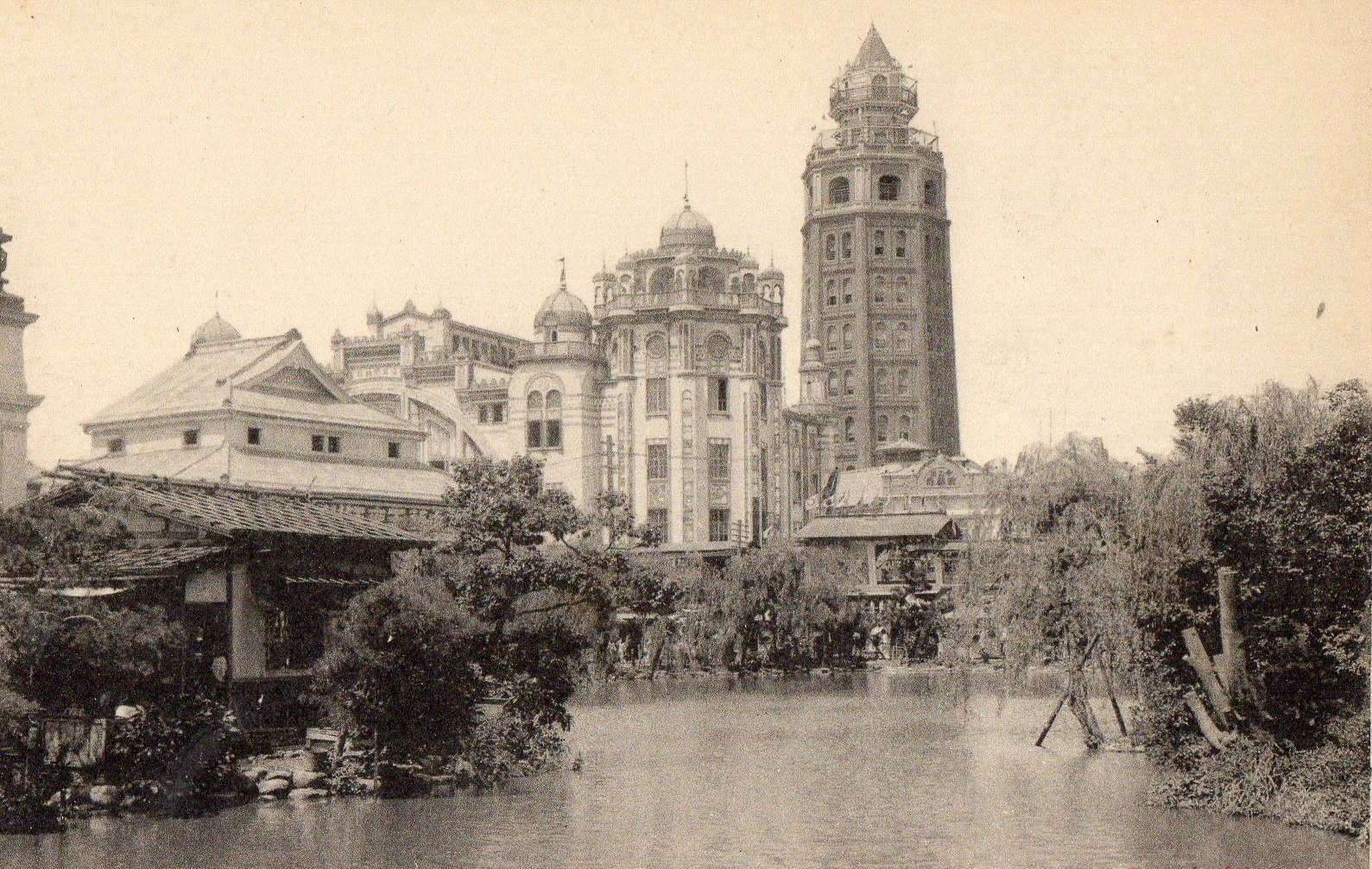
Ryounkaku
Tokyoites called it the Twelve Stories, and on clear days you could see Mount Fuji from the top. The Ryounkaku rose above Asakusa in 1890, a twelve-floor tower of red brick over a wooden frame that gave Japan its first Western-style skyscraper and its first electric elevators. Designed by a Scottish engineer who had come to teach sanitation, built in a neighborhood already famous for theaters and pleasure quarters, the tower became the most recognizable structure in the capital. It lasted thirty-three years before the Great Kanto earthquake shattered its upper floors and forced the army to finish the job with dynamite.
A Scotsman's Tower in the Pleasure District
W. K. Burton arrived in Japan as a foreign expert hired to modernize Tokyo's water supply. He designed the Ryounkaku on the side, drawing plans in the late 1880s for a twelve-story octagonal tower in renaissance revival style. Red brick clad the exterior over a wooden frame, and all twelve floors blazed with electric lighting at a time when most of Tokyo still relied on oil lamps and candles. The two electric elevators, designed by Ichisuke Fujioka, a co-founder of what would become Toshiba, carried up to ten passengers each from the first through eighth floors. They were technological marvels, but safety concerns shut them down after just six months. The location was deliberate: Asakusa was already the entertainment heart of the city, home to Senso-ji temple, kabuki theaters, and a famous licensed quarter. The tower fit right in as the neighborhood's newest spectacle.
Forty-Six Shops in the Sky
The Ryounkaku was not just a tower to climb; it was a vertical bazaar. Floors two through seven contained 46 shops selling imported goods from around the world, an exotic novelty for customers who had never left Japan. A lounge occupied the eighth floor, and art exhibitions rotated through the ninth. The real draw was the view from the tenth through twelfth floors, open observation decks where visitors could survey the entire city spread below them and, on clear days, glimpse the snow-capped cone of Mount Fuji on the horizon. The tower also hosted Western music concerts, geisha photograph exhibitions, and beauty contests. A popular shop specialized in woodblock prints made for sugoroku, a traditional Japanese board game. The Ryounkaku was, in effect, a department store, gallery, concert hall, and observation tower compressed into a single vertical column.
Earthquake, Aftershock, and Dynamite
The tower survived its first seismic test in 1894, when a Tokyo earthquake cracked the structure badly enough that steel girders had to be bolted through the brick and wood to reinforce it. For nearly three more decades, the patched-up Twelve Stories continued to anchor the Asakusa skyline. Then, on September 1, 1923, the Great Kanto earthquake struck. The tremor destroyed the upper floors and left the entire structure leaning and fractured beyond any hope of repair. On September 23, the Japanese army packed the ruins with explosives and brought the Ryounkaku down. The tower that had symbolized Meiji-era ambition and technological wonder became, in its final moments, a casualty of the forces that Japan's engineers had not yet learned to tame.
Ghost of the Twelve Stories
A supermarket stands on the former site today, with a small historic marker near its entrance. For decades that was the only trace. Then in 2018, a construction project beside the old footprint unearthed the original red bricks of the tower's foundation, a physical reminder buried just beneath the surface of modern Asakusa. When the new building was finished, a reproduction of an 1890 ukiyo-e illustration of the Ryounkaku by Utagawa Kunimasa IV was mounted on its exterior wall. The tower also lives on in literature: Tanizaki Junichiro, Ishikawa Takuboku, Kitahara Hakushu, and Kaneko Mitsuharu all wrote about it, and the photographer Ogawa Kazumasa commemorated its opening in his famous 1892 work. The Ryounkaku may be gone, but its shadow still falls across the neighborhood that made it famous.
From the Air
The Ryounkaku's former site is at 35.716N, 139.793E in the Asakusa district of Taito ward, Tokyo. The tower no longer exists, but the location sits within the dense entertainment district surrounding Senso-ji temple, identifiable from the air by the temple's large roof and adjacent five-story pagoda. Nearest major airport is Tokyo Haneda (RJTT), approximately 16 km south. Narita International (RJAA) lies 62 km northeast. The Sumida River runs just to the east, and Tokyo Skytree is visible roughly 1.3 km to the northeast.