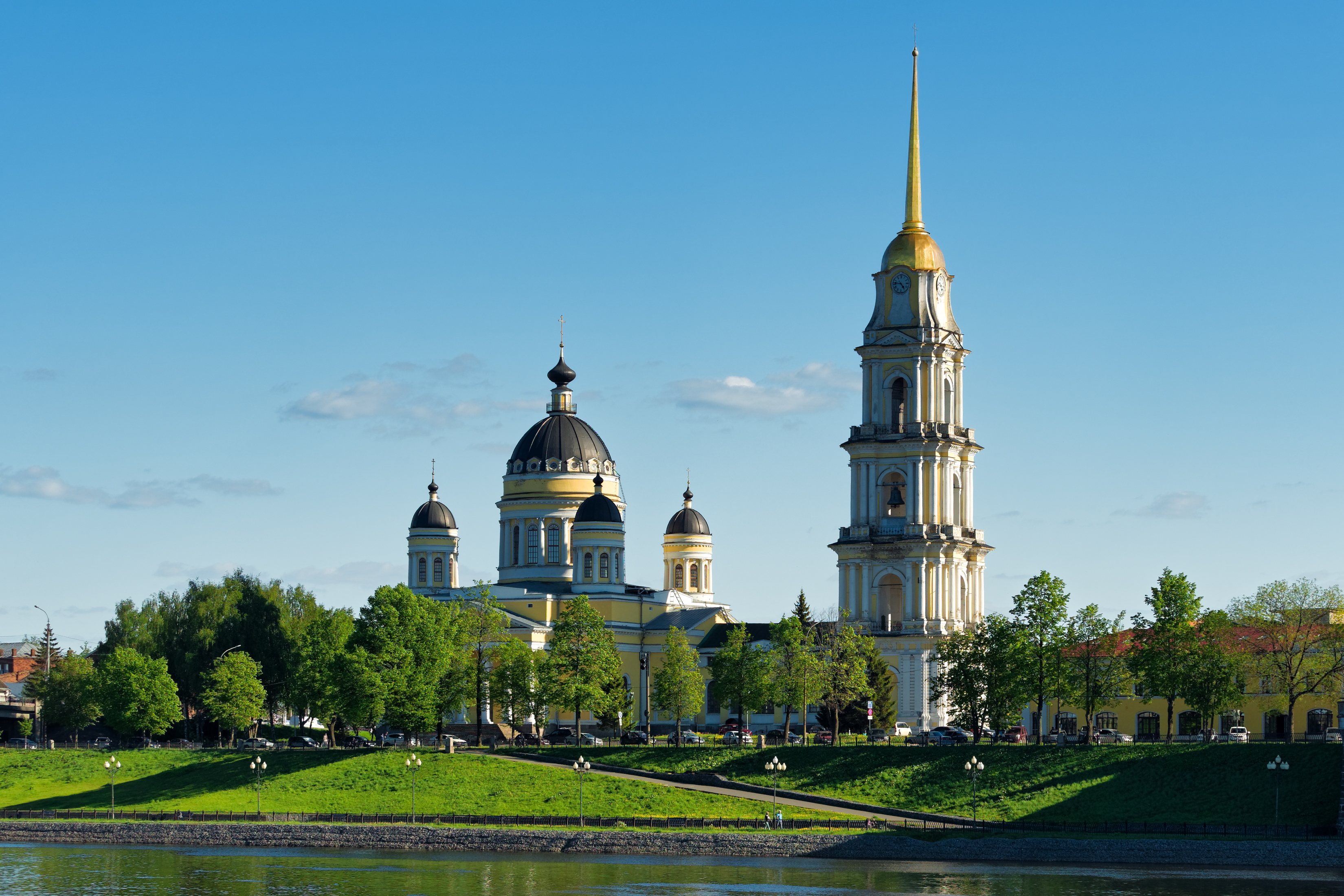
Rybinsk
Three times in the twentieth century, this city's name was taken away and replaced with someone else's. First it became Shcherbakov, then it was restored to Rybinsk, then it became Andropov, and finally, in 1989, Rybinsk again. The name means Fish Town, from the centuries when this settlement held a royal monopoly on catching sturgeon, beluga, and sterlet from the Volga to supply the Muscovite court. That straightforward identity -- a place defined by its river and what the river provides -- has persisted through a thousand years of reinvention, from medieval fishing village to imperial transshipment hub to Soviet industrial powerhouse.
Capital of the Barge Haulers
Rybinsk sits at the northernmost bend of the Volga, where the river turns southeast toward the Caspian. Above this point, the Volga was often too shallow for the heavy barges that carried grain, salt, and timber from the empire's interior. So everything stopped at Rybinsk. Cargo was unloaded from large vessels and transferred to smaller craft capable of navigating the canal systems that connected the Volga basin to St. Petersburg and the Baltic. Grain warehouses, salt depots, inns, and wharves multiplied along the embankment. The city earned the nickname "capital of barge haulers" -- a title that captures both the commerce and the brutal labor that sustained it. Catherine the Great granted town rights in 1777, and by the nineteenth century the Neoclassical Savior-Transfiguration Cathedral, built between 1838 and 1851, dominated a waterfront crowded with barges, merchants, and ambition.
The Town Beneath the Water
In 1935, construction began on the Rybinsk hydroelectric complex as part of Stalin's "Big Volga" project. Reservoir filling started in 1941 and continued through 1947, and the rising waters swallowed farmland, forests, and entire communities. The town of Mologa disappeared completely, its residents resettled -- many of them to Rybinsk itself, where they watched the waters cover the place they had called home. Two generating units came online during the desperate winter of 1941-1942, feeding wartime electricity to Moscow through a dedicated underground cable. The reservoir that made this possible stretches across the landscape like an inland sea, its shores dotted with the remnants of what existed before the water came. A museum in Rybinsk now preserves the memory of Mologa and its "Submerged Sanctuaries."
From Fish to Film to Jet Engines
Rybinsk's most improbable export was a pair of brothers. Joseph Schenck, born here in 1876, and Nicholas Schenck, born in 1880, emigrated to the United States and rose to control the commanding heights of the American film industry. Joseph became chairman of United Artists and co-founded Twentieth Century Pictures; Nicholas ran Loew's Inc. and its subsidiary, Metro-Goldwyn-Mayer. A museum in Rybinsk now tells their story under the name "Rybinsk-Cinema-Hollywood." Meanwhile, the city's industrial backbone evolved along different lines: a 1916 auto plant, originally called Russkiy Renault, transformed into one of Russia's major aero-engine manufacturers, now known as ODK-Saturn. Gas turbines, shipbuilding, and instrument-making sustain the local economy alongside newer sectors including IT.
The Embankment and Its Layers
Walk the Volga embankment today and the city's layered history reveals itself in architecture. Two Grain Exchange buildings stand as landmarks: the older one in strict classicism, the 1912 replacement in ornamental Russian revival style with tile facing, now housing the Rybinsk Museum-Reserve and its collection of over 120,000 items. The Transfiguration Cathedral anchors one end; the 1963 road bridge frames the other. On Krasnaya Square, a monument to Alexander II -- the last major work of sculptor Opekushin -- stood from 1914 until it was destroyed in 1918. A statue of Lenin now occupies the same pedestal, which may be the most concise summary of twentieth-century Russian history a city could offer. At the hydroelectric dam, the Mother Volga statue has watched over the spillway since 1953, voted the city's symbol in a 2016 poll. She gazes out over the reservoir that drowned Mologa, the river that built the city, and a skyline that keeps accumulating new identities without quite forgetting the old ones.
From the Air
Located at 58.05N, 38.83E at the northernmost bend of the Volga River in Yaroslavl Oblast, where the Sheksna and Cheremukha rivers join the Volga. The Rybinsk Reservoir is a massive water feature visible from altitude extending to the northwest. The hydroelectric dam and the city's 22 km stretch along the river are identifiable from 5,000-8,000 feet. Nearest airport with scheduled service is Tunoshna (UUDL) near Yaroslavl, about 95 km southeast. The confluence of the three rivers and the reservoir's enormous expanse make Rybinsk a prominent visual landmark.