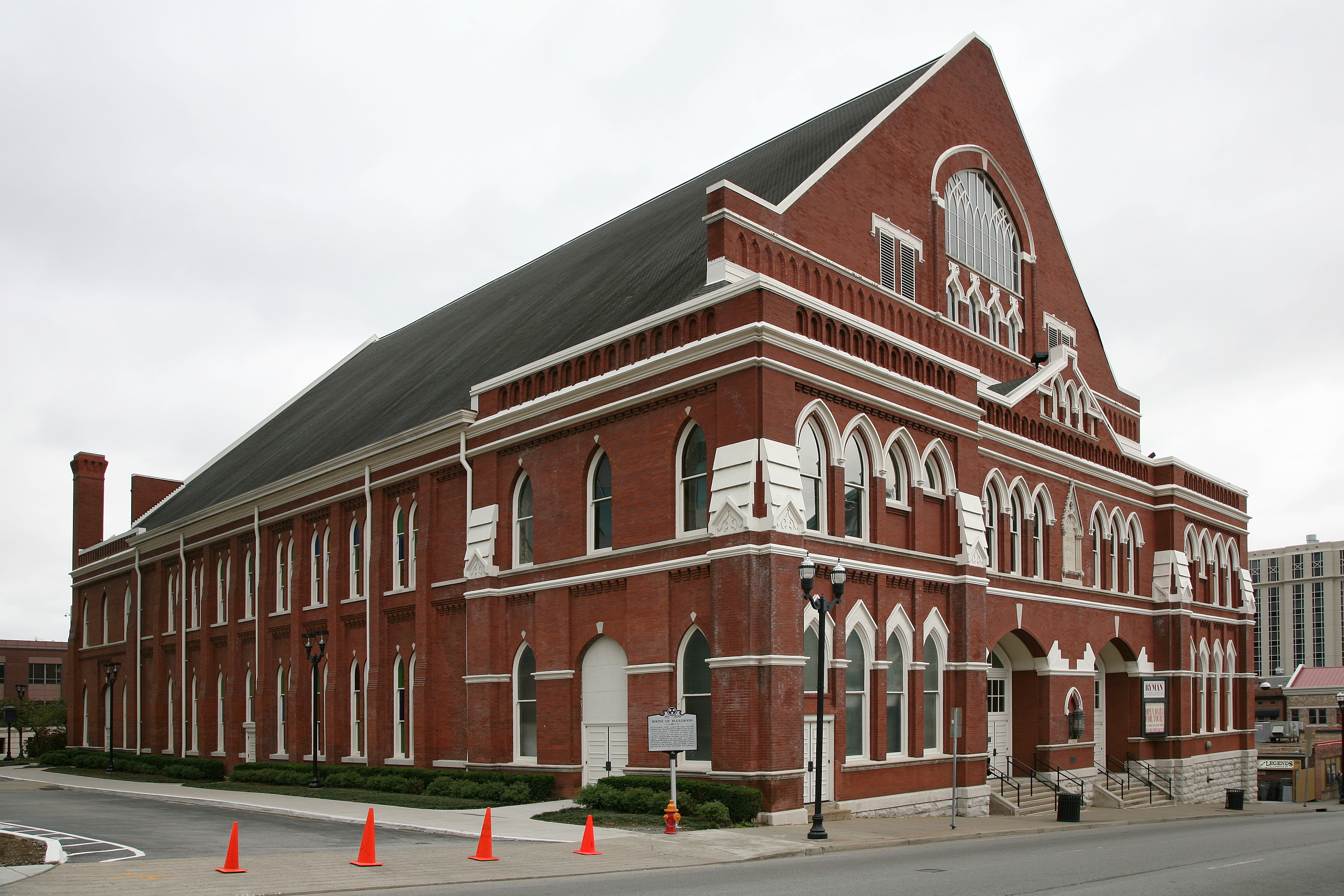
Ryman Auditorium
Captain Tom Ryman came to heckle a preacher in 1885 and left a changed man. The Nashville riverboat baron and saloon owner had intended to disrupt one of evangelist Samuel Porter Jones's tent revivals, but instead experienced a conversion so profound that he pledged to build an indoor tabernacle for the people of Nashville. Seven years and $100,000 later, the Union Gospel Tabernacle opened its doors in 1892 -- a towering brick sanctuary with soaring stained-glass windows and church pews that would become, against all odds, the beating heart of American country music.
From Tabernacle to Temple of Sound
When Ryman died on December 23, 1904, the tabernacle was renamed in his honor. For decades it served double duty -- hosting revivals and community gatherings while increasingly attracting touring performers who discovered something remarkable about the space. The building's curved ceiling and wooden pew-lined interior produced a warm, resonant acoustic that seemed to embrace every note. On June 5, 1943, the Grand Ole Opry moved its weekly radio broadcast to the Ryman, and for the next 31 years every show sold out. Hundreds of fans were routinely turned away at the door. Within those 2,362 wooden pew seats, Hank Williams made his debut, Patsy Cline sang her last Nashville show, and Dolly Parton became a household name. The building earned its enduring nickname: the Mother Church of Country Music.
Twenty Years of Silence
On March 15, 1974, the Grand Ole Opry played its final show at the Ryman and decamped to a purpose-built facility east of town. What followed was nearly two decades of dormancy. The Ryman sat mostly vacant, its neighborhood declining around it. Demolition was seriously discussed. But the building survived, kept alive as a heritage tourist stop even as its pews gathered dust. In 1983, Oklahoma broadcaster Ed Gaylord acquired the Ryman along with the Opry properties, motivated partly by his friendships with Opry performers -- especially the beloved Sarah Cannon, better known as Minnie Pearl. A careful renovation in 1994 preserved the original sanctuary while adding modern backstage facilities, and concerts returned to the hallowed room.
The Prodigal Opry Returns
On October 18, 1998, the Grand Ole Opry held a benefit concert at the Ryman, its first show in the building since 1974. The reception was electric. Beginning in November 1999, the Opry returned to the Ryman each winter for three months of shows, reconnecting with its roots in the intimate, acoustically rich hall. The tradition continued annually until the pandemic suspended it in 2020. The Ryman also stepped in during emergencies -- hosting the Opry throughout summer 2010 after devastating floods damaged the Grand Ole Opry House. Through floods and even the 2020 Nashville Christmas Day bombing, the Ryman itself emerged unscathed, as though something in those old tabernacle walls refused to give in.
Where Every Genre Finds a Pulpit
In 2018, Architectural Digest named the Ryman the most iconic structure in Tennessee. By then, the building had long since transcended its country music roots. In 2019, Wu-Tang Clan became the first hip-hop act to headline the Ryman -- rap reverberating off the same walls that once amplified fiddles and steel guitars. Ringo Starr celebrated his 72nd birthday on the Ryman stage. Garth Brooks waited over 30 years into his career before performing there, as if the venue demanded a certain reverence. In 2022, comedian John Mulaney held the Ryman's first comedy residency, and that same year the building was designated a Rock & Roll Hall of Fame Landmark. The Ryman has been named Pollstar's Theater of the Year 15 times, and its stage has hosted memorial services for country legends from Johnny Cash to Naomi Judd -- a fitting role for a building that began as a house of worship.
Sacred Wood
In 2012, the Ryman's 61-year-old stage was replaced with Brazilian teak, but the builders preserved an 18-inch lip of the predecessor's blonde oak at the front edge -- a deliberate act of continuity, echoing the inlaid circle of Ryman stage wood set into the floor of the newer Opry House across town. The original hickory support beams beneath the stage were reinforced with concrete to triple the load capacity, ensuring the structure could bear whatever the future demanded. A 2015 expansion added modern amenities while leaving the original sanctuary largely untouched. The building still feels like what it has always been: part church, part concert hall, and wholly Nashville. Every performer who steps onto that stage stands on layers of history, from tent-revival hymns to country standards to hip-hop verses, all held within the same resonant, redemptive walls.
From the Air
Ryman Auditorium sits at 36.1613N, 86.7785W in downtown Nashville, Tennessee. The distinctive red-brick building with its Gothic Revival windows is visible from low altitudes along the Cumberland River corridor. Look for it on 5th Avenue North, roughly 8 miles southeast of Nashville International Airport (KBNA). The Cumberland River bends prominently nearby, providing a useful visual reference. Best viewed at 1,500-2,500 feet AGL in clear conditions. The downtown Nashville skyline and the AT&T Building (the distinctive 'Batman Building') serve as prominent orientation landmarks.