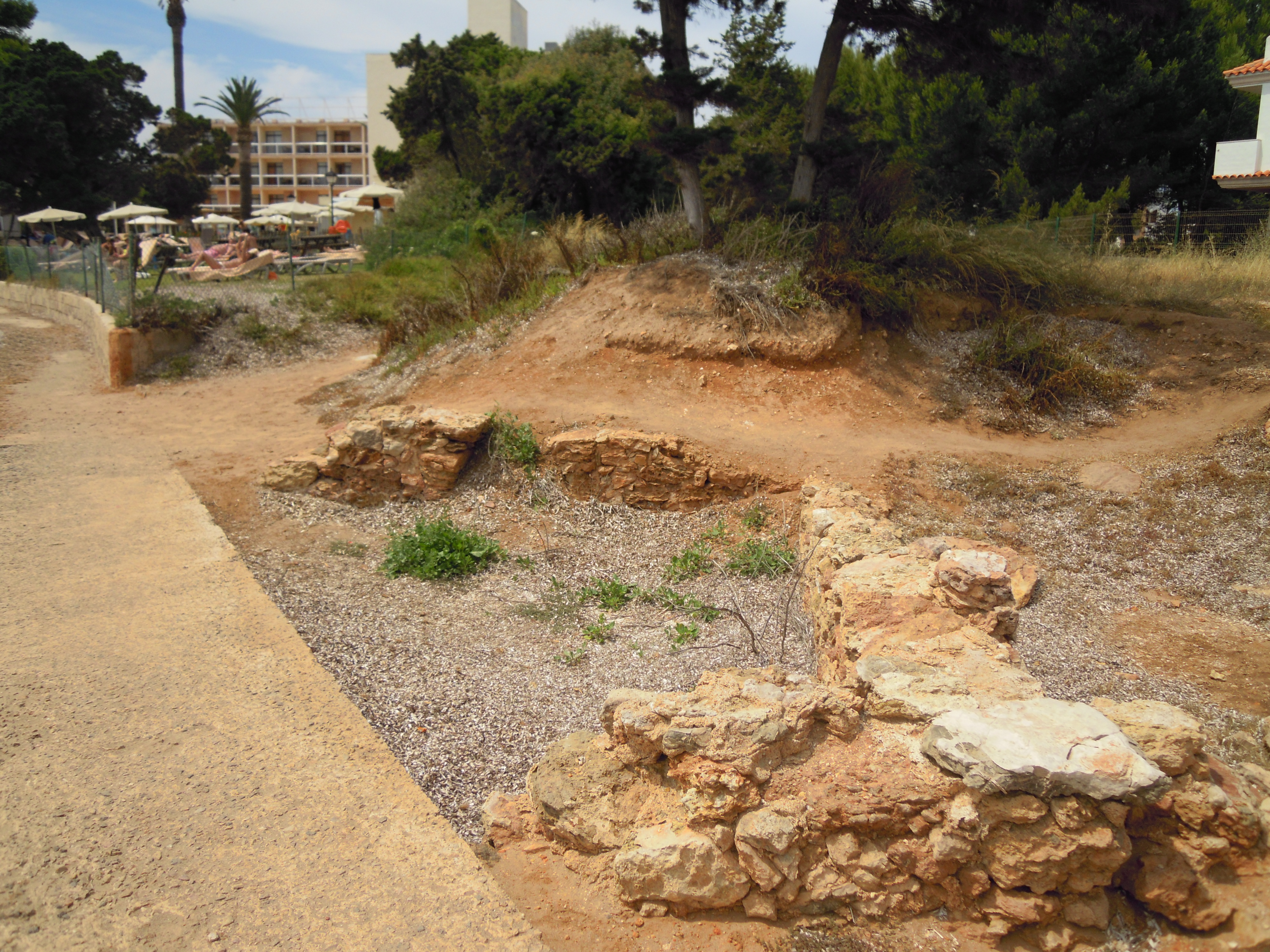
S'Argamassa Roman Fish Farm
The Romans had a condiment problem. Garum -- a pungent, amber liquid fermented from fish innards, salt, and Mediterranean sunshine -- was consumed in vast quantities across the empire, drizzled on everything from bread to roasted meats. Producing it required coastline, salt, fish, and patience, exactly the resources available on the island of Ibiza after Rome occupied it in 146 BC. On the eastern shore, 2.8 miles from the town of Santa Eularia des Riu, the remains of the S'Argamassa fish farm and its connecting aqueduct still trace the outlines of an industrial operation that turned Ibiza's coastal waters into one of the ancient world's most sought-after sauces.
After Carthage Fell
Rome arrived on Ibiza in the wake of Carthage's destruction in 146 BC. The island, previously a Carthaginian outpost, received the status of a federated city -- a Roman ally rather than a conquered territory. The economic transformation was immediate. Salt mining, already practiced on the island, expanded under Roman management. Agricultural production intensified. But the most distinctive industry to emerge under Roman Ibiza was fishing, not for the catch itself but for what the catch could become. The island's combination of warm Mediterranean waters, abundant salt deposits, and a coastline dotted with natural coves made it an ideal location for garum production on a commercial scale.
The Alchemy of Rot
Garum production was as much chemistry as cooking. Fish heads, tails, gills, and innards were boiled, macerated in salt, and laid out to cure in the sun for one to three months. In the dry Mediterranean warmth, the mixture fermented and liquefied, the salt preventing the kind of decay that would produce something merely rotten rather than complexly flavorful. The clear liquid that rose to the top was garum, drawn off through fine strainers. The sludge that remained at the bottom -- called allec -- was sold separately as a cheaper alternative. At S'Argamassa, rectangular fermentation tanks near the shoreline held this slow-motion transformation, the aqueduct delivering the fresh water needed to keep the operation running. The process smelled exactly as terrible as it sounds, which is why garum factories were consistently located downwind of residential areas.
Packed in Clay, Shipped Across an Empire
Once the fermentation was complete, the garum was packed into enormous earthenware storage jars -- amphorae -- also produced locally on Ibiza. These standardized vessels, each holding roughly 25 liters, were loaded onto merchant ships and distributed to every corner of the Roman world. Garum from different regions commanded different prices, much as olive oil or wine varied in quality and reputation. The sauce was not merely a condiment; it was a source of protein and salt in a diet that often lacked both, and a flavoring agent that could transform bland grain porridges into something approaching a meal. At S'Argamassa, the remains of the fermentation tanks sit at the end of the aqueduct run, close enough to the shoreline that the finished product could be loaded directly onto boats.
Ruins Among the Resorts
The S'Argamassa site occupies an incongruous position on modern Ibiza's eastern coast. The municipality of Santa Eularia des Riu has grown around and beyond the ancient remains, and the coastline that once reeked of fermenting fish now hosts hotels and beach bars. The aqueduct's water channel is still visible in the top surface of the surviving stonework, a groove worn smooth by centuries of use. The holding tanks are low rectangular structures, easy to overlook amid the coastal development that has transformed this stretch of shore. There is something both humbling and amusing in the contrast: an island now famous for its nightclubs and electronic music festivals was once famous for producing a fermented fish sauce. The appetites change; the island's talent for satisfying them does not.
From the Air
Located at 38.99N, 1.57E on the eastern coast of Ibiza, approximately 2.8 miles east of Santa Eularia des Riu. The site is along the coastline amid modern development and is not easily distinguished from altitude. Ibiza Airport (LEIB) is approximately 15 km to the southwest. The eastern coast of Ibiza, with its series of coves and small bays, is visible as an irregular shoreline from 2,000-4,000 feet AGL. Santa Eularia des Riu is identifiable as a coastal town with a river mouth.