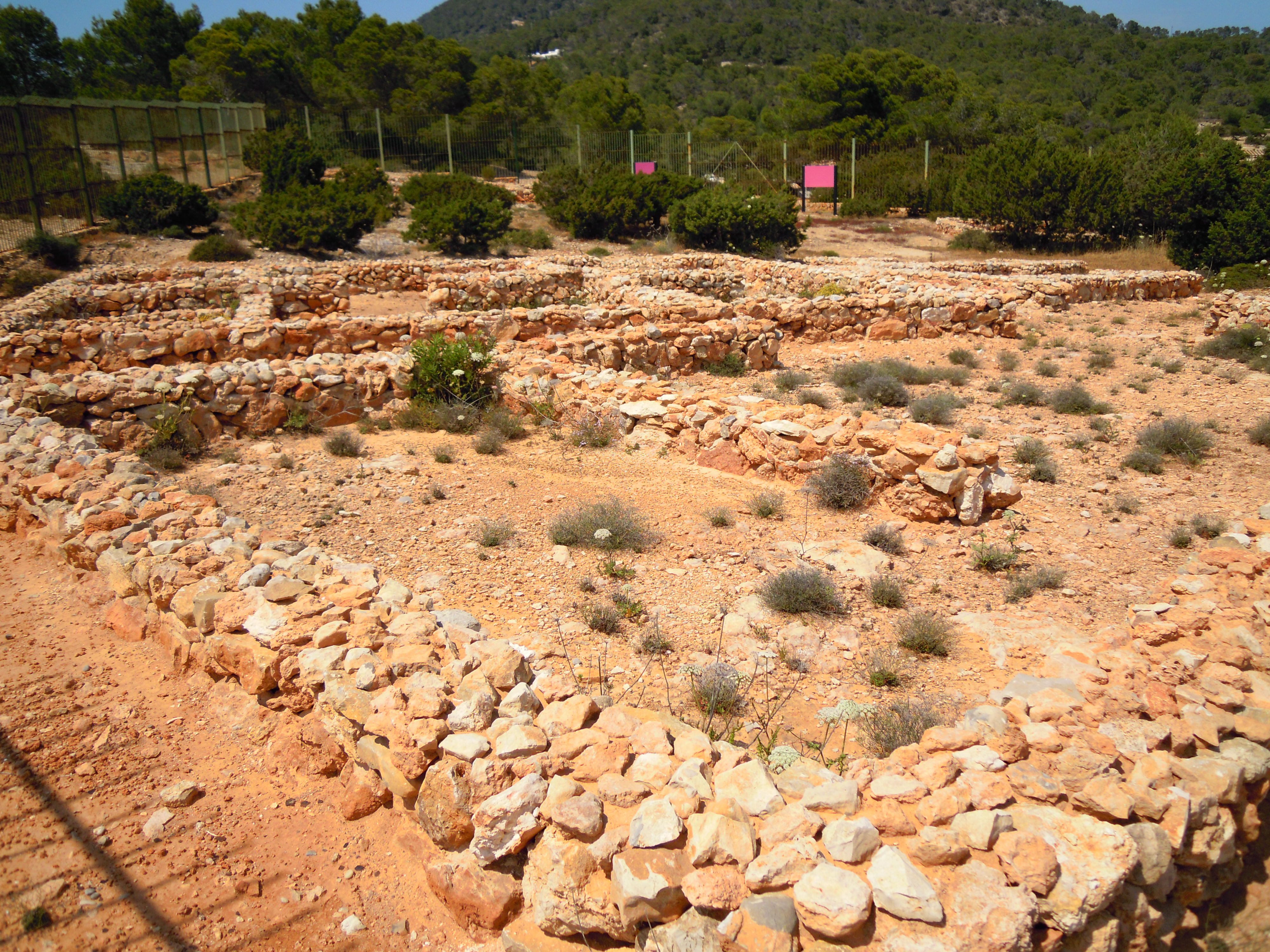
Sa Caleta Phoenician Settlement
Fifty years is all it took. Around 654 BC, Phoenician sailors from the Iberian coast landed on a rocky headland ten kilometers west of what is now Ibiza Town and began building. By 600 BC, they were gone, having abandoned a settlement that had grown to cover four hectares -- streets, a small square, distinct neighborhoods -- all compressed onto every usable meter of this windswept promontory jutting into the Mediterranean. The foundations they left behind lay buried for twenty-six centuries until archaeologists uncovered them in the 1980s and 1990s, revealing the oldest known urban settlement on Ibiza.
Salt, Harbor, and Opportunity
The Phoenicians chose this headland for practical reasons. Sa Caleta sits near natural salt marshes -- a resource as valuable as gold in the ancient Mediterranean, essential for preserving fish and meat during long sea voyages. The small cove on the eastern side of the promontory provided a natural harbor, sheltered enough for the trading vessels that connected Ibiza to the Phoenician commercial network stretching from Lebanon to the Strait of Gibraltar. That cove still serves a handful of local fishing boats and pleasure craft today, a continuity of use spanning nearly three millennia. The settlers who arrived here came not directly from Phoenicia but from established colonies along the Iberian coast, part of a westward expansion that was reshaping the Mediterranean's economic geography.
Streets and Neighborhoods in Stone
What archaeologists found beneath the soil was not a scattering of isolated structures but a planned settlement. Streets organized the space. A small square provided a communal gathering point. Researchers describe distinct "neighborhoods" -- clusters of simple stone buildings whose foundations reveal how the community organized itself as it grew. The settlement expanded progressively, each wave of construction filling more of the available headland until the entire usable area had been built over. The buildings themselves were modest -- stone foundations supporting walls of perishable materials long since vanished -- but their arrangement tells a story of deliberate urban planning, an impulse to impose order on a new landscape that the Phoenicians carried with them wherever they settled.
The Departure and What Remains
Why the Phoenicians abandoned Sa Caleta around 600 BC remains uncertain. They may have consolidated their presence on Ibiza at the site that would become Ibiza Town, where better harbor facilities and more defensible terrain offered advantages that Sa Caleta's exposed headland could not match. The settlement's brief lifespan -- roughly two generations -- means it captures a specific moment in Phoenician expansion rather than a long arc of development. In December 1999, UNESCO designated Sa Caleta a World Heritage Site, recognizing it alongside the necropolis of Puig des Molins in Ibiza Town as exceptional evidence of Phoenician urbanization in the western Mediterranean. The rocky headland today is quiet, its archaeological remains protected but unmonumental -- low walls tracing the outlines of rooms where Phoenician traders once counted their salt and planned their voyages.
Ibiza Before Ibiza
Sa Caleta reframes the familiar image of Ibiza. Long before the island became synonymous with nightlife and tourism, it was a strategic point on ancient trade routes. The Phoenicians saw in this Balearic island what every subsequent culture would see: a position in the western Mediterranean from which to project commercial and military influence. Sa Caleta is the beginning of that story, the first chapter in a settlement history that would pass through Carthaginian, Roman, Byzantine, Moorish, and Catalan hands before arriving at the modern Spanish province. The foundations on the headland are the oldest evidence that someone looked at Ibiza and decided to stay -- even if that first stay lasted only fifty years.
From the Air
Located at 38.87N, 1.33E on the southwestern coast of Ibiza, Balearic Islands, Spain. Sa Caleta occupies a rocky headland visible as a promontory jutting into the Mediterranean, approximately 10 km west of Ibiza Town. Nearest airport is Ibiza Airport (LEIB), roughly 3 km to the northeast. The salt marshes (Ses Salines) between the airport and Sa Caleta are visible as flat, reflective terrain. Best viewed at 1,500-3,000 feet AGL. The headland and small cove on its eastern side are identifiable features.