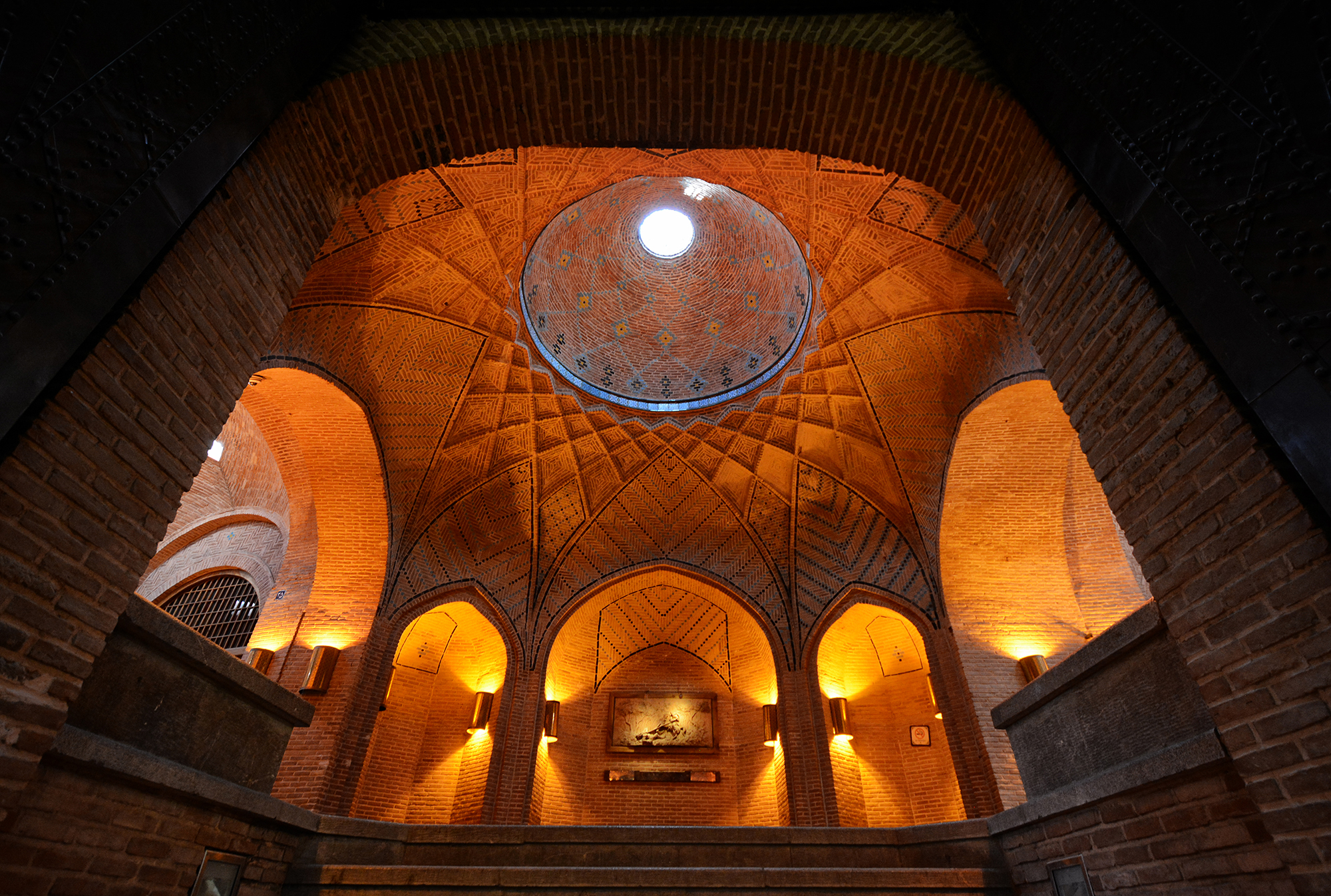
Sa'd al-Saltaneh Caravanserai
Step inside Sa'd al-Saltaneh and the noise of modern Qazvin fades. Vaulted ceilings climb overhead, muqarnas honeycomb the corners of arched doorways, and the light that filters through is the same cool, diffuse glow that once greeted merchants arriving from weeks on the road. At 6.2 hectares, this is the largest indoor caravanserai in the world, and walking its corridors today is less like visiting a museum than stepping into the skeleton of a trade empire that once stretched from China to the Mediterranean.
A Governor's Grand Ambition
The caravanserai owes its existence to Mohammad Bagher Khan Sa'd al-Saltaneh, governor of Qazvin during the reign of Naser al-Din Shah in the late Qajar period. Qazvin had served as Persia's capital under the Safavids and remained a crossroads of major trade routes, but it lacked a commercial complex worthy of its ambitions. Sa'd al-Saltaneh set out to change that. The result was a vast square-plan structure organized around a central courtyard, framed by four iwans -- the grand vaulted halls that are a signature of Persian architecture. The hujrehs, or traveler rooms, sit raised one meter above the courtyard floor, a practical measure that kept goods dry and provided some security against theft. The whole building was designed not merely as a place to sleep, but as a self-contained commercial ecosystem.
Caesar's Hall and the Architecture of Commerce
Two grand axes define the interior. The east-west passage, called Dalan-e Qeisariyeh -- Caesar's Hall -- connects directly to the Bazaar of Vizir, weaving the caravanserai into the commercial fabric of the city. The north-south axis, Dalan-e Ghahremani, intersects it at the hashti, a domed vestibule behind the southern iwan that holds the building's largest gonbad, flanked by four semi-domes. Two smaller courtyards open to the east and west, creating quieter zones away from the main trading floor. The muqarnas decorating the interiors -- geometric stalactite vaulting carved in plaster -- catch the light at different angles throughout the day. Persian architects had perfected this technique over centuries, and at Sa'd al-Saltaneh they deployed it with a confidence that borders on exuberance.
Where Silk Road Met City Street
Caravanserais were the infrastructure of overland trade, spaced roughly a day's journey apart along the routes that connected Central Asia, China, and the Ottoman Empire to Persian Gulf ports. Most sat in remote desert or mountain passes. Sa'd al-Saltaneh was different. Built inside an established city, it functioned as both a waystation and a wholesale market, a place where long-distance goods changed hands and entered the local economy. Merchants arriving from the east could stable their animals, store their wares, negotiate prices, and sleep under a solid roof -- all without leaving the complex. The connection to the Bazaar of Vizir meant buyers could browse imported textiles, spices, and metalwork steps from where they were unloaded.
Survival and Revival
The twentieth century was unkind to many of Iran's caravanserais. Motor transport rendered them obsolete, and neglect did the rest. Sa'd al-Saltaneh survived largely because of its urban location and sheer mass -- a building this large is difficult to ignore and impractical to demolish. A renovation in 2012 brought the complex back to active use. Today, local artisans occupy the hujrehs, selling handicrafts, serving tea, and keeping the corridors alive with the low hum of commerce that the building was designed for. In 2023, Sa'd al-Saltaneh was inscribed as a UNESCO World Heritage Site as part of a collective listing of 54 Iranian caravanserais, recognition that these structures represent not just architectural achievement but a trade network that shaped civilizations.
From the Air
Located at 36.269N, 50.001E in central Qazvin. The caravanserai is embedded in the city's commercial district and not easily distinguished from altitude, but Qazvin itself is identifiable as a large city on the southern edge of the Alborz range, northwest of Tehran. Nearest airport is Qazvin Airport (OIIK), approximately 10 km southeast. Tehran Imam Khomeini International Airport (OIIE) lies roughly 150 km to the southeast. Best viewed at low altitude approaching from the south, where the dense old city grid is visible against the backdrop of the Alborz mountains.