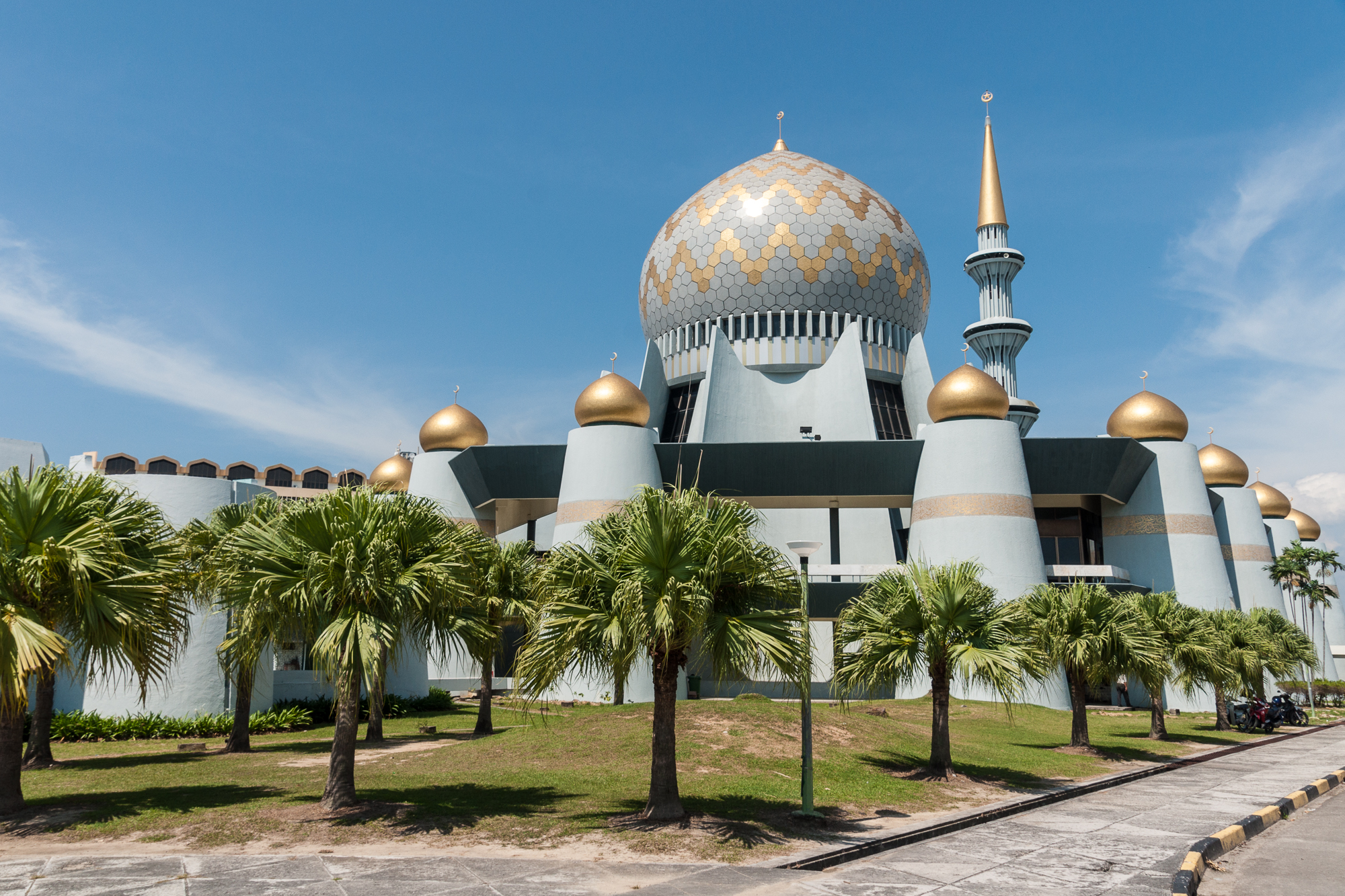
Sabah State Mosque
On 6 June 1976, a plane carrying Sabah's Chief Minister Tun Fuad Stephens crashed shortly after takeoff from Kota Kinabalu, killing him and several senior officials in what became known as the Double Six Tragedy. When the state needed a place to lay its leader to rest, the answer stood at the Sembulan roundabout: the Sabah State Mosque, completed just a year earlier and not yet quite finished absorbing its role in the life of this young Malaysian state. Fuad Stephens became the first person interred in the adjacent State Mausoleum, and in the decades since, five more of Sabah's governors have joined him there. The mosque is both a house of worship and a repository of Sabah's political memory.
Rising at the Roundabout
Construction of the Sabah State Mosque began in 1970 and was completed in 1975, a five-year project that transformed a prominent intersection into a landmark visible from much of central Kota Kinabalu. The architectural firm Arkitek Jurubina Bertiga, led by Dato Baharuddin Abu Kassim, designed the building with a gold-colored dome and minarets that draw on pan-Islamic architectural traditions while responding to the tropical climate with generous openings and shaded colonnades. The mosque sits between Jalan Mat Salleh and Jalan Tunku Abdul Rahman, two of the city's major arteries, ensuring that it is encountered daily by commuters, shoppers, and schoolchildren. Its official opening came on 28 June 1977, when the sixth Yang di-Pertuan Agong, Sultan Yahya Petra of Kelantan, presided over the ceremony.
The Mausoleum and Its Ghosts
The State Mausoleum adjacent to the mosque has become, almost by accident, a chronicle of Sabah's post-independence political history. Fuad Stephens, born Donald Stephens before his conversion to Islam, served as Sabah's first Chief Minister after the formation of Malaysia in 1963 and again in 1976 before the plane crash that killed him. His tomb is the mausoleum's anchor point. Tun Mohd Hamdan Abdullah, who served as governor from 1975 to 1977, was interred there after his death in 1977. Tun Pengiran Ahmad Raffae, Tun Mohammad Said Keruak, Tun Mohamad Adnan Robert, and Tun Sakaran Dandai followed across the subsequent decades. Together, their burials span from 1976 to 2021, covering nearly the entire arc of Sabah's existence as a Malaysian state. The mausoleum is not merely adjacent to the mosque; it is inseparable from it, linking prayer and political legacy in stone.
Faith at a Crossroads
Sabah's religious landscape is among the most diverse in Malaysia. Islam arrived through centuries of trade contact with the sultanates of Sulu and Brunei, but Christianity took deep root among the Kadazan-Dusun and other indigenous communities through the work of Mill Hill Missionaries beginning in the 1880s. Animist traditions persisted alongside both. The State Mosque represents the Islamic dimension of this complex mosaic, serving as the spiritual center for Sabah's Muslim community while existing in a city where churches, Chinese temples, and indigenous sacred sites are all within a short drive. Its gold dome catches the tropical sun and throws it back across a cityscape that reflects, in miniature, the religious pluralism of Southeast Asia itself.
Dome and Minaret Against the Sea
From the air, the Sabah State Mosque is unmistakable. Its dome and minarets rise above the low commercial buildings of the Sembulan neighborhood, oriented toward Mecca but facing the South China Sea. The interior floors are polished to a mirror finish, and the ceiling structure radiates outward from the dome in geometric patterns that pull the eye upward. Outside, the grounds are maintained with the kind of tropical landscaping that benefits from year-round rainfall and equatorial light. The mosque is not the oldest Islamic structure in Sabah, nor the largest, but its position at the center of the state capital and its role as the final resting place for the men who governed Sabah give it a weight that transcends architecture. It is where the state goes to pray and where it goes to remember.
From the Air
Located at 5.96°N, 116.07°E at the Sembulan roundabout in central Kota Kinabalu. The gold dome and white minarets are clearly visible from the air against the surrounding low-rise commercial buildings. Nearest airport is Kota Kinabalu International Airport (WBKK), approximately 6 km to the south. The mosque sits between two major roads and is easily spotted on approach from any direction. Best viewed at 1,500-3,000 feet AGL on the northern approach to the airport.