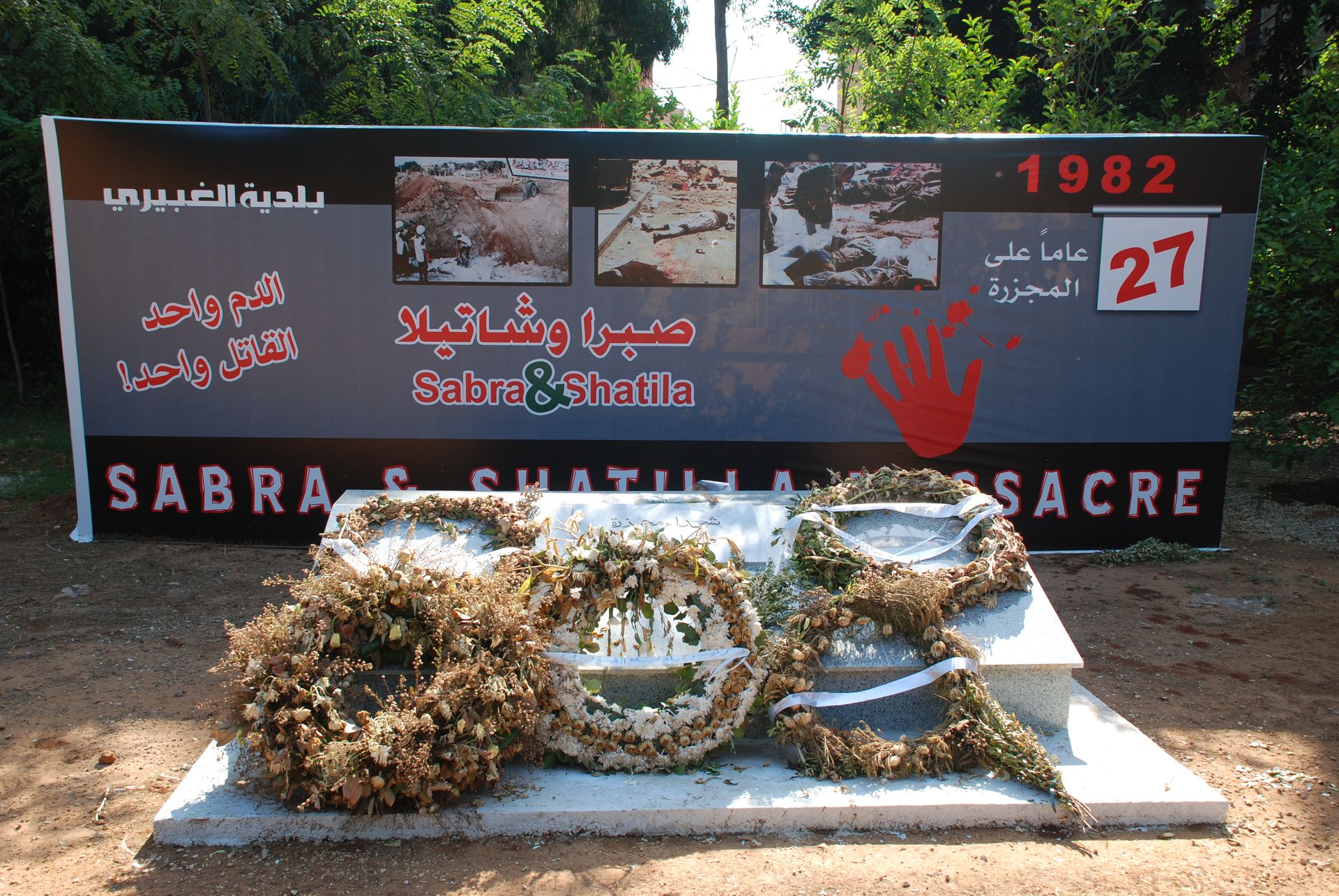
Sabra and Shatila Massacre
The killing lasted roughly 40 hours. Between the evening of September 16 and the morning of September 18, 1982, Lebanese Forces militiamen moved through the Sabra neighborhood and the adjacent Shatila refugee camp in southwest Beirut, systematically killing civilians. The victims -- between 1,300 and 3,500, depending on the source -- were mostly Palestinian refugees and Lebanese Shia Muslims. Israeli Defense Forces had encircled the area and controlled its access points. They illuminated the camps with flares at night.
The Weeks Before
The massacre followed a summer of extraordinary violence. Israel had invaded Lebanon in June 1982, besieging West Beirut for two months to expel the Palestine Liberation Organization. Under a U.S.-brokered agreement, PLO fighters had evacuated by late August, boarding ships to Tunisia and overland to other Arab countries. A multinational peacekeeping force supervised the withdrawal, then departed. Lebanese president-elect Bashir Gemayel, the Phalangist leader whose ascent Israel had supported, was assassinated on September 14 -- three weeks after his election on August 23, before he had ever been inaugurated. Israel moved into West Beirut the following day, claiming the need to maintain order. The Lebanese Forces, Christian militia allies of Israel aligned with the Phalangist movement, were authorized to enter the camps to root out what Israel described as remaining PLO fighters.
Forty Hours
Under the command of Elie Hobeika, approximately 1,500 Lebanese Forces militiamen assembled at Beirut International Airport, then occupied by Israel, on the afternoon of September 16. They entered the Sabra and Shatila area from multiple directions, some in IDF-supplied vehicles. What followed was not a military operation against armed combatants. The militiamen killed families in their homes. Bodies were found in streets, alleys, and shelters. Journalist Robert Fisk, among the first outsiders to enter after the killing, described finding the dead stacked in rooms, many showing signs of execution. Women, children, and elderly people were among the victims. Some bodies bore evidence of mutilation. The killing continued through the night of September 16, all of September 17, and into the morning of September 18, when international pressure and media exposure finally forced it to stop.
What the World Concluded
On December 16, 1982, the United Nations General Assembly condemned the massacre and declared it an act of genocide, with 123 nations voting in favor and none opposed, though 22 abstained. In Israel, an estimated 400,000 people -- roughly 10 percent of the country's population at the time -- demonstrated in Tel Aviv demanding an inquiry into their government's role. The resulting Kahan Commission found that Israeli military and political leaders bore indirect responsibility. Defense Minister Ariel Sharon was found to bear personal responsibility for failing to prevent the massacre, and the commission recommended his dismissal. Sharon resigned as defense minister but remained in the cabinet as a minister without portfolio, and later became prime minister in 2001.
The Weight of Names
Determining the true number of dead became its own contested history. The Palestinian Red Crescent estimated over 2,000 killed. Lebanese government intelligence put the figure at 460. Researcher Bayan Nuwayhed al-Hout, in her detailed study of 17 separate victim lists, identified a minimum of 1,300 named individuals and estimated the full toll may have reached 3,500. The discrepancy itself tells a story: many of the dead were refugees, people who had already been displaced once from Palestine, whose records were incomplete and whose families had been scattered. Counting them accurately required years of cross-referencing testimony, death certificates, and missing-person reports -- work that continued decades after the last body was buried.
A Place That Persists
Shatila remains a refugee camp today, home to thousands of Palestinians and, increasingly, Syrian refugees who arrived after 2011. The narrow streets where the massacre occurred are now dense with multistory buildings, electrical wiring draped between them in chaotic webs. A memorial and mass grave mark the site. The camp was established in 1949 for Palestinians displaced by the 1948 Arab-Israeli War, and its residents have now lived there for more than seven decades -- a temporary arrangement that became permanent through the sheer inertia of unresolved politics. From the air, Shatila is distinguishable from the surrounding city by its density and its flatness, a neighborhood that grew inward rather than upward, hemmed in by boundaries that were never meant to last this long.
From the Air
Located at 33.863N, 35.498E in southwest Beirut. The Sabra neighborhood and Shatila refugee camp sit south of the city center, identifiable from altitude by their dense, low-rise construction contrasting with surrounding development. Nearest airport: Rafic Hariri International Airport (OLBA), approximately 5 km south. The site is inland from the Mediterranean coast, roughly 2 km south of downtown Beirut's high-rise corridor.