Sack of Lindisfarne
On June 8, 793 CE, the scholar Alcuin was at the court of Charlemagne when word reached him from Northumbria. Norse raiders had descended upon the island monastery of Lindisfarne, slaughtering monks, drowning captives in the sea, and stripping the church of its treasures. 'Never before has such terror appeared in Britain,' Alcuin wrote in anguish, 'as we have now suffered from a pagan race.' The attack lasted hours. Its consequences shaped centuries.
A Monastery in the Morning
Lindisfarne in 793 was one of the holiest sites in the Christian world. Founded in 635 CE by Saint Aidan at the invitation of King Oswald of Northumbria, the monastery had produced saints, scholars, and one of the finest illuminated manuscripts ever created -- the Lindisfarne Gospels. The community lived according to the rhythms of tide and prayer, separated from the mainland by a causeway that flooded twice daily. The island's isolation was its spiritual strength, but it was also its weakness. Monasteries were treasure houses -- gold chalices, jeweled reliquaries, fine metalwork -- and they were undefended. The monks had no walls, no garrison, no reason to expect violence. The Anglo-Saxon Chronicle recorded portents in the skies that year: 'immense sheets of light rushing through the air' and 'fiery dragons flying in the sky.' Whether these were auroras, lightning, or literary embellishment, they became part of the story that Northumbrians told themselves about what came next.
Longships on the Shore
The raiders arrived in shallow-draft longships, vessels capable of crossing the open North Sea and beaching directly on sand. Their speed was the key to their tactics -- strike fast, take everything of value, and withdraw before any organized defence could form. At Lindisfarne they found no resistance. The monks were killed, thrown into the sea, or taken as enslaved captives. The church was plundered of its sacred vessels, and relics were desecrated. The attack was methodical and brutal, but it was not random. Scandinavian maritime capabilities had been developing for decades, and coastal monasteries -- wealthy, visible, and unguarded -- represented ideal targets. Lindisfarne may have been the first major raid recorded in English sources, but it was not the first Norse incursion into the British Isles. A raid on Portland in Dorset around 789 had already shown what these Northmen were capable of. What made Lindisfarne different was the target: a site of such profound sanctity that its violation seemed to Christians like an affront against God himself.
The Shockwave Through Christendom
The psychological impact dwarfed the material loss. Alcuin's letters, written from Aachen to the monks and bishops of Northumbria, reveal genuine theological crisis. How could God permit pagans to violate his holy places? Was this divine punishment for the sins of the English? The questions echoed across Europe. Monasteries had always been understood as sanctuaries -- places where the boundary between the human and divine worlds was thinnest. The Norse raiders did not share this understanding and were not constrained by it. The raid shattered assumptions about the safety of religious communities and forced a rethinking of coastal defence across the British Isles. Within a generation, Viking attacks would become a regular feature of life in England, Ireland, and Scotland. The Danelaw would partition England. Norse settlers would reshape the language, law, and culture of the islands. The sack of Lindisfarne did not cause all of this, but it opened the door.
Endurance and Exile
The monastic community at Lindisfarne did not die on June 8, 793. Monks rebuilt, prayed, and continued their work. The so-called 'Domesday Stone,' a carved slab showing armed warriors, may commemorate the raid and the community's determination to persist. But the Norse kept coming. Further attacks struck Iona in 795 and 806, when sixty-eight monks were killed at Martyrs' Bay. At Lindisfarne, the pattern of raid and recovery continued until 875, when the community finally abandoned the island. They carried with them their most precious possession: the body of Saint Cuthbert, along with the Lindisfarne Gospels and other relics. For seven years the monks wandered northern England with Cuthbert's coffin, eventually settling at Chester-le-Street before reaching their final home at Durham in 995. Cuthbert's shrine at Durham Cathedral became one of the great pilgrimage destinations of medieval England, and the Lindisfarne Gospels -- survivor of Vikings, exile, and centuries of handling -- is now preserved in the British Library.
The Mark It Left
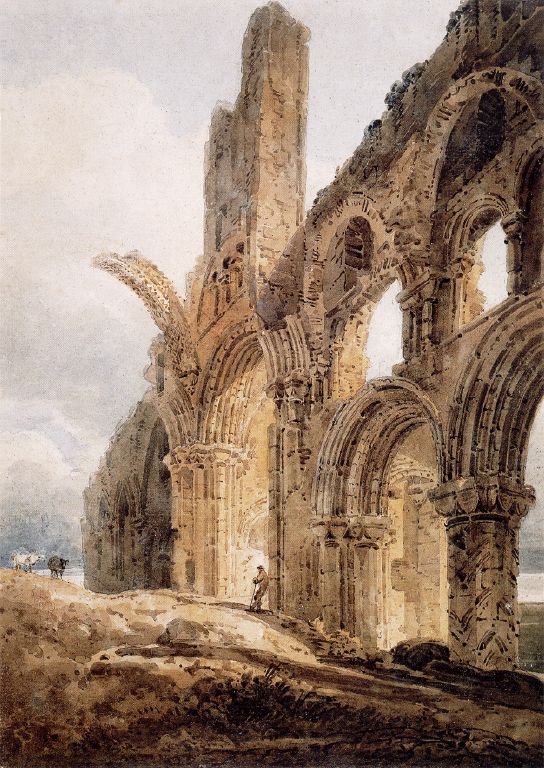
Historians debate whether the sack of Lindisfarne truly 'began' the Viking Age -- Norse seafarers had been active for decades before 793, and the concept of a single starting point for a complex phenomenon is inherently artificial. But the raid holds its place in historical memory because of how it was recorded and what it represented. It was the moment when the Latin-writing, chronicle-keeping Christian world first registered the full force of what was coming from Scandinavia. The island today bears the scars quietly. The priory ruins date from the later Norman period, not from Aidan's monastery, which was built of wood and has left no visible trace. A modern sculpture by Fenwick Lawson depicts six monks carrying Cuthbert's coffin, their hooded figures leaning into an invisible wind. They stand near the priory, facing out to sea -- a memorial not to a single day of violence but to the long aftermath of faith under siege.
From the Air
The site of the 793 raid is on Lindisfarne (Holy Island) at 55.67°N, 1.80°W, off the Northumberland coast. The island, tidal causeway, and priory ruins are clearly visible from the air. Bamburgh Castle is visible on the mainland coast approximately 5 nm to the south. Nearest airport: Newcastle (EGNT), about 55 nm south.