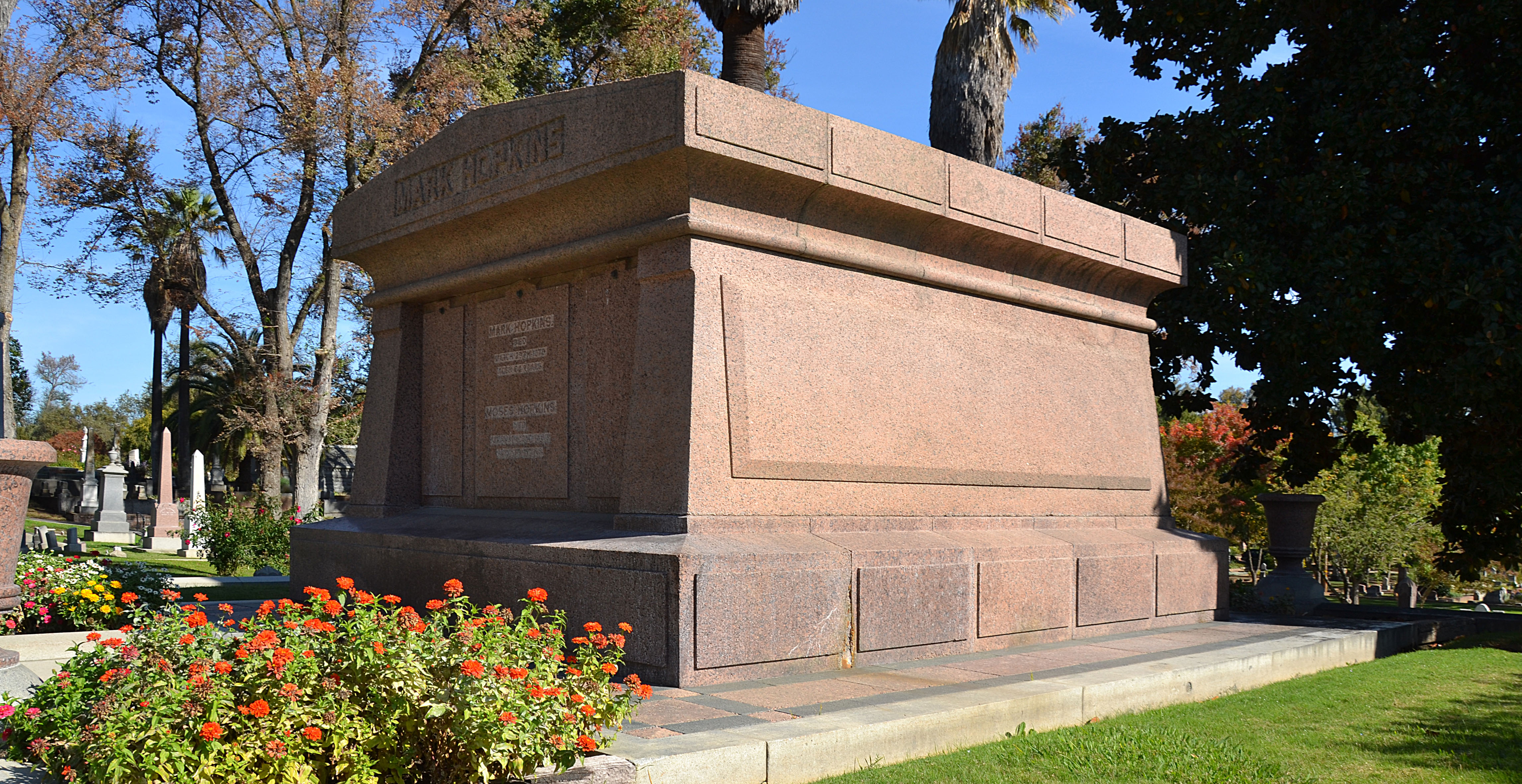
Sacramento's Garden of Stone
Alexander Hamilton's son is buried here, far from the marble halls of the republic his father helped build. William S. Hamilton died in Sacramento in 1850, almost certainly of cholera, during the same epidemic that killed some fourteen hundred people in a city that barely existed. He was laid to rest in what would become the Sacramento Historic City Cemetery, sixty acres of terraced ground at the corner of Broadway and 10th Street where California's earliest ambitions and earliest tragedies lie side by side beneath Victorian rosebushes.
A City Built on Borrowed Ground
Before the cemetery took its present form, Sacramento's dead had nowhere permanent to go. The New Helvetia Cemetery, founded around 1845, occupied low ground near the Sacramento River, and seasonal flooding had a grim habit of unearthing the buried. Bodies would surface and drift, a recurring horror that made the need for higher ground impossible to ignore. By 1850, burials had begun shifting to the site that would become the Historic City Cemetery. That same year, cholera swept through the boomtown with devastating speed. Some six hundred victims were buried in mass graves within the new cemetery grounds. Another eight hundred went into mass graves at New Helvetia. The epidemic killed roughly one in seven residents of the city, a staggering toll for a settlement that had existed for barely two years.
Order Among the Dead
In 1856, the city hired its first cemetery superintendent and began imposing order on what had been, until then, a haphazard burial ground. A gatehouse and bell tower went up in 1857, giving the cemetery a formal entrance that would stand for nearly a century before being demolished in 1949 to widen Broadway. The grounds were landscaped in the Victorian garden style, with brick and concrete retaining walls creating level terraces on uneven terrain. Fraternal orders soon staked their claims: the Masons purchased a section in 1859, the Odd Fellows in 1861, the Sacramento Pioneers Association in 1862. The city set aside dedicated sections for volunteer firemen in 1858 and Grand Army of the Republic veterans in 1878. By 1880, when Margaret Crocker, widow of railroad attorney Edwin B. Crocker, donated twenty-three acres, the cemetery had grown to sixty acres total.
The Roll Call of the Forgotten Republic
Walk the rows and you encounter a compressed history of California's first generation. John Bigler, the state's third governor, rests here alongside Newton Booth, the eleventh. Amos P. Catlin, the legislator who wrote the bill making Sacramento the permanent state capital, lies in the same ground as the capital city he secured. Confederate Brigadier General George B. Cosby is buried not far from Union veterans of the Grand Army of the Republic, their old enmity quieted by decades and dirt. Grove L. Johnson, a U.S. Representative, shares the cemetery with the legacy of his son Hiram, who went on to become both governor and senator. Lieutenant Thomas F. Wright, son of General George Wright, was killed fighting in the Modoc War and came home to this ground. These are not names most Americans would recognize today, yet they are the people who built the scaffolding of a state.
Roses and Remembrance
The cemetery's roses have earned a reputation as some of the finest in California, a living ornament layered over the dead. Heritage varieties bloom among the headstones, tended by volunteers who have made the grounds their cause. The Old City Cemetery Committee organizes tours, raises money for headstone restoration, and maintains a database project that helps descendants locate ancestors buried in unmarked or forgotten plots. On May 5, 1957, the cemetery was declared a State Historic Landmark, acknowledging what Sacramento residents had long understood: this was not just a burial ground but a document. Every section, every fraternal plot, every mass grave from the cholera year tells a piece of the story of how California's capital grew from a muddy camp on the American River into a city that needed a place to put its dead and, eventually, to honor them.
From the Air
Located at 38.5625N, 121.501W, the cemetery's sixty acres of greenery are visible at the intersection of Broadway and 10th Street in midtown Sacramento. The Victorian garden layout with its terraced sections stands out as a large, tree-shaded rectangle amid the urban grid. Sacramento Executive Airport (KSAC) is approximately 2nm south. Sacramento International (KSMF) lies 10nm northwest. Best viewed at 2,000-3,000 feet AGL. The Capitol Mall corridor running east-west provides a good visual reference to orient relative to downtown.