The Printer Who Broke the Internet
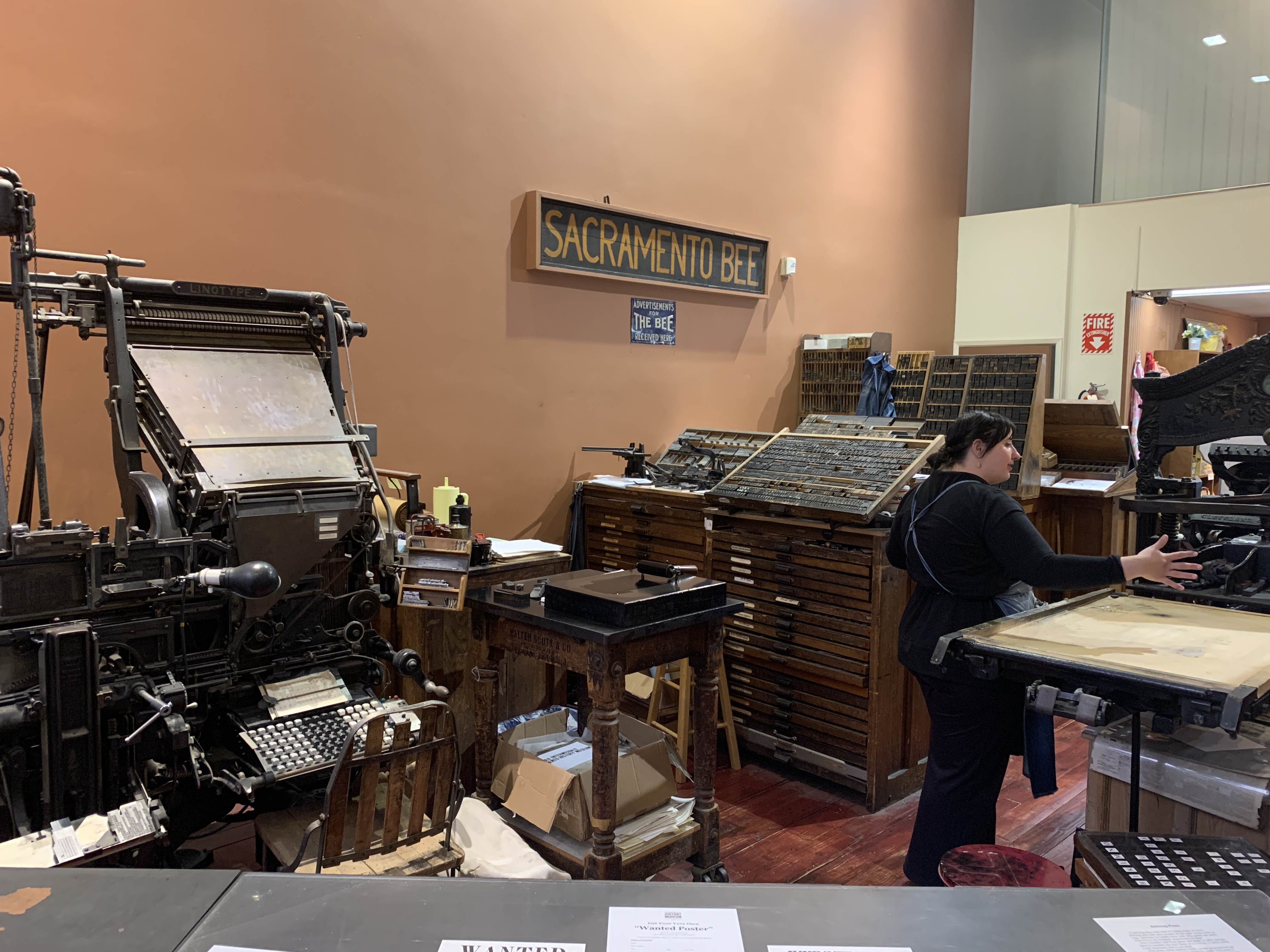
Howard Hatch never expected to become famous. A volunteer at the Sacramento History Museum, he demonstrated a nineteenth-century printing press the way he always had, setting lead type by hand and pulling the lever with the practiced ease of someone who genuinely loves the machinery. Then someone filmed it for TikTok. By 2024, the museum's YouTube channel had crossed one billion views and accumulated over 3.24 million subscribers, while its TikTok account drew another 2.7 million followers. A quiet history museum in Old Sacramento, one that most Californians had probably never heard of, had become one of the most-watched museum channels on the internet, all because of a man and a printing press.
A Building That Remembers Its Own Demolition
The museum building is itself a piece of history, though not the original. It reproduces Sacramento's 1854 City Hall and Waterworks, the city's first municipal building, constructed beginning in 1853 at a cost of $120,000, roughly $4.8 million in today's money. The original was an ambitious structure for a boomtown, housing the mayor's office, a city jail, a receiving hospital, and a court behind two stories of fourteen-foot double doors. City government outgrew it by 1909 and moved to an interim space before settling into a new permanent city hall in 1915. The original building was demolished in 1913, with only a small fragment of the jail surviving. The museum's reproduction, built in natural brick with the same grand double-door facade, now occupies the site as part of the Old Sacramento State Historic Park, standing along the Sacramento River between the Tower Bridge and the I Street Bridge.
Beneath the Sidewalks
The museum's most unusual attraction lies underground. In the 1860s and 1870s, Sacramento repeatedly flooded, and rather than surrender to the river, the city raised itself. Buildings were jacked up, new foundations were built beneath them, and what had been the ground floor became a buried basement. The Sacramento History Museum and the Sacramento History Alliance conduct tours of these subterranean passages, the Old Sacramento Underground, where visitors walk through the remnants of streets and storefronts that were simply buried and built over. The experience is disorienting in the best way: you descend below the modern sidewalk and find yourself standing in a nineteenth-century streetscape, sealed beneath the city like a time capsule that no one deliberately made.
Gold, Fur, and the First Peoples
The museum's seven thousand square feet of exhibit space covers Sacramento's history from its earliest human inhabitants forward. Exhibits on the Nisenan and Maidu nations tell the story of the peoples who lived along the Sacramento and American Rivers long before John Sutter arrived. The fur trapping era gets its due alongside the Gold Rush, which transformed Sacramento from a supply depot into a proper city almost overnight. Agricultural exhibits trace the Central Valley's evolution into one of the most productive farming regions on Earth. The museum opened in 1985 as the Sacramento History Center, housing artifacts and records from the Sacramento Archives and Museum Collection Center. It went through several identity changes, merging with the Sacramento Science Center in 1993 to become the Discovery Museum, before splitting again in 2008 under a city directive. The current name stuck, and the museum found its focus: Sacramento's story, told through the objects its residents left behind.
Where a City Learns Its Own Story
The museum is jointly administered by the City and County of Sacramento and the Sacramento History Alliance, a nonprofit dedicated to preserving the region's history. Beyond the building itself, the Alliance conducts walking tours of Old Sacramento's historic district, interpreting the wooden sidewalks, iron-fronted commercial buildings, and river frontage that made this neighborhood the commercial heart of Gold Rush California. The museum sits in a landscape dense with history: the California State Railroad Museum is steps away, the Tower Bridge gleams gold over the river, and the streets follow the same grid that Sacramento's founders laid out when the city was little more than a collection of canvas tents. That a volunteer with a printing press turned this modest museum into a global sensation says something about what people hunger for: not spectacle, but the tangible, mechanical reality of how things used to work, demonstrated by someone who clearly cares.
From the Air
Located at 38.585N, 121.505W in Old Sacramento, along the Sacramento River waterfront. The museum sits within the Old Sacramento State Historic Park district, identifiable from the air by the historic building cluster between the Tower Bridge and I Street Bridge. Sacramento Executive Airport (KSAC) is approximately 3nm south; Sacramento International (KSMF) lies 10nm northwest. The gold-painted Tower Bridge serves as an excellent visual landmark. Best viewed at 2,000-3,000 feet AGL.