The Night Keith Richards Nearly Died
On December 3, 1965, Keith Richards plugged in his guitar at the Sacramento Memorial Auditorium, launched into "The Last Time," and was nearly killed. A microphone stand made contact with his ungrounded guitar, sending a jolt of electricity through the Rolling Stones guitarist that knocked him off his feet. He survived, obviously, and the band returned to play the auditorium the following year, because that was the kind of place it was: a venue so central to the California circuit that even a near-death experience could not keep the acts away.
Built for the Dead, Claimed by the Living
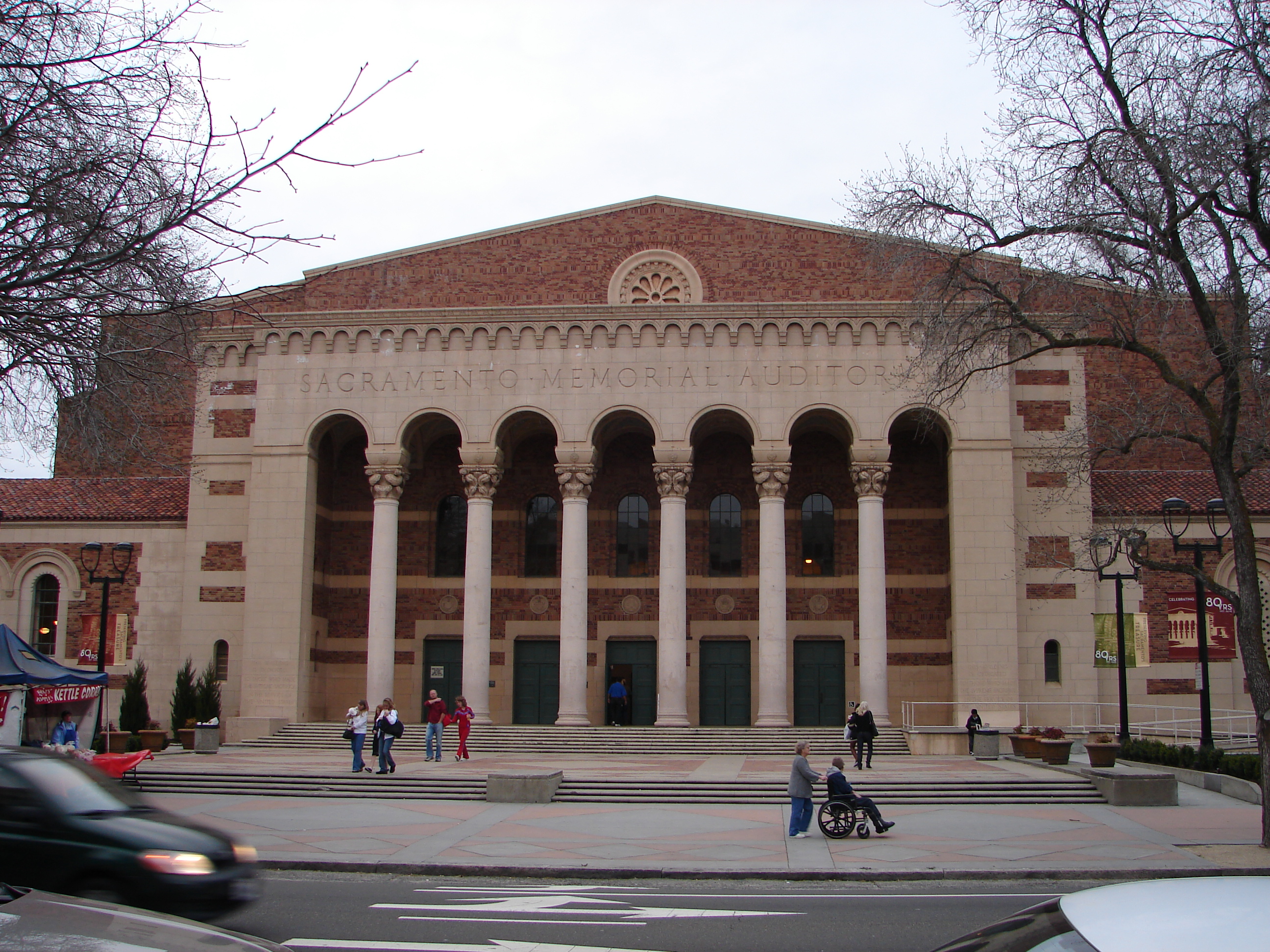
The Sacramento Memorial Auditorium was never meant to be a rock venue. Completed in 1926 and opened on February 22, 1927, the building was constructed as a memorial to Sacramento County veterans of the Spanish-American War and World War I. Etched into the stone on either side of the front entrance are the words: "This building is dedicated to those who made the supreme sacrifice in the service of the United States." A list of the county's war dead from both conflicts remains in the foyer, above the entry into the main hall. The building was constructed primarily of locally sourced brick, with stone, plaster, and terra cotta ornamentation giving it the heavy civic dignity that 1920s municipal architecture favored. The main auditorium seats 3,849, with the smaller Jean Runyon Little Theater seating 272. Memorial Hall rounds out the complex. Plaques inside and outside the building continue to honor military veterans, even as the auditorium's identity shifted over the decades from solemn memorial to one of Northern California's most important performance spaces.
The Decade That Changed Everything
The 1960s transformed the Memorial Auditorium from a civic hall into a cathedral of rock and roll. The Beach Boys played in 1963. The Rolling Stones came through four times between 1964 and 1966, including the infamous night Richards nearly died. Ike and Tina Turner brought their revue in 1965. By 1967, the lineup reflected the psychedelic revolution happening up the road in San Francisco: the Turtles and the 5th Dimension played that year. In 1968, the bookings read like a who's who of the counterculture, with the Grateful Dead, Jefferson Airplane, and the Doors all taking the stage. Chicago, then still calling themselves Chicago Transit Authority, played in 1969. Sacramento was not San Francisco, not the Fillmore, not Winterland. But the Memorial Auditorium's nearly four-thousand-seat capacity and its position on the touring circuit between the Bay Area and the Pacific Northwest made it an essential stop. If you were a major act in the 1960s, you played Sacramento.
The Long Encore
The parade of talent continued through the following decades, if never quite matching the concentrated brilliance of the 1960s. Eric Burdon and War performed in 1970. Frank Zappa played in 1971. The early 1970s brought Cheech and Chong, Canned Heat, and the Doobie Brothers. The Eagles passed through in 1974, as did Steppenwolf. Toto played in 1977, and Motley Crue brought the 1980s hair metal era to the old brick hall in 1983. By the 1990s, John Fogerty, Primus, and 311 were carrying the torch. The auditorium's ability to attract such varied acts across so many decades speaks to something fundamental about the building: its size was right, its acoustics were workable, and its location in the state capital kept it relevant even as newer, flashier venues opened elsewhere. The brick walls that were built to memorialize soldiers ended up absorbing four decades of amplified sound.
Sacred Ground, Twice Over
The auditorium occupies an unusual position in Sacramento's cultural landscape, serving two purposes that rarely coexist. It remains, formally, a war memorial. The plaques are still there. The names of the dead are still listed in the foyer. Governors have been inaugurated within its walls. But it is also the room where the Grateful Dead played, where Jim Morrison performed, where the Rolling Stones nearly lost their guitarist to a faulty ground wire. Bobby Chacon and Rafael Limon fought their historic fourth bout here, a boxing match memorable enough to earn its own Wikipedia entry. The building sits on the National Register of Historic Places, recognized not for any single event but for the accumulated weight of a century's worth of civic life. Sacramento built it to remember sacrifice. The city kept filling it with life.
From the Air
Located at 38.579N, 121.486W in downtown Sacramento, the auditorium's substantial brick structure is visible east of the Capitol building along the urban grid. Sacramento Executive Airport (KSAC) lies approximately 2nm south; Sacramento International (KSMF) is 10nm northwest. The California State Capitol dome provides an excellent visual landmark nearby. The building sits between J Street and I Street corridors. Best viewed at 2,000-3,000 feet AGL in clear conditions.