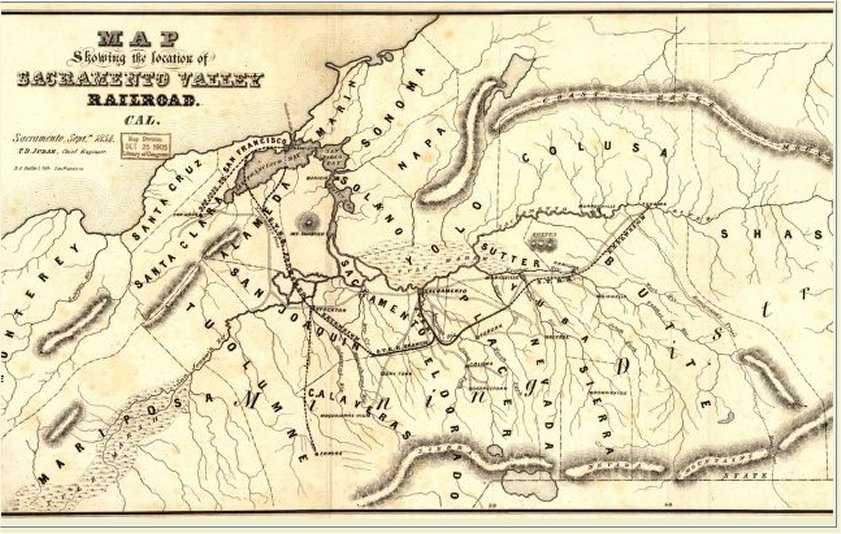
California's First Railroad
The stagecoach fare from San Francisco to San Jose in the early 1850s was thirty-two dollars, and the trip took nine hours. When the railroad arrived, the same journey cost two dollars and fifty cents and took three and a half. That collapse in time and cost -- transportation's version of a dam breaking -- is what the Sacramento Valley Railroad brought to California. Incorporated on August 4, 1852, the SVRR was the first transit railroad company in the state, and its chief engineer was a young New Yorker whose ambitions would reshape the entire continent.
A New Yorker Comes West
Charles Lincoln Wilson, the SVRR's first president, traveled to New York in 1852 to recruit talent and capital. He returned to Sacramento with Theodore D. Judah, a survey engineer barely thirty years old who had already worked on several Eastern railroads. Judah threw himself into the California project, but financing proved agonizing. Construction did not begin until February 1855, and even then the problems multiplied. The SVRR board brought in heavier hitters: Commodore C. K. Garrison, former mayor of San Francisco, became president in August 1855. The vice presidency went to William Tecumseh Sherman -- not yet the Civil War general, but at the time a San Francisco banker heading the firm of Lucas and Turner. Sherman tried to leverage his brother John's new seat in Congress to secure federal land grants for the railroad. Congress said no.
Twenty-Two Miles to Folsom
The original plan had been ambitious: Sacramento to Folsom, then onward to Marysville. But the funding for the northern extension never materialized. What did get built was a 22.9-mile line running from the Sacramento River levee at Front and L Street -- in what is now Old Sacramento -- eastward to Folsom. On February 22, 1856, the first train ran the full route. It was not the oldest working railroad in California; the Arcata and Mad River Railroad, far to the north on the Humboldt Bay coast, had been operational since December 1854. But the SVRR was the state's first incorporated railroad, and its impact on commerce was immediate. Freight rates plummeted. Economic activity along the corridor surged. The line proved what California's boosters had been arguing for years: railroads could transform the West.
Judah's Bigger Dream
Theodore Judah did not linger long with the SVRR. The Sacramento-to-Folsom line was a proving ground, but his real obsession was a railroad over the Sierra Nevada -- a transcontinental link that most engineers considered impossible. Judah spent years surveying mountain passes, eventually settling on a route through Dutch Flat. He persuaded four Sacramento merchants -- Leland Stanford, Collis Huntington, Mark Hopkins, and Charles Crocker, later known as the Big Four -- to finance the Central Pacific Railroad. In August 1865, Central Pacific bought a controlling interest in the Sacramento Valley Railroad, absorbing its profitable Washoe traffic and leaving the smaller line with only local business. The gauge was standardized to match the Pacific Railroad, and the SVRR became a feeder line for the empire it had helped inspire.
Consolidation and Disappearance
On April 19, 1877, the Sacramento Valley Railroad was consolidated with the Folsom and Placerville Railroad to form the Sacramento and Placerville Railroad, which operated 49.1 miles of track between Sacramento and Shingle Springs. The merged company fell under Southern Pacific's control by 1888, first through SP's subsidiary the Northern Railway and then directly under SP in 1898. The corporate identity of California's first railroad vanished into the ledgers of a larger system -- the same pattern that swallowed dozens of pioneer railroads across the country.
Traces on the Ground
Much of the original SVRR route survives in altered forms. Sacramento's light rail Gold Line parallels the old right-of-way between the capital and Folsom, carrying commuters along the same corridor that Judah surveyed in the 1850s. The Placerville and Sacramento Valley Railroad, a heritage line, operates excursion trains from Folsom toward the El Dorado County line. El Dorado County has built the El Dorado Trail along the former rail bed from White Rock to Placerville. Even the Niles Canyon Railway, southeast of the Bay Area, runs on a historic section of what was once part of the broader SVRR-planned network. The iron is different, the locomotives are different, the passengers are tourists rather than gold-seekers -- but the route Judah drew across the landscape is still there, still carrying people east.
From the Air
Located at 38.573N, 121.506W, starting from Old Sacramento along the Sacramento River levee and running east to Folsom. The original 22.9-mile route is paralleled by the SacRT Gold Line light rail. Sacramento Executive Airport (KSAC) is about 3 miles south; Sacramento International (KSMF) is 10 miles northwest. Folsom, the eastern terminus, is visible along the American River. Best viewed at 3,000-5,000 feet AGL to trace the corridor from Old Sacramento through the suburban landscape to Folsom.