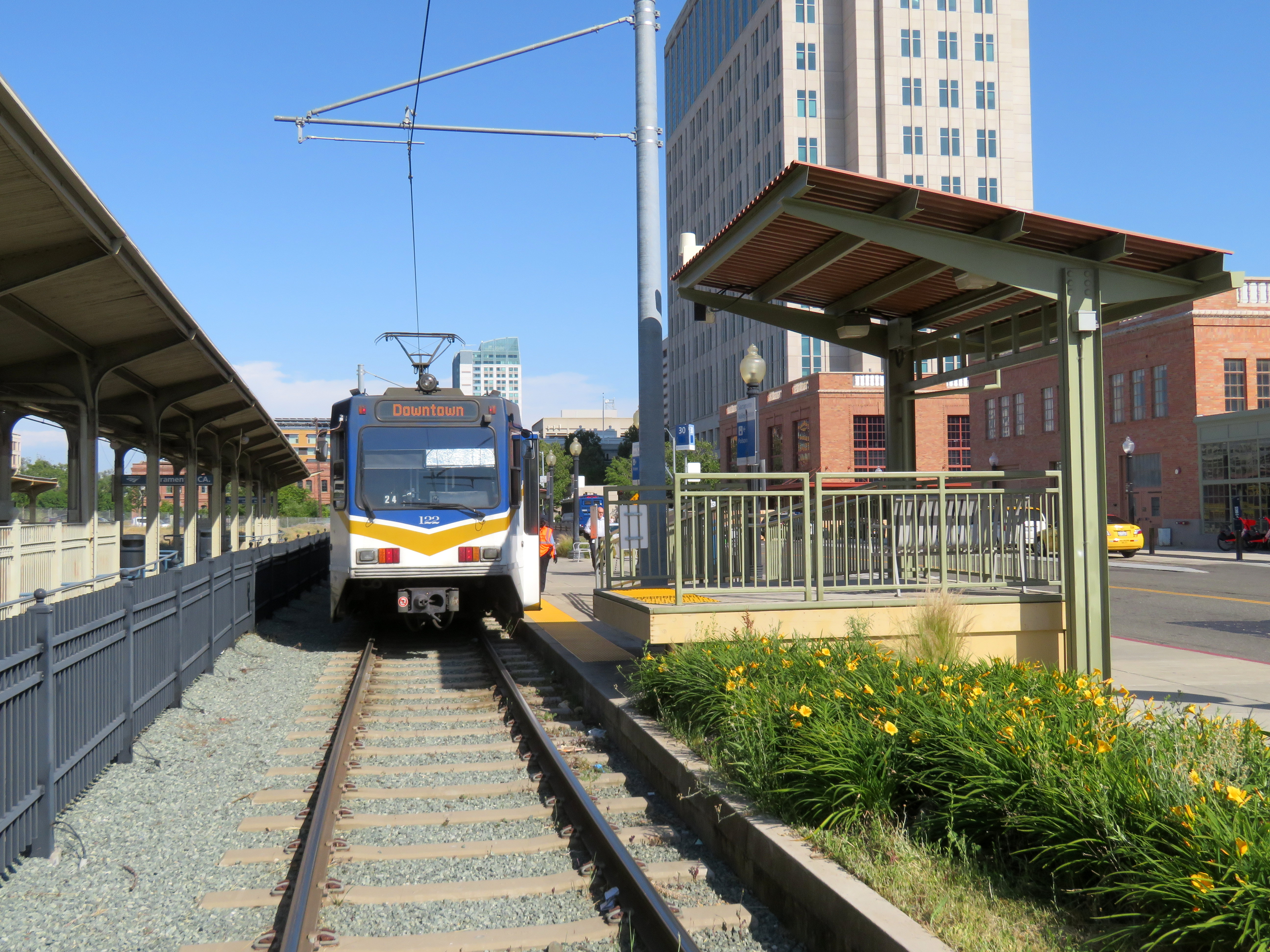
Sacramento Valley Station
Inside Sacramento Valley Station, a mural stretches across the waiting room wall. Painted by John A. MacQuarrie, it depicts a jubilant crowd gathered on January 8, 1863, to break ground on the transcontinental railroad -- the Central Pacific's great push east from Sacramento. The station where this mural hangs was built six decades after that celebration, but it occupies the same psychic ground: this is where California's railroad story began, and where it continues. Nearly three thousand passengers board or step off Amtrak trains here every day, making Sacramento Valley Station the second-busiest Amtrak stop in the Western United States.
Built on Buried Ground
The site of the station carries a complicated history. Before the Renaissance Revival building rose in 1926, this stretch along the Sacramento River was China Slough, a waterway and neighborhood that served Sacramento's Chinese community. The Southern Pacific Railroad commissioned the San Francisco firm of Bliss and Faville to design a building that would announce Sacramento as a city of consequence. The architects delivered: a red tile roof in the California mission tradition, terracotta trim, and large arches on the main facade that frame the entrance like a gateway. The original Sacramento station had been the terminal of the Central Pacific Railroad, the company that employed thousands of Chinese laborers to blast tunnels and lay track through the Sierra Nevada. That the new station was built on land their community once occupied is a historical irony the building does not acknowledge.
The Hub That Never Stopped Spinning
Sacramento Valley Station serves as a crossroads for an extraordinary number of transit systems. Four Amtrak routes converge here: the California Zephyr crosses the Sierra Nevada to Chicago, the Coast Starlight runs the Pacific corridor from Seattle to Los Angeles, and two Capitol Corridor and San Joaquin trains handle California's busy intercity routes. On weekdays, 38 trains pass through. The Gold Line of Sacramento's light rail system terminates directly behind the depot, while bus routes fan out to suburbs and the Sierra foothills. An El Dorado Transit commuter bus connects the station to South Lake Tahoe, carrying skiers and hikers between the valley floor and the mountains. The station's role may expand further -- Sacramento is planned as the northern terminus for California's high-speed rail system, which would put the 1926 building at the heart of twenty-first-century rail travel.
A Century of Reinvention
Grand old train stations have a tendency to fall into decline. Sacramento Valley Station has defied that trajectory through sheer persistence and public investment. By the early 2000s, the building needed serious work. The city undertook a multi-stage renovation that began in 2012, when all Amtrak platforms were relocated roughly a thousand feet north of their original position. The second phase tackled the historic depot itself: structural retrofitting, window replacement, accessibility upgrades, and fire safety improvements that had been deferred for years. Amtrak's ticket and baggage offices moved from a cramped 1960s-era addition to the station's former restaurant space, which turned out to be a far more welcoming arrangement. The renovation concluded on February 23, 2017, with a grand reopening hosted by city officials. The building had been restored without losing its character -- the MacQuarrie mural still presides over the waiting room, and the arched facade still draws the eye.
The Railyards Next Door
The station's future is bound up with the Sacramento Railyards, a massive redevelopment project taking shape on the old Southern Pacific rail yard just to the north. A planned third phase of station improvements would connect the depot to this new district via an elevated concourse, add a reconfigured bus terminal, and realign the light rail tracks into a downtown loop that would allow through-running service. Bicycle trails, mixed-use development, and a possible expansion of the California State Railroad Museum are all on the drawing board. The ambition is to transform what was once a rail yard full of switching tracks and maintenance shops into an urban neighborhood, with the century-old station serving as its front door. Whether the plan survives budget realities and environmental review remains to be seen, but the vision is clear: Sacramento Valley Station is not a relic to be preserved under glass. It is a working building with a working future.
From the Air
Located at 38.58N, 121.50W in downtown Sacramento, near the Sacramento River waterfront. The station's red tile roof and Renaissance Revival architecture are visible among the downtown grid. Sacramento Executive Airport (KSAC) lies 3nm south; Sacramento International (KSMF) is 10nm northwest. The Sacramento Railyards development area is immediately north of the station. Best viewed at 2,000-3,000 feet AGL.