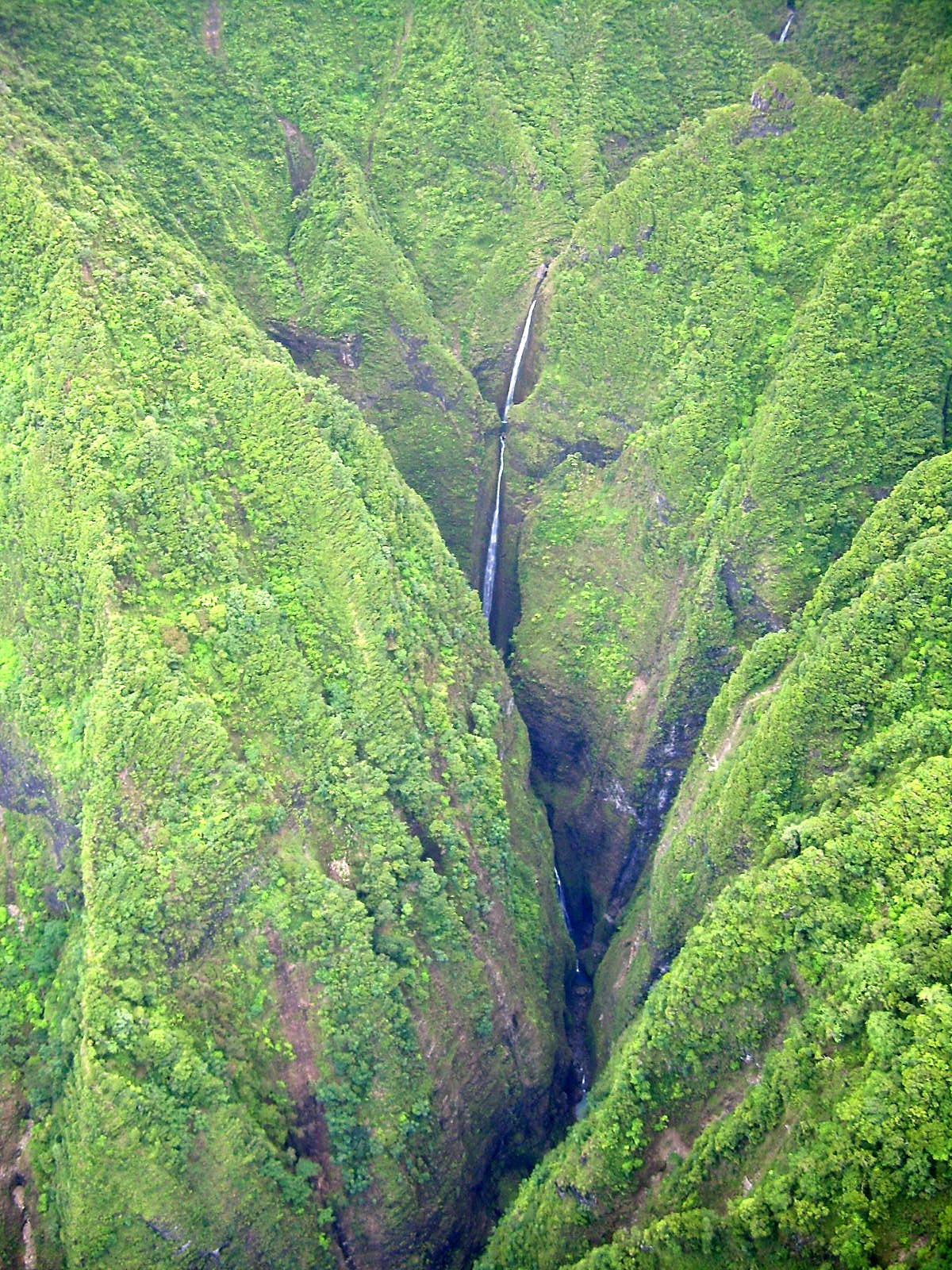
Sacred Falls State Park
On Mother's Day 1999, a wall of rock broke loose inside Kaluanui Gulch and fell without warning. Eight hikers died. At least thirty more were injured. First responders carried victims 2.2 miles out of the narrow valley on foot. Sacred Falls State Park has been permanently closed ever since, and yet people keep going in. They climb past the warning signs, past the QR codes linking to videos about the dead, past the threat of a $2,500 fine for a first offense. What draws them is what has always drawn people to Kaliuwa'a: the waterfall at the end of the canyon, the sheer volcanic walls, and a Hawaiian story old enough that the landscape itself is a character in it.
The Demigod's Escape Route
In Hawaiian tradition, this valley belongs to Kamapua'a, the pig demigod known for his mischief and his temper. The story goes that Kamapua'a stole poultry from the ruling chief of the Ko'olau districts and tore up taro and potato plantations under the jurisdiction of 'Olopana. When 'Olopana marched an army to Kaliuwa'a to confront him, Kamapua'a let himself be captured -- but only until he was far enough from his grandmother Kamaunuaniho to spare her the violence. Then he turned and destroyed much of the army. When 'Olopana returned with a larger force, Kamapua'a led his grandmother and his people deep into the valley, to the base of the falls. There he transformed into his pig form, pressed his back against the cliff face, and enlarged his body until his people could climb over him to the unreachable tablelands above. Two hollowed depressions in the rock wall are said to be the marks his body left, shaped like canoes standing on end. The name Kaliuwa'a comes from this: liu meaning ready, wa'a meaning canoe.
Mountain to Sea
Kaliuwa'a sits within the ahupua'a of Kaluanui, in the moku of Ko'olauloa on Oahu's windward coast. The ahupua'a was the fundamental unit of Hawaiian land management -- a strip running from the mountain ridge to the sea, containing everything a community needed for subsistence. Ko'olauloa is defined by deep valleys and narrow coastlines. In the southern half of the district, moist trade winds drive against steep windward cliffs and become rain, feeding the large streams of Kaluanui, Punalu'u, Kahana, and Ka'a'awa. Before European contact, Hawaiians built extensive agricultural and aquacultural terraces along these waterways. The steep, weathered cliffs and sudden thunderstorms that characterize the region gave rise to legends -- and Kamapua'a's story is the most famous of them. The landscape is not backdrop; it is the reason the stories exist.
The Day the Valley Fell
More than twenty incidents of death or injury had already occurred at Sacred Falls before May 9, 1999. The rockfall that day killed eight and injured over thirty, but geologists from the U.S. Geological Survey's Hazards Team later determined it was a typical event for this kind of terrain. The walls of Kaluanui Gulch are volcanic rock, deeply weathered, showing fresh scars from recent slides alongside older, vegetation-covered ones. The valley floor averages only 50 to 100 feet in width, which means any rockfall has a high probability of hitting anyone below. The steep, narrow canyon environment also makes conventional rock-fall mitigation -- netting, barriers, rerouting trails -- impractical. The USGS team concluded that decreased stability from accumulated scarring made future rockfalls not just likely but inevitable. The decision to permanently close the park was not about one bad day; it was about geology that will never stop being dangerous.
The Pull of the Forbidden
Despite the closure, trespassing remains constant. The Hawaii Department of Land and Natural Resources enforces fines of $2,500 for a first violation, $5,000 for a second, and $10,000 for a third. Warning signs at the trailhead include QR codes linking to videos that detail the history of death in the valley and the legal consequences of entry. None of it works well enough. Hikers argue they should be allowed to go at their own risk. Others point to the danger that trespassers pose to the first responders who would have to carry them out if something went wrong again. The park exists in a strange limbo: a wahi pana -- a storied, sacred place in Hawaiian culture -- that the state cannot let people visit, that people refuse to stop visiting, and that the mountain itself, in its slow geological way, is dismantling one rockfall at a time.
From the Air
Located at 21.57N, 157.91W on Oahu's windward North Shore in Hau'ula. The narrow Kaluanui Gulch cuts into the steep Ko'olau Range and is visible from the air as a deep V-shaped valley with sheer walls. The waterfall at the valley's end may be visible in wet conditions. Nearest major airport is Daniel K. Inouye International Airport (PHNL), approximately 20 nautical miles to the southwest. Best viewed at 2,000-4,000 feet AGL from offshore.