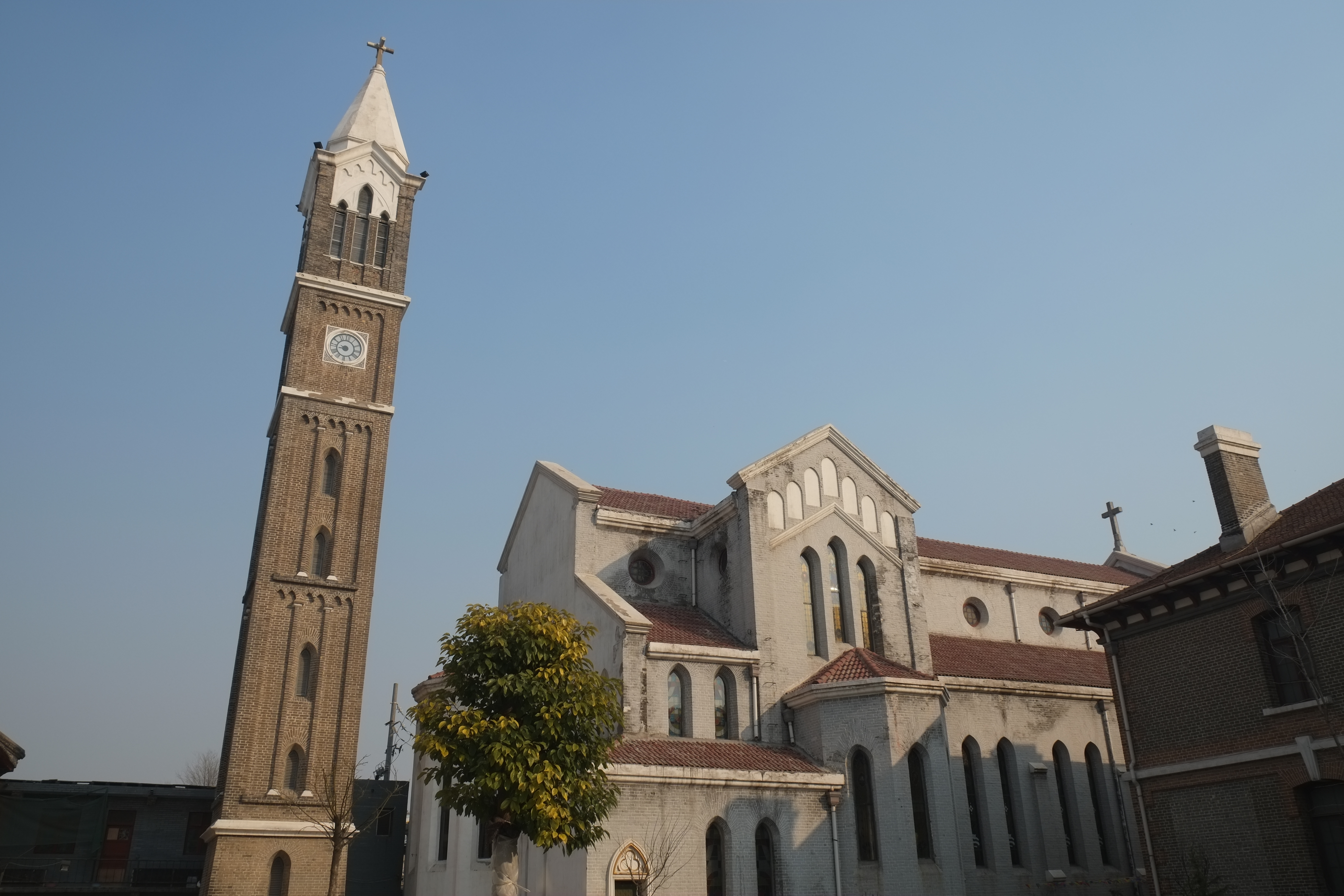
Sacred Heart Cathedral, Kaifeng
When Japanese bombers began striking Kaifeng in 1937, the Italian bishop Tacconi had four large flags sewn -- two of Italy, two of Vatican City. Whenever the air-raid sirens sounded, workers scrambled to hoist a flag to the top of the cathedral's bell tower. It was a gamble: Italy was an Axis power, and Japan might respect the neutrality implied by the Vatican banner. The gamble worked. Sacred Heart Cathedral survived the Second Sino-Japanese War, as it would survive the civil war that followed and the Cultural Revolution after that -- the largest Catholic church in Henan province, stubbornly enduring in a city that has been repeatedly destroyed and rebuilt.
Jesuits, Jewish Communities, and a Flood
Catholicism arrived in Kaifeng in the seventeenth century, carried by Jesuits including Giulio Aleni and Nicolas Trigault who came searching for the city's famed Jewish community. In 1629, Francesco Sambiasi established the first Catholic church in Kaifeng. It lasted thirteen years before the Yellow River floods of 1642 destroyed it along with much of the city. Nearly three centuries passed before the faith regained an institutional foothold. In 1916, the Apostolic Vicariate of Eastern Honan was established in Kaifeng, with the Italian bishop Tacconi as its inaugural apostolic vicar. With European nations consumed by World War I, Tacconi traveled to the United States to raise construction funds, then hired designers from Shanghai and Tianjin and a French building company. Construction began in 1917 and the cathedral was completed in 1919.
A Bell Tower in the Crossfire
The bell tower became Kaifeng's most strategically coveted vantage point during the Chinese Civil War. In May 1948, during the First Battle of Kaifeng, a communist commander set up headquarters inside the cathedral complex and used the tower to observe and direct combat operations. Kuomintang forces responded by hitting the tower with two mortar rounds. The building absorbed the damage and stood. Earlier, in August 1946, the communist advance through northern Henan had driven clergy and believers from surrounding provinces to seek shelter in the cathedral's dormitory. Through these years of upheaval, the building served double duty -- house of worship and refugee shelter, observation post and target.
Shattered Glass, Enduring Walls
The Cultural Revolution inflicted a different kind of damage. Red Guards shattered the stained glass windows that had once depicted the Sacred Heart of Jesus flanked by Saints Peter and Paul, with the martyrs Francis Ferdinand de Capillas and John Gabriel Perboyre on the outer panels -- both men killed in China for their faith during the Qing dynasty's prohibition against Christianity. The guards also removed the copper wires that held the cathedral's special Tianjin roof tiles in place. The windows were eventually replaced with plain glass; the tiles with locally made substitutes. What survived intact was the structure itself: a basilica-form building 34.6 meters long and 22.7 meters wide, with twelve cylindrical pillars rising to a nave ceiling 14.7 meters high.
The Bronze Bell Still Rings
The bell tower stands independently to the north of the cathedral, topped by a three-meter cement cross. Inside, a bronze bell cast in 1921 hangs at the summit, decorated with patterns of flora and fauna and inscribed in Latin by Tacconi. A pulley system with ropes reaching to the ground floor allows bell ringers to sound it across the city. The former episcopal residence sits just four meters west of the cathedral -- a two-story building with a basement originally designed for storing Eucharistic wine, now used for clergy housing and reception. In 2006, the entire complex was recognized as a province-level cultural heritage protected site. The cathedral continues to function as an active parish, its congregation worshiping beneath a ceiling that has witnessed nearly every upheaval modern China has endured.
From the Air
Located at 34.80N, 114.36E in central Kaifeng, Henan province. The cathedral and its bell tower are identifiable from low altitude within the dense urban fabric of the old city. Nearest major airport is Zhengzhou Xinzheng International (ZHCC/CGO), approximately 75 km west. The flat terrain of the Yellow River plain surrounds Kaifeng, with the river itself visible to the north.