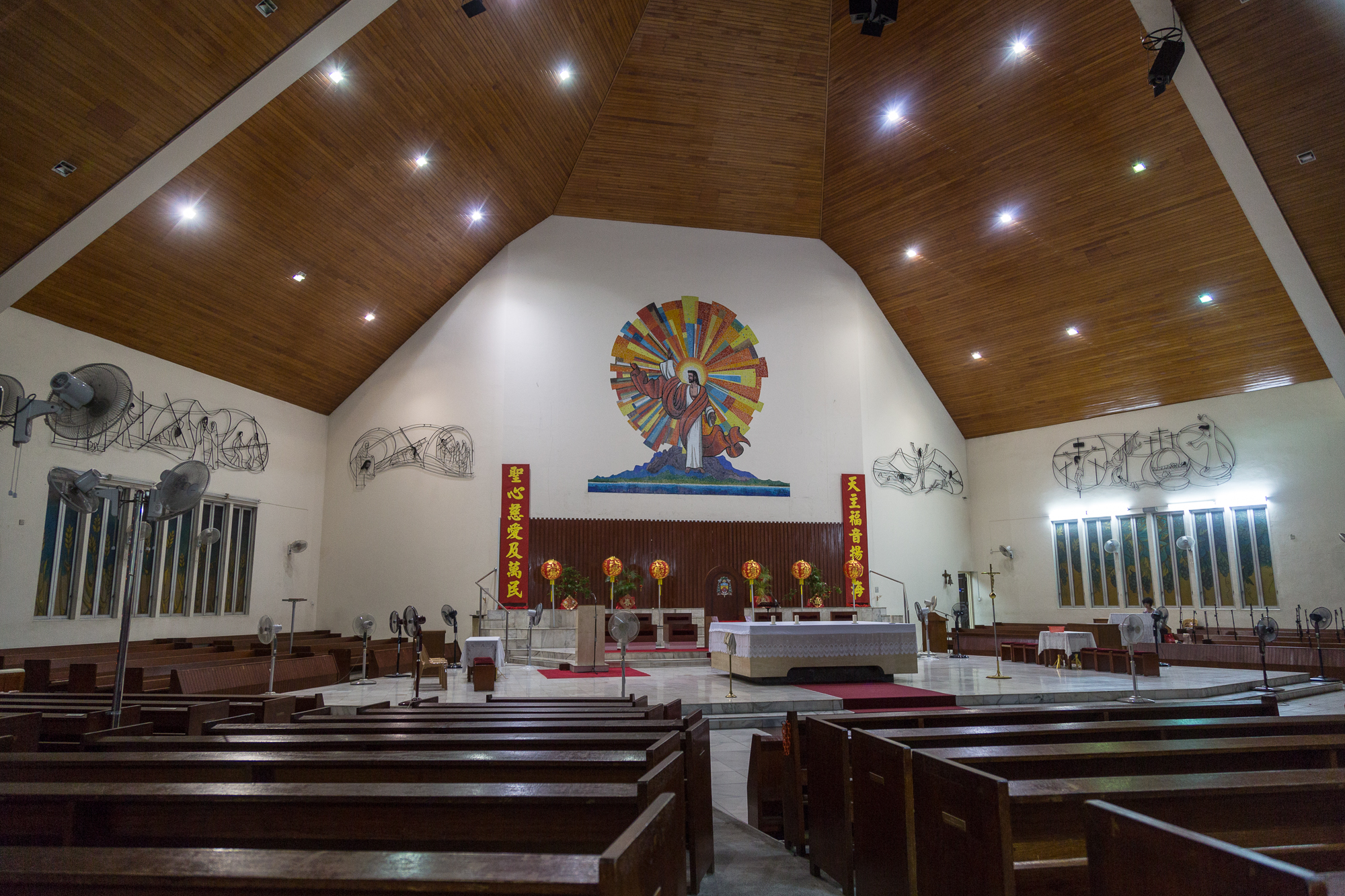
Sacred Heart Cathedral, Kota Kinabalu
In January 1903, a Dutch Mill Hill missionary named Henry van der Heyden stepped off a boat in Jesselton, the small colonial trading post that would eventually become Kota Kinabalu. He found a town in flux. The North Borneo Chartered Company was importing Chinese workers by the hundreds, and among these new arrivals were Hakka farmers, poor and far from home, who would form the nucleus of what became one of Borneo's most enduring Catholic communities. The cathedral that grew from those beginnings has been built, bombed, and rebuilt three times. Each version tells a chapter of Sabah's history.
Three Cathedrals, One Century
The first cathedral building was erected in 1911 by Fr. Valentine Weber, another Mill Hill missionary working in what was then British North Borneo. It served the growing Catholic population of Jesselton, a community that included not only the Hakka Chinese but also Europeans, Indians, Filipinos, and an increasing number of Kadazan-Dusun converts who would eventually form the backbone of the parish. In 1938, Fr. Arnold Verhoeven built a second, larger structure to accommodate the expanding congregation. Then came the war. Japanese bombing during World War II reduced the cathedral to pillars and foundation. The devastation was so thorough that rebuilding required starting from little more than rubble. The third iteration opened in 1949 under Monsignor James Buis, and the current structure, the product of a major renovation by Fr. Tobias Chi, was dedicated on 21 November 1981.
The Hakka Foundation
What makes Sacred Heart Cathedral distinctive among Southeast Asian churches is the role of the Hakka community in its formation. The Hakka people, a Chinese ethnic group known for their migrations and resilience, arrived in Jesselton as laborers recruited by the Chartered Company. They were farmers transplanted to a foreign shore, struggling with unfamiliar soil, tropical diseases, and the disorientation of building new lives in a land where they knew no one. Catholicism offered community, education, and a network of mutual support. The Mill Hill Missionaries, an order founded in London in 1866 specifically for overseas mission work, provided schools and social services alongside spiritual guidance. The cathedral became the center of a community that was both immigrant and indigenous, Chinese and Kadazan-Dusun, European and Filipino.
Survival and Reconstruction
The Japanese occupation of North Borneo was catastrophic for Jesselton. Allied bombing and Japanese military operations left most of the town in ruins, and the cathedral was no exception. That only some pillars and the foundation survived gives a sense of the destruction's scale. The decision to rebuild was not merely architectural but existential. The Catholic community that gathered around the new church in 1949 was a community that had survived occupation, bombing, and the execution of resistance fighters, some of whom were parishioners. The church became a symbol of continuity in a landscape that had been stripped of nearly every other familiar structure. Kota Kinabalu was, in effect, a new city built on the ashes of Jesselton, and Sacred Heart Cathedral was one of the threads connecting the two.
A Living Parish
Today the cathedral serves as the seat of the Roman Catholic Archdiocese of Kota Kinabalu, under Archbishop John Wong Soo Kau. The parish center, Marian grotto, and Emmaus Home surround the main church, creating a campus that functions as both spiritual anchor and community hub. During Chinese New Year, the interior fills with red and gold decorations, a visible reminder of the Hakka heritage that built this place. The congregation reflects Kota Kinabalu's broader demographics: Kadazan-Dusun families sit alongside Chinese, Filipino, Indian, and European parishioners. In a city where mosques, temples, and churches share the same neighborhoods, Sacred Heart Cathedral represents a particular strain of Bornean Catholicism, one that was forged by immigrant labor, tempered by war, and sustained by the kind of multicultural community that North Borneo's geography has always demanded.
From the Air
Located at 5.965°N, 116.072°E in central Kota Kinabalu, near the waterfront area. The cathedral complex is visible as a cluster of institutional buildings on the city's coastal plain. Nearest airport is Kota Kinabalu International Airport (WBKK), approximately 7 km to the south. The church is situated between Signal Hill and the waterfront, close to other major landmarks including the Sabah State Mosque and Sabah Museum. Best viewed at 2,000-3,000 feet AGL.