Sacred Heart Cultural Center
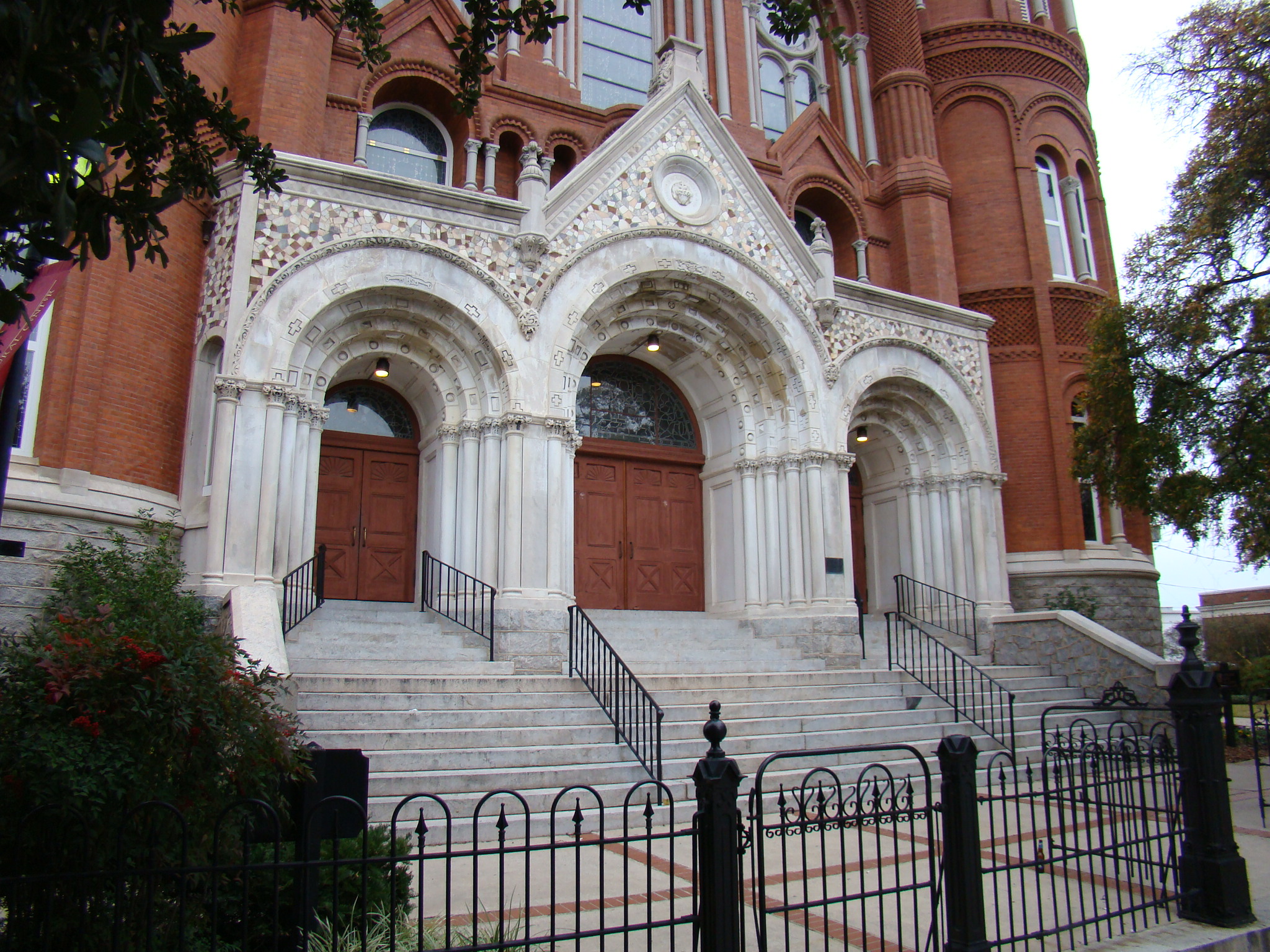
Count the brick patterns. There are fifteen different types woven into the facade of Sacred Heart, each one laid by hand at the turn of the twentieth century, forming an intricate surface that catches light differently at every hour. Above them, twin round towers rise to conical spires. Below, three stone arches frame the entrances. And inside, 94 stained glass windows, most of them created by the firm of Mayer in Munich, throw colored light across an Italian marble altar and a barrel-vaulted ceiling that amplifies every whisper into something like prayer. Sacred Heart Catholic Church held its first mass on December 2, 1900, built to serve Augusta's growing Catholic immigrant population that had outgrown the older St. Patrick parish. It served that community for seventy years. Then it nearly died. That it survived at all is a story of stubbornness, money, and the conviction that some buildings are too beautiful to lose.
An Immigrant Parish Builds a Cathedral
The story begins in 1874, when Father Theodore Bulter acquired land for a new church and a Christian school intended to serve people of all denominations. Temporary structures went up first, and Jesuit priests were brought in to lead the new parish. Construction of the permanent church did not begin until 1897, and three years of work produced something far grander than a neighborhood parish. The architects chose a cruciform Romanesque plan, its weight and ornamentation reflecting the ambitions of a Catholic community eager to put down visible roots. The Italian marble high altar fills the apse. Two side altars occupy the transept. Six rose windows dominate the transept ends, while the aisle windows depict saints and Catholic symbols in glass that had crossed the Atlantic from Munich. A small dome crowns the crossing where nave and transept meet. Every surface declares permanence, a community building not for a generation but for centuries.
The Silence of Abandonment
Seventy years turned out to be optimistic. By the 1960s, the neighborhood around Sacred Heart was in decline. Two major floods of the Savannah River had driven residents out, and the growth of modern suburbs pulled families away from downtown Augusta. Maintenance costs climbed as the congregation shrank. In 1971, the Diocese closed Sacred Heart. The building stood empty, and emptiness invited destruction. Vandals broke windows and defaced walls. Weather crept through gaps that no one repaired. The church that had taken three years to build began a slow collapse that lasted more than a decade. Proposals to demolish it circulated. Sacred Heart was listed on the National Register of Historic Places in 1972, a recognition that offered prestige but no funding and no protection from decay.
The Knox Foundation's Bet
The rescue came in the 1980s, when Peter Knox Jr. and his sons Peter III and Boone purchased the property through their company Knox Limited. The first restoration in 1987 was primarily structural: stabilize the building before it went beyond saving. Local architect Spyro Meimarides oversaw repairs to the roof and the painstaking restoration of the stained glass windows, some of which had survived vandalism intact while others required skilled glasswork to rebuild. The Knox Foundation transformed the church into a cultural center, repurposing the sacred space for secular community use without erasing its character. The former rectory and school building now house non-profit organizations and arts groups. The nave that once held pews holds banquet tables and concert chairs. The transformation preserved everything that made Sacred Heart extraordinary while giving it a purpose that could sustain it.
Fifteen Types of Brick, One Living Building
Today Sacred Heart Cultural Center hosts wine festivals, choral concerts, Christmas celebrations, and an annual garden festival. Art exhibitions rotate through the gallery spaces. Weddings fill the nave with flowers and music where incense once hung in the air. The building works as an event venue precisely because of its extravagance: the stained glass, the marble, the dome, the fifteen varieties of brick all create an atmosphere that no modern construction could replicate. Augusta nearly lost this. The floods, the suburban exodus, the vandalism, the years of emptiness could have ended with a wrecking ball. Instead, Sacred Heart stands as proof that civic preservation is not nostalgia but investment. The Munich glass still glows. The brick patterns still catch the light. And every event held beneath that barrel vault adds another layer to a story that began with immigrants building something permanent in a new country.
From the Air
Located at 33.48°N, 81.98°W in downtown Augusta, Georgia. The church's distinctive twin round towers with conical spires and cruciform plan are visible from lower altitudes. The building sits in Augusta's historic downtown, a few blocks west of the Savannah River. Augusta Regional Airport (KAGS) is approximately 6 miles south. Daniel Field (KDNL), a general aviation airport, is about 1 nautical mile west of downtown. From altitude, look for the Savannah River and Augusta's downtown grid; Sacred Heart's towers and dome distinguish it from surrounding structures. The Romanesque silhouette is most recognizable below 2,500 feet AGL. The church is roughly 0.5 miles southwest of the Riverwalk Augusta promenade along the river.