Sacromonte
On summer evenings, the sound of clapping hands and stamping feet rises from the hillside caves of Sacromonte, carrying across the Darro valley toward the floodlit walls of the Alhambra. This is where flamenco lives in its rawest form -- not in theaters or tourist tablaos, but in whitewashed caves dug into the slopes of Valparaiso hill by people who had nowhere else to go. The Romani families who settled here after Granada's fall to the Catholic Monarchs in 1492 turned marginalization into a culture so magnetic that Federico Garcia Lorca devoted an entire book of poems to them.
Houses Carved from Necessity
The caves of Sacromonte began as refuges for the displaced. After 1492, Jewish and Muslim populations were expelled from their homes, and the Romani who had arrived with the Christian conquest found themselves pushed to the margins of the city, beyond its walls and beyond the reach of the Spanish Inquisition. To build a cave, a settler would carve a vertical face into the hillside, insert an arch for a doorway, and excavate rooms as deep as the terrain allowed. No two caves are identical -- each is shaped by the particular geology of its location, the angle of the slope, the hardness of the rock. Over centuries, the whitewashed facades, narrow paths, and irregular plazas formed a landscape unlike anything else in Spain. The Sacromonte Caves Museum, opened in 2002, preserves eleven caves in their original state, displaying the forge, loom, pottery workshop, and living quarters that defined daily life here.
The River of Gold
Sacromonte occupies both banks of the Darro, a river whose name may derive from the phrase d'auro -- "of gold" -- a reference to the gold-bearing sediments that once drew prospectors to its banks. The neighborhood faces the Alhambra directly, and the contrast between the two is the story of Granada in miniature: the palatial fortress on one hillside, the cave dwellings of the dispossessed on the other, separated by a river that runs through both their histories. The Romani who settled here spoke Calo, a mixed language with roots in India that has seen rapid decline over the past century. Their community produced artists, musicians, and dancers whose influence on flamenco would prove incalculable. The Maya family, one of the most important dynasties in flamenco, founded the Cueva de la Rocio in 1951, where the zambra gitana is still performed nightly.
Forgeries and Holy Mountains
The neighborhood owes its name -- Sacred Mountain -- to a remarkable episode of religious fraud. Between 1595 and 1606, lead tablets were discovered on the hill of Valparaiso containing texts in Latin and Arabic characters that some interpreted as a fifth gospel. The discovery sparked enormous excitement and led to the construction of the Abbey of Sacromonte, where the supposed relics of Saint Caecilius, co-patron of Granada, were enshrined. The lead books were declared forgeries in the 17th century, but the abbey endured. It houses a significant library with numerous incunabula and manuscripts, and its catacombs contain chapels where tradition claims the apostle James the Lesser once officiated. Every first Sunday of February, pilgrims still climb to the abbey for the feast of San Cecilio, a celebration that bridges the neighborhood's invented sacred history with genuine devotion.
The Ravine of the Blacks
Local legend offers a vivid origin story for the first cave dwellers. When the ruling Arab families fled Granada after 1492, afraid of bandits on the roads to the ports of Almunécar and Almeria, they reportedly buried their treasures among the olive groves of Sacromonte. At the same time, they freed the enslaved people in their households, many of whom were Black, who had overheard conversations about the hidden wealth. Freed but destitute, these men and women climbed the hill, dug into the slopes searching for treasure, and when they found nothing, turned their excavations into homes. The area became known as the Barranco de los Negros -- the Ravine of the Blacks. Later, as Romani settlers arrived, legend holds that older women known as ferminibí attempted to locate the buried treasures through hydromancy and pyromancy, staring into basins of water or flames for clues. Whether any treasure was ever found remains unknown.
Flamenco's Living Root
By the mid-20th century, the zambra -- a musical and dance form rooted in Sacromonte's wedding rituals -- was in danger of extinction. In 1985, Francisco Guardia Contreras, known as Curro Albaicin, gathered the neighborhood's veteran artists to revive the tradition. Born in 1948 into the Cabreras family, he had grown up among legendary performers including Mario Maya and the Habichuelas and Amaya families. His efforts produced not only performances but scholarship: the Cancionero del Sacromonte in 1992, followed by books documenting the neighborhood's artistic legacy and its decline. Today, the caves where zambras are performed remain active, drawing audiences into intimate spaces where the acoustics of rock and whitewash concentrate the music in ways no concert hall can replicate. The neighborhood celebrates its festivals in the first ten days of August, and the annual Costume Parade on the first weekend of September sends costumed neighbors parading through the streets and into the adjacent Albaicin.
From the Air
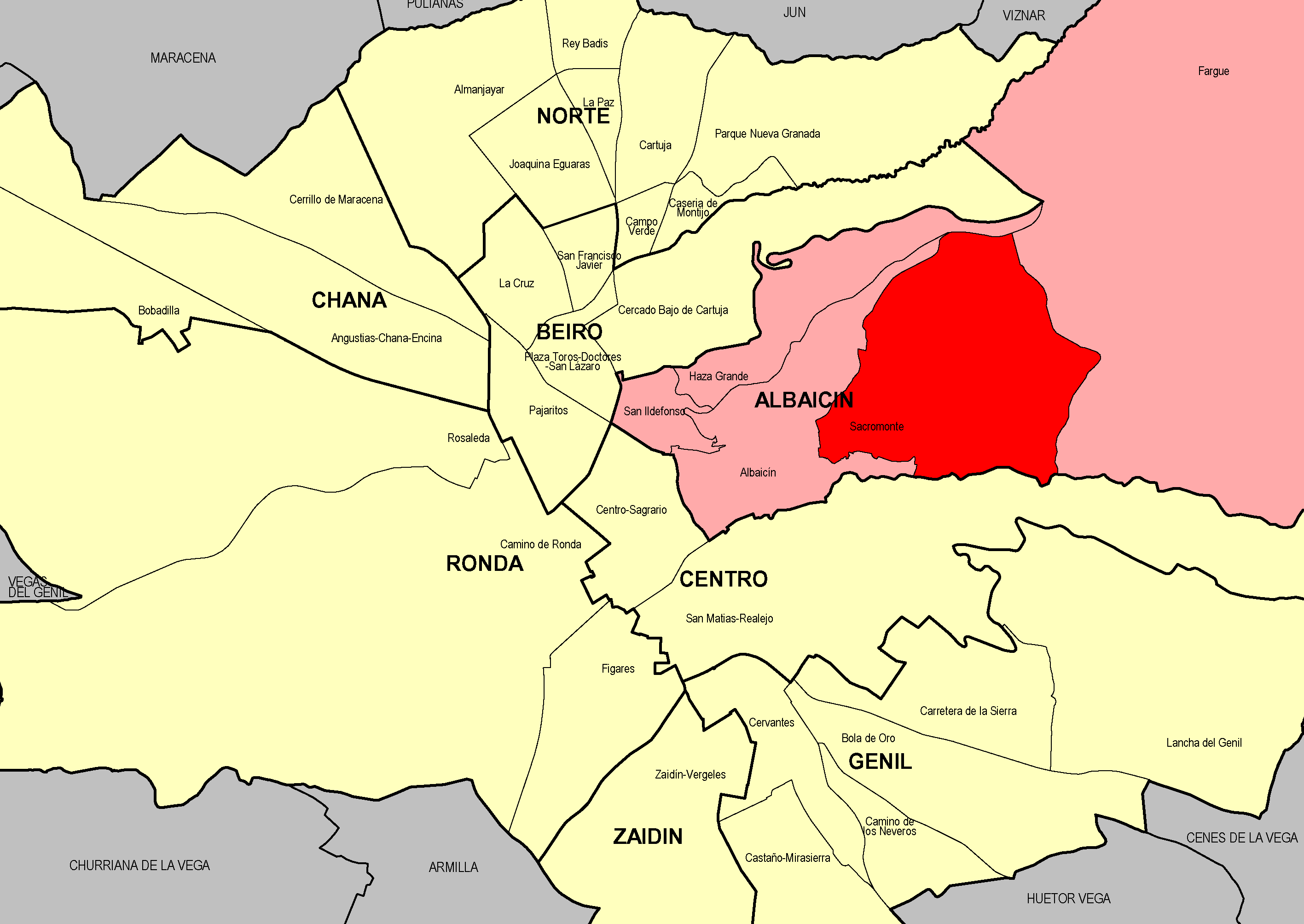
Located at 37.18°N, 3.59°W on the hillside east of central Granada, directly facing the Alhambra across the Darro valley. The whitewashed caves are visible on the hillside from moderate altitude. Nearest airport: LEGR (Federico Garcia Lorca Granada-Jaen Airport), approximately 15 km west. Best viewed at 2,000-4,000 ft AGL, where the contrast between Sacromonte's cave-studded hillside and the Alhambra opposite is most dramatic.