Sado Kokubun-ji
In 741, Japan was burying its dead. A smallpox epidemic that had raged since 735 had killed roughly a third of the population, devastating the court aristocracy and collapsing the government's ability to administer its provinces. Emperor Shomu's response was spiritual on a national scale: he ordered a Buddhist monastery and nunnery built in every province of Japan, a network of temples called kokubunji that would project imperial authority and Buddhist protection to the farthest corners of the realm. On Sado Island -- a mountainous exile colony in the Sea of Japan, already remote and isolated -- the provincial temple that rose from this decree became the oldest on the island. Twelve centuries later, its foundation stones still mark the ground, and a wooden Buddha carved from a single block of wood still sits in its successor hall, surviving everything the centuries have thrown at this place.
An Emperor's Answer to Plague
The 735-737 Japanese smallpox epidemic was catastrophic. It arrived from the Korean Peninsula and swept through a population with no immunity, killing an estimated one-third of Japan's people. Four of the most powerful court ministers died in a single year. Emperor Shomu, shaken by the collapse of his government and the suffering of his subjects, turned to Buddhism. The Shoku Nihongi, Japan's official chronicle of the period, records that in 741 the emperor ordered a kokubunji -- a provincial monastery -- established in each of Japan's sixty-odd provinces, modeled on Todai-ji in Nara. Each temple was to house monks who would chant sutras for the protection of the state. On Sado, construction of the provincial temple began between 743 and 775. The island was small and remote, but it received the same imperial mandate as every other province.
Tiled Roofs at the Edge of the Realm
The original Sado Kokubun-ji was built on a scale that announced imperial ambition. Its layout mirrored Todai-ji itself: the main buildings aligned south to north, with a Kondo (main hall), Middle Gate, South Gate, cloisters connecting the Middle Gate to the Lecture Hall, and a pagoda positioned to the southeast. That pagoda was a seven-story structure -- extraordinary for a remote island province. The temple had tiled roofs, a rarity in the Hokuriku region of northwestern Japan, where most buildings used thatch. The foundation stones for these structures have been found by archaeologists, and they reveal a complex that was meant to impress. Sado was an island of exile, a place where disgraced nobles and monks were sent to disappear. The kokubunji was a reminder that even here, the emperor's will reached.
Lightning, Fire, and War
The pagoda was the first to fall. Sometime during the Shoan era, between 1288 and 1301, lightning struck the seven-story tower and destroyed it. The rest of the temple survived until 1529, when the Sengoku period's civil wars reached even this island exile ground and the complex burned. What rose in its place during the early Edo period was humbler -- a Shingon sect temple rebuilt on a site slightly east of the original foundations, on a much smaller scale. The Ryuri-do chapel, built in 1666, is a five-by-four-bay hall with a thatched hip-and-gable roof in the irimoya-zukuri style. Earthquakes damaged it in 1793 and 1812, requiring repairs each time. It is a modest building, but it shelters something remarkable: a statue of Yakushi Nyorai, the Medicine Buddha, carved from a single block of wood during the early Heian period. The statue stands 1.36 meters tall and the temple claims it is the surviving honzon -- the principal sacred image -- of the original eighth-century temple. It was designated a National Important Cultural Property in 1906.
Exile Island, Gold Island
Sado Island's history runs deeper than any single temple. The island served as an official place of exile from the Nara period onward, and among its most famous involuntary residents were the Buddhist monk Nichiren, exiled in 1271 for criticizing the Kamakura shogunate, and Zeami, the great Noh dramatist, who arrived in 1434 after falling out of favor with the shogun. Gold was discovered on Sado around the twelfth century, and full-scale mining began in 1601, producing vast quantities of gold and silver for nearly four hundred years until operations ceased in 1989. In July 2024, the Sado Island Gold Mines were inscribed as a UNESCO World Heritage Site. The ancient kokubunji grounds sit within this layered history -- exile, devotion, mineral wealth, and time. The archaeological site was designated a National Historic Site in 1929, and 394 artifacts including roof tiles bearing an eight-petal lotus motif were collectively designated a National Tangible Cultural Property in 2019.
Stones in a Park
Today the original temple ruins are maintained as a historic park, about thirty-five minutes by car from Ryotsu Port, where ferries arrive from the Niigata mainland. The foundation stones sit in neat rows in a grassy field, marking where the Kondo stood, where the seven-story pagoda rose, where the cloisters connected hall to gate. The current temple operates quietly nearby. Sado Airport (RJSD), long dormant, has been undergoing renovations with the prospect of renewed air service. For now, most visitors arrive by sea. The park is not dramatic -- no towering reconstruction, no busy pilgrimage crowds. It is simply the ground where an emperor's decree met an island's isolation, where monks chanted for the protection of a state they could not see from their exile shore, and where a wooden Buddha has watched over the remains for a thousand years.
From the Air
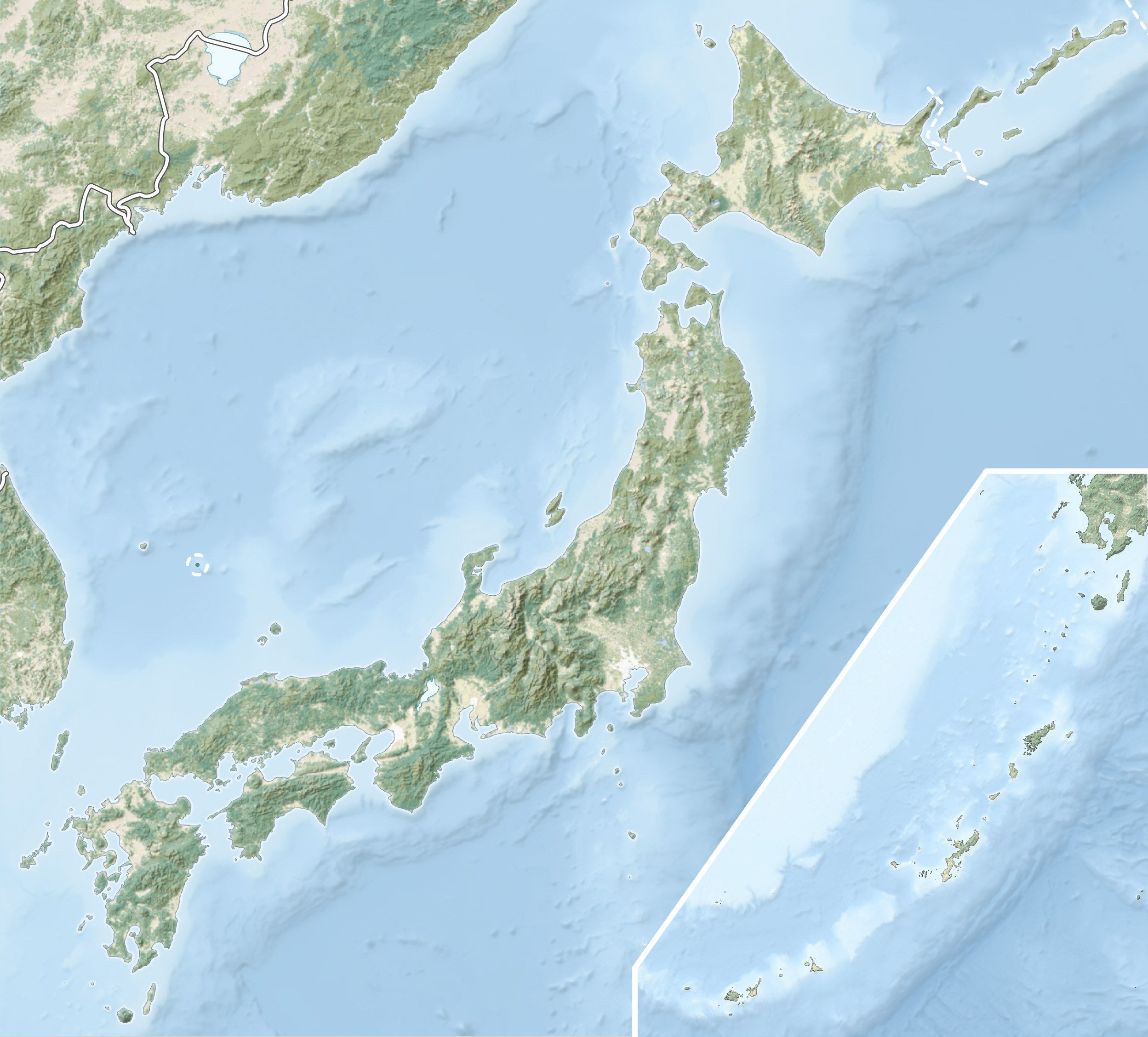
Located at 37.97N, 138.37E on Sado Island in the Sea of Japan, off the coast of Niigata Prefecture. Sado Island is Japan's sixth-largest island and is clearly visible from altitude as a distinctive elongated landmass roughly 60 km off the Niigata coast. The temple ruins are in the central-southern part of the island. Sado Airport (RJSD) is located approximately 4 km southwest of Ryotsu, though commercial service has been suspended since 2014 with potential resumption planned. Niigata Airport (RJSN) on the mainland is the nearest active airport with scheduled service. Best viewed at 3,000-5,000 feet AGL. The island's mountainous terrain rises to over 1,000 meters in places.