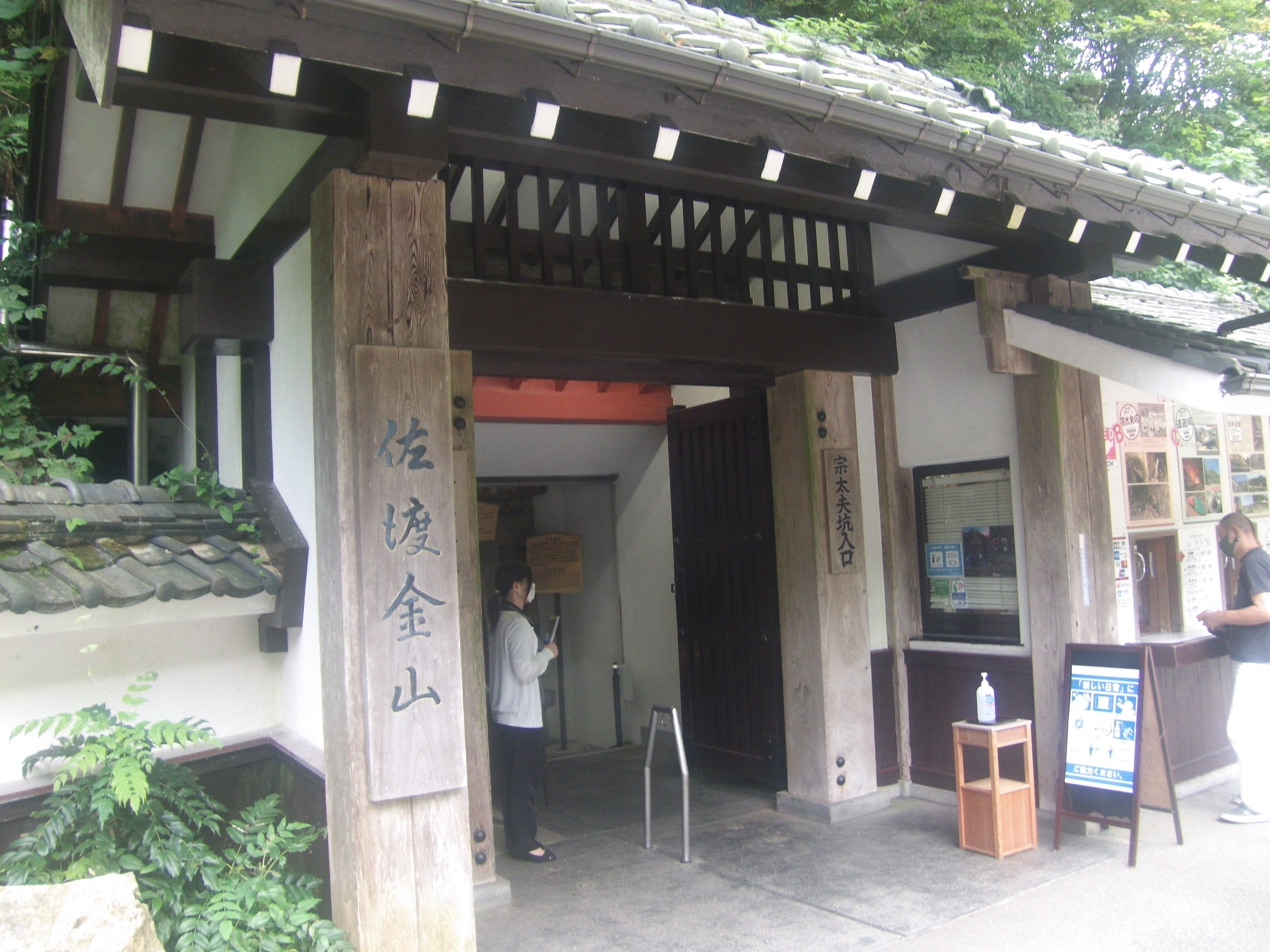
Sado Mine: Four Centuries Underground
Gold sand on Sado Island was already legendary by the eleventh century, when the Konjaku Monogatari -- Tales of Ancient and Modern Japan -- included an anecdote about a journey to Sado Province to collect it. But the real treasure lay deeper. In 1601, miners struck veins of gold and silver in the mountains near Aikawa, and within two years Tokugawa Ieyasu had seized the entire island as direct shogunal territory. What followed was one of the longest continuous mining operations in history: nearly four hundred years of extraction that produced seventy-eight tons of gold and 2,300 tons of silver, financed the Tokugawa shogunate's rise, powered Japan's transition to a modern gold standard, and left behind a network of tunnels, ruins, and unresolved questions that earned UNESCO World Heritage status in 2024.
Warlords and Silver Dust
Long before the Tokugawa era, Sado's mineral wealth shaped the island's politics. During the Sengoku period, competing branches of the Honma clan fought for control over newly discovered deposits -- the Tsurushi Silver Mine found in 1542, the Nishimikawa Gold Mine redeveloped in 1593. The island fractured into warring factions until Uesugi Kagekatsu's military campaign pacified Sado in 1589. Under Uesugi control, large-scale mine development began in earnest, incorporating tunnel-digging techniques imported from Iwami Province. These innovations laid the groundwork for what would come next. When Tokugawa Ieyasu claimed the island after the Battle of Sekigahara, the infrastructure for industrial-scale extraction was already taking shape in the mountains above Aikawa.
The Shogun's Treasury
The Aikawa Mine became the beating financial heart of the Tokugawa shogunate. During the Genna and Kan'ei eras in the early seventeenth century, the mine produced more than four hundred kilograms of gold annually, while ten thousand kan -- roughly 37.5 tons -- of silver flowed to the shogunate each year. The refined metals went to the Kinza and Ginza mints, where they were struck into Keicho gold and silver coins. Sado silver, known as 'Seda silver,' was exported to China and other countries in exchange for raw silk and luxury goods. At its peak, the Sado Mine ranked among the largest gold mines in the world. But the deeper the miners dug, the harder the work became. By the later Edo period, natural springs flooded the tunnels that followed ore veins beneath the seabed. The shogunate supplemented the labor force with convicted criminals and indigents swept from the streets of Edo. A sentence to the Sado mines was a life sentence -- the most dangerous shafts were reserved for those society had discarded.
Western Drills, Rising Output
The Meiji government inherited a declining mine and resolved to reverse the slide. In 1869, Western engineers arrived at Sado, bringing gunpowder mining, rock drills, and pumping machines. By 1877, a modern ore processing plant and Japan's first Western-style vertical shafts, including the Odate shaft, were completed. A mining school was established in 1890, making Sado a cradle of modern Japanese mining education. In 1896, the mine was sold from imperial household assets to Mitsubishi Goshi Kaisha, which electrified the operation and drove mechanization further. By the late Meiji era, annual gold production once again exceeded four hundred kilograms -- matching the output of the mine's seventeenth-century peak. Production continued climbing. By 1940, the mine reached its all-time high: approximately 1,500 kilograms of gold and about twenty-five tons of silver in a single year, driven by wartime demand for gold to finance military procurement.
Contested Memories
In February 1939, as Japan's war in China expanded and Japanese laborers were drafted into the military, the Sado Mine began recruiting workers from the Korean Peninsula, then under Japanese colonial rule. Korean sources document between 1,000 and 2,000 forced laborers working in the mines during the war. Workers sometimes went on strike demanding better treatment, and conditions were harsh enough that some fled the island. The mine's wartime labor history became a diplomatic flashpoint in 2022, when Japan nominated the Sado mines for UNESCO World Heritage status. South Korea objected, citing Japan's failure to properly acknowledge forced labor at the previously listed Hashima Island. Japan's initial application was rejected over concerns about historical presentation. After bilateral negotiations, Japan refiled in January 2023 and on July 27, 2024, the UNESCO committee unanimously approved the listing. Japan agreed to install an exhibit about harsh working conditions and hold an annual memorial, though critics note the exhibits avoid the specific phrase 'forced labor.'
What the Mountain Holds
The Sado gold mine was designated a National Historic Site of Japan in 1994, with protections expanded in 2017. Today, a portion of the Aikawa Mine's vast tunnel network is open to the public as a museum, where mannequins and dioramas recreate centuries of mining life -- from hand-chiseled Edo-period shafts to Meiji-era machine rooms. The ruins of the Kitazawa Flotation Plant, a massive concrete industrial complex from the twentieth century, stand on the hillside above Aikawa like a modernist cathedral slowly returning to the earth. The mine closed in 1989, but its legacy reverberates. The gold coins it produced still appear in museums across Japan. The tunnels still honeycomb the mountain. And the question of how to remember who worked in them -- and under what conditions -- remains unanswered, carried forward into each new memorial ceremony and each contested exhibit panel.
From the Air
The Sado Mine complex is located at 38.04N, 138.26E on the western coast of Sado Island, near the town of Aikawa. From altitude, the ruins of the Kitazawa Flotation Plant are visible as a cluster of large concrete structures on the hillside above the coast. The V-shaped cleft in the mountain created by centuries of open-pit mining at the Doyu no Wareto is a distinctive landmark. Sado Island itself sits approximately 45 km off the Niigata coast in the Sea of Japan. Nearest major airport is Niigata Airport (RJSN) on the mainland. Sado Airport (RJSD) is on the island's southern coast. Best viewed at 3,000-5,000 feet AGL approaching from the sea to see the mine ruins against the mountain backdrop.