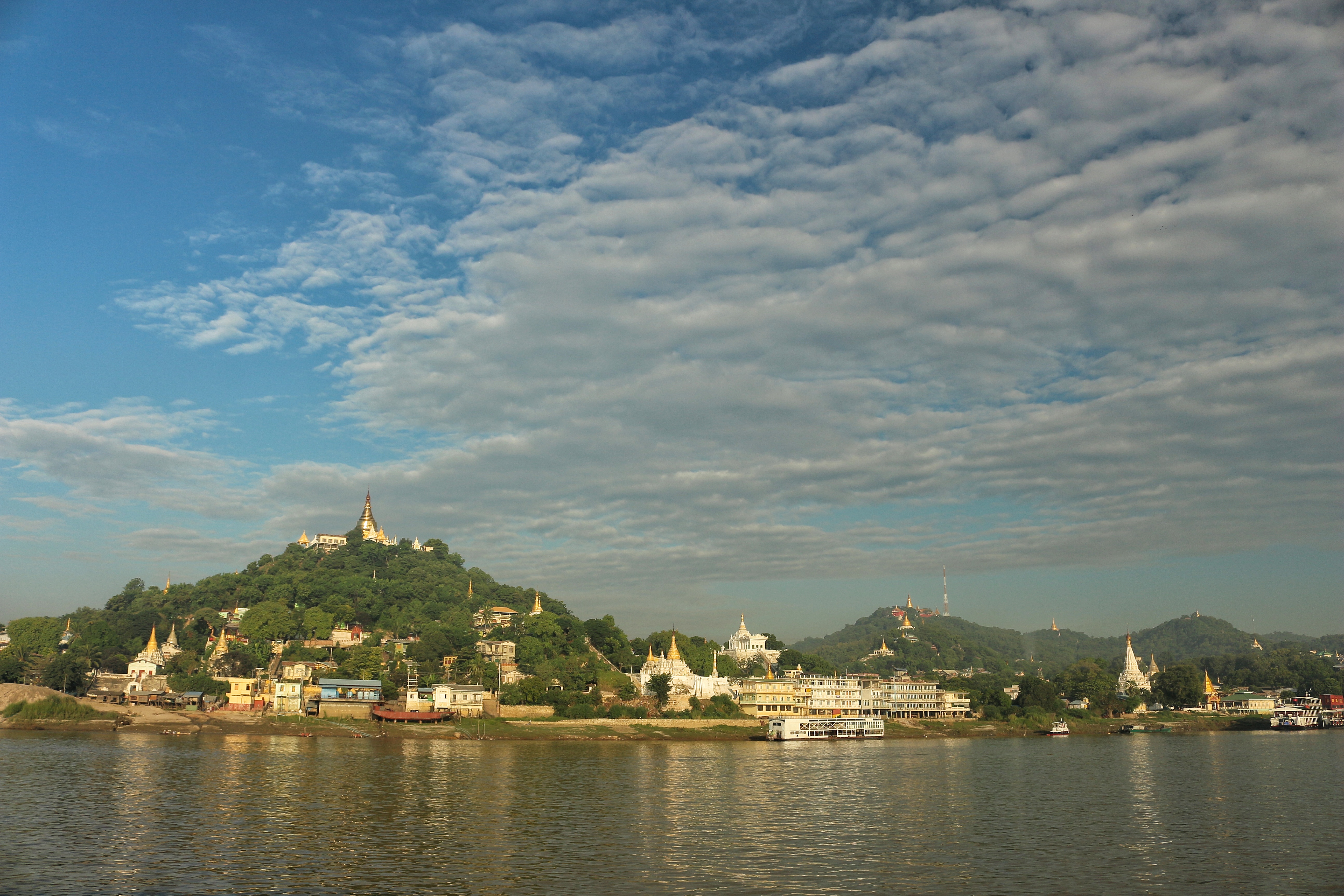
Sagaing
Its classical name is Zeyapura -- "city of victory" -- and from a distance Sagaing looks the part. Hundreds of gilded pagodas and whitewashed monasteries crowd the forested hills along the western bank of the Irrawaddy River, their spires catching the light like scattered coins. Across the water sits Mandalay, linked by the Ava and Yadanabon bridges. But Sagaing has never been content to play second city. It was a royal capital before Mandalay existed, and today it remains one of Myanmar's most important centers of Buddhist monasticism, its hills alive with the low hum of chanting and the rustle of monks' robes.
A Capital Before Mandalay
Sagaing's royal pedigree stretches back to 1315, when Saw Yun, a son of King Thihathu of Pinya, established the Sagaing Kingdom in the power vacuum left by the collapse of the Pagan dynasty. For half a century the kingdom ruled Upper Burma from these hills, until it was absorbed by the Ava Kingdom in 1364. Even then, Sagaing remained a prestigious fief -- the traditional holding of the crown prince or the most senior princes of the Ava court. Centuries later, during the reign of King Naungdawgyi, it briefly reclaimed the title of royal capital between 1760 and 1763. That restless cycle of prominence and eclipse gives Sagaing its character: a place that has tasted power, lost it, and found something more enduring in the contemplative life that took root on its hillsides.
The Monasteries on the Ridge
Walk along the ridge that runs parallel to the river and the density of religious life is staggering. Pagodas stud the hilltops in every direction, their gold and white forms visible for miles. The central landmark is the Soon U Ponya Shin Pagoda, reached by covered staircases that zigzag up the hill, each step worn smooth by generations of bare feet. On the northwestern outskirts stands the Kaunghmudaw Pagoda, a massive dome modeled after the Mahaceti Pagoda in Sri Lanka, its rounded shape unusual among Myanmar's typically bell-shaped stupas. Sagaing draws day-trippers from Mandalay as part of the "three former capitals" circuit -- alongside Amarapura and Innwa -- but for the thousands of monks, nuns, and novices who live here permanently, it is not a tourist stop. It is home, a place where the rhythms of monastic life unfold with the same regularity as the river's flow.
Uprising and Aftermath
On 8 August 1988, Sagaing joined the nationwide 8888 Uprising, a mass pro-democracy movement against decades of military rule. Citizens filled the streets in peaceful protest. The response was devastating: local police forces opened fire, killing around 300 civilians. The massacre left deep scars in a city more commonly associated with meditation than politics. Yet the violence revealed a truth about Sagaing that its serene appearance can obscure -- that its people, like those across Myanmar, have repeatedly risked everything for political change, and that the monasteries perched on these hills have served not only as places of worship but as centers of moral authority in times of crisis.
The Ground Shifts
On 28 March 2025, a 7.7-magnitude earthquake struck with its epicenter beneath the city. The destruction was catastrophic. An estimated ninety percent of structures were destroyed, and the Ava Bridge -- one of the two vital links to Mandalay -- partially collapsed. More than 100 bodies were recovered from the rubble. Four of Sagaing's five mosques collapsed, killing an estimated 150 Muslim worshippers; the Min Street Mosque is feared to have fallen with over 100 people still inside. Monastic schools and a nunnery were heavily damaged, trapping over 900 monks across four institutions. Even the city's fire station collapsed, crippling the very infrastructure needed for rescue. The earthquake laid bare how fragile these ancient hills could be, and how much the city still had to lose.
What Endures
Sagaing has a population of roughly 84,000 people within the city limits, part of the broader Mandalay metropolitan area of over a million. It is home to five universities, including the Sagaing Institute of Education and Sagaing Technological University. Its historical residents read like an unlikely guest list: Sithu Kyawhtin, a sixteenth-century king of Ava; Zhu Youlang, the last Ming dynasty claimant to the Chinese throne, who lived in exile here in 1661; Maurice Collis, the British author and district commissioner of the 1920s; and Tom Mitford, brother of the famous Mitford Sisters, who was killed here while serving with the Devonshire Regiment in 1945. Through centuries of royal intrigue, colonial rule, pro-democracy struggle, and natural disaster, Sagaing has kept rebuilding -- and kept chanting.
From the Air
Sagaing sits at 21.88N, 95.98E on the western bank of the Irrawaddy River, directly southwest of Mandalay. From the air, look for the distinctive ridge of hills studded with white and gold pagodas running parallel to the river, with the Ava and Yadanabon bridges connecting to Mandalay visible as twin river crossings. The nearest major airport is Mandalay International (ICAO: VYMD), approximately 35 km to the south. Best viewed at 3,000-5,000 feet for detail on the pagoda-covered hills.