Sagami Kokubun-ji: The Temple That Refused to Stay Dead
Nobody can agree on why this temple is here. In 741 AD, Emperor Shomu ordered a monastery and nunnery built in every province of Japan, part spiritual shield against a devastating smallpox epidemic, part administrative power play to extend Nara-period authority into the provinces. The Sagami Kokubun-ji should have been planted near the provincial capital at Kozu, like every other kokubunji in the country. Instead it appeared in Ebina, deep in Koza District, far from the seat of government. Over the following thirteen centuries, the temple has burned in 819, been shaken apart by an earthquake in 878, vanished from all records for decades at a stretch, been rebuilt by a shogun's hand, shrunk to a single chapel on a hilltop, and burned again in 1910. The current buildings date from 1994. The eighth-century roof tiles, however, are still here -- and they are the reason archaeologists keep digging.
An Emperor's Spiritual Shield
The smallpox epidemic that swept Japan between 735 and 737 killed roughly a third of the population and devastated the ruling class. Emperor Shomu's response was monumental: the Shoku Nihongi records his 741 decree that a monastery and nunnery be established in every province, built to a semi-standardized template modeled on major capital temples. These kokubunji served a dual purpose -- spreading Buddhist orthodoxy into the provinces while physically demonstrating the reach of centralized power under the Ritsuryo system. In Sagami Province, the resulting temple complex was enormous: the original grounds stretched 240 meters east to west and 300 meters north to south, enclosed by moats and an earthen rampart. Inside the cloister stood a Kondo on the east side, a seven-story pagoda on the west, and a Lecture Hall connected to the central gate by a rectangular corridor. Monks' residences and administrative buildings lined the northern edge. This was not a place of quiet contemplation. It was a statement of imperial will.
The Mystery of the Wrong Location
The puzzle that still occupies researchers is distance. The provincial capital of Sagami sat at Kozu, but the Kokubun-ji ended up in Ebina, far enough away to raise eyebrows across the centuries. One theory held that this was an existing temple, its layout patterned after Horyu-ji, that was simply converted into the provincial monastery. Archaeology disproved that. Another theory pointed to the Chiyo temple ruins near Odawara as the original kokubunji, later relocated. But the roof tiles excavated from the Ebina site date squarely from the middle of the eighth century, matching Emperor Shomu's construction timeline. A third theory flips the question: perhaps the temple was not in the wrong place -- perhaps the provincial capital once sat nearby and was later moved to Kozu. The Sagami ichinomiya shrine also stands in Koza District, lending weight to this idea. A final theory involves the Mibu clan, major temple builders across the Kanto region, whose base was in Koza. They may have simply built the temple on their home ground. The exact location of the Sagami provincial capital has never been positively identified, so the argument continues.
Fire, Earthquake, and Vanishing Acts
The Ruiju Kokushi records the temple's destruction by fire in 819. Fifty-nine years later, the great earthquake of 878 shattered what had been rebuilt. The Nihon Sandai Jitsuroku says reconstruction happened in 881, but archaeology tells a different story -- there is no evidence the original site was rebuilt after the quake. The temple may have relocated to the Uenodai hill on the southeast side, where another set of ruins awaits excavation. The name Sagami Kokubun-ji resurfaces in 1008 in an inventory by the governor of Sagami Province, Taira no Takayoshi. In 1139, Emperor Sutoku designated it a chokugan-ji, a temple authorized to pray for the nation's welfare. Then in 1186, Minamoto no Yoritomo, the first Kamakura shogun, rebuilt it. In 1192, Hojo Masako donated horses to pray for safe childbirth. After the Kamakura period, the temple vanished from the historical record again, and by the Edo period it had dwindled to a single Yakushi-do chapel perched on the Uenodai hilltop.
The Companion Nunnery and the Lost Canal
Beside the monastery stood its companion nunnery, the Sagami Kokubun-niji, built slightly later in the fourth quarter of the eighth century. The two temples were connected by a canal whose remnants lay hidden underground until 1949, when workers stumbled upon it. Full excavation did not happen until 1990. The nunnery had its own turbulent history: records say it was moved to a temple called Kankawa-ji in 873, then returned to its original location in 881 after the 878 earthquake. Archaeology confirms the sequence -- a tiled building on the original foundation burned, and a simpler structure with a thatched roof and wooden pillars replaced it. There is also evidence the nunnery may have moved back to Kankawa-ji again shortly after 881. The location of Kankawa-ji itself remains unknown. Two temples, a canal, a nunnery relocated at least twice, and a site so complex that each dig raises more questions than it answers.
What Remains
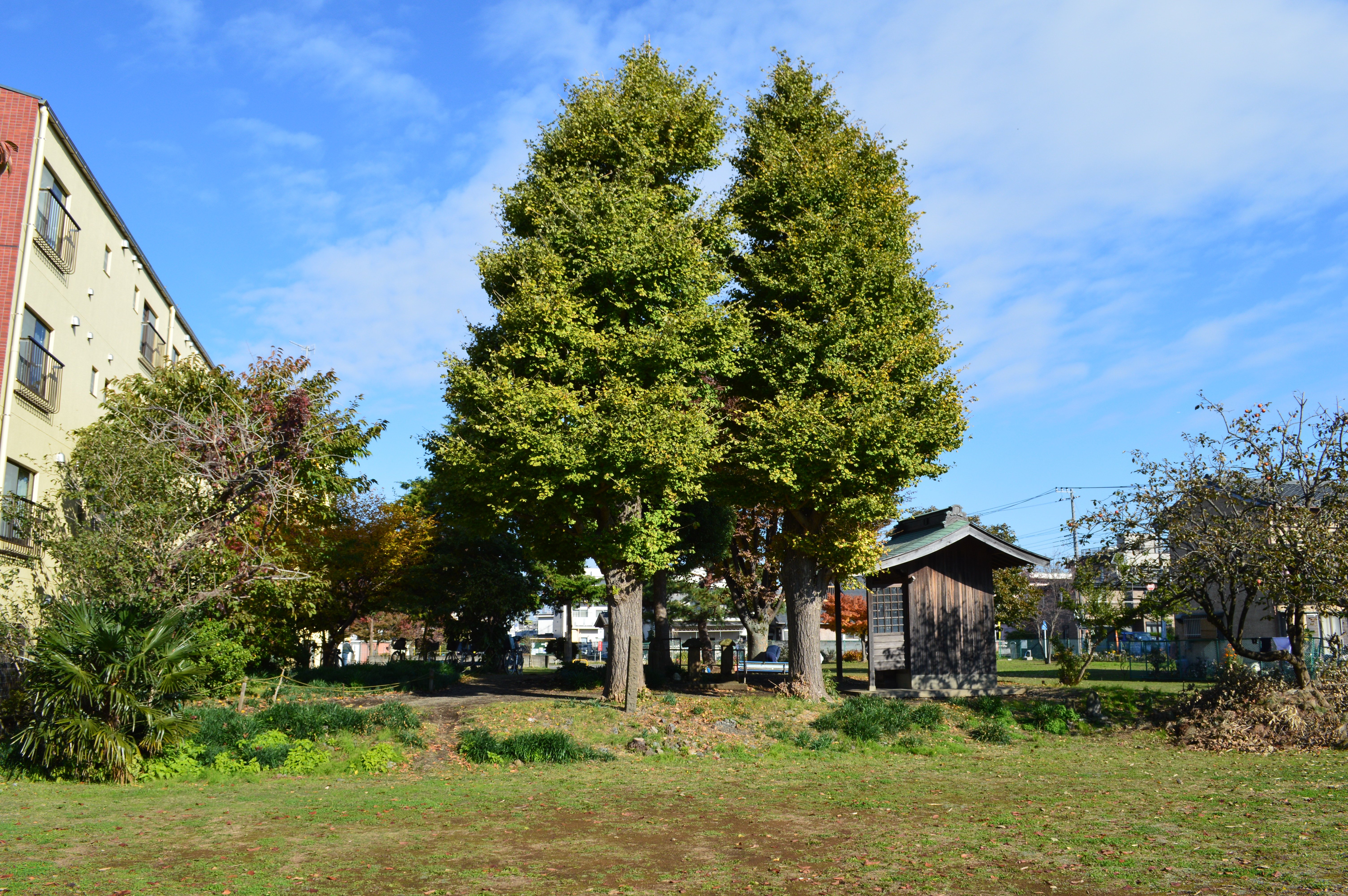
The current Sagami Kokubun-ji sits about 100 meters southeast of the original ruins, belonging to the Koyasan Shingon-shu sect with a statue of Yakushi Nyorai -- the Medicine Buddha -- as its honzon. The 1713 chapel that replaced the Edo-period ruin burned in 1910, was rebuilt that same year, rebuilt again in 1974, and once more in 1994. The temple grounds are designated a National Historic Site, and the Kamakura-period bonsho -- a temple bell dating to 1292, inscribed with the date of the sixth day of October in the fifth year of Shoo -- is classified as an Important Cultural Property. The ruins of the original complex lie in an open field to the northwest, marked and mapped but still yielding surprises every time a shovel goes into the earth. Thirteen centuries of burning, shaking, vanishing, and rebuilding have not erased the footprint Emperor Shomu ordered into this landscape.
From the Air
Located at 35.454°N, 139.398°E in the city of Ebina, Kanagawa Prefecture, on the Sagami Plain southwest of Tokyo. From altitude, the temple grounds sit in the flat agricultural and suburban terrain between the Sagami River to the west and the low hills to the east. The ruins of the original complex are visible as an open field northwest of the current temple buildings. Best viewed at 2,000-3,000 feet AGL. Atsugi Naval Air Facility (RJTA) is approximately 5 nautical miles to the north. Tokyo Haneda (RJTT) lies about 25 nautical miles northeast.