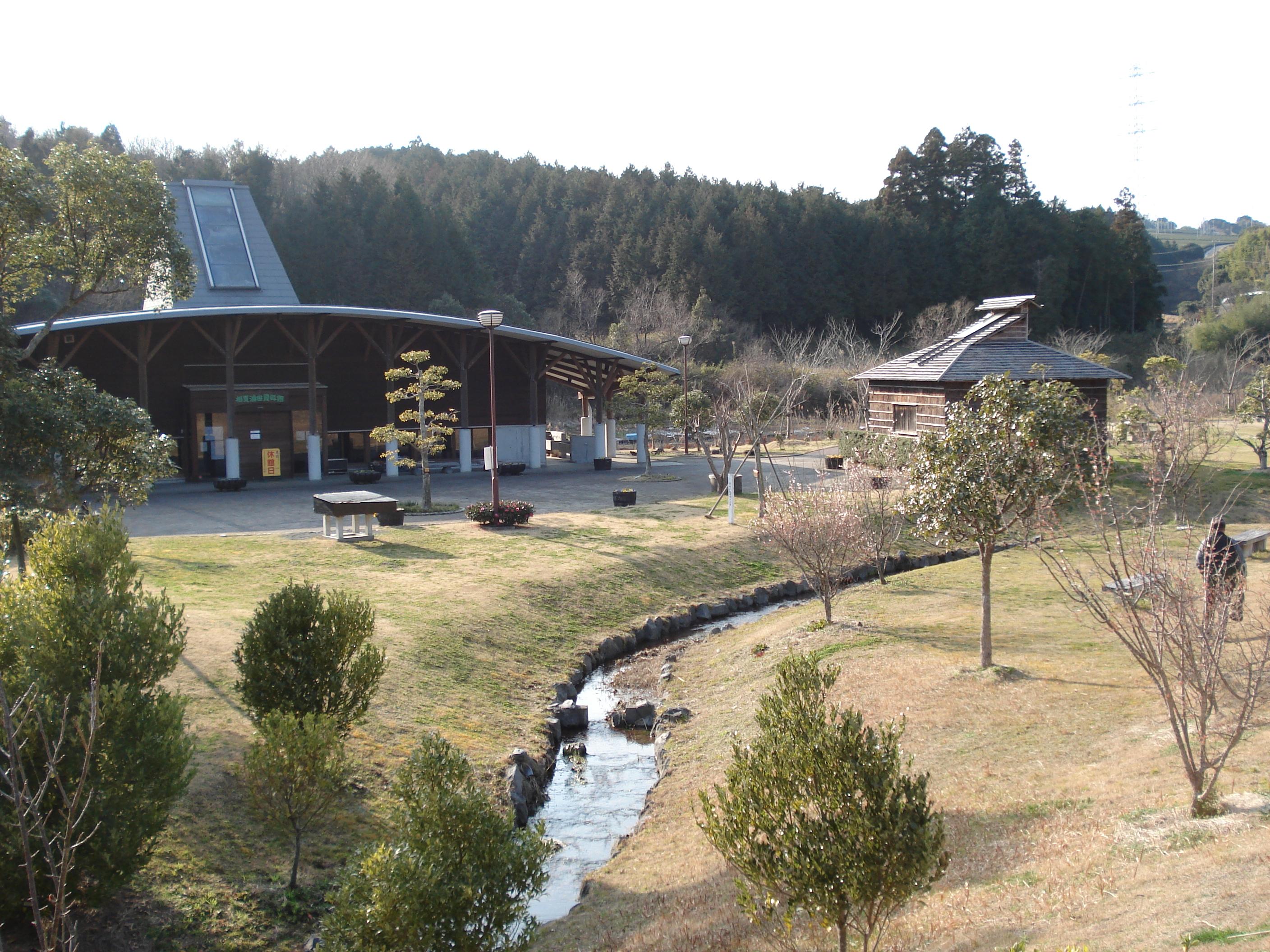
Sagara Oil Field
The crude oil that seeped from the ground near Sagara Village in May 1873 had an unusual quality: it was so light and pure that it could power an automobile engine without a drop of refining. This was no ordinary petroleum deposit. Tucked into the hills of what is now Makinohara in Shizuoka Prefecture, the Sagara Oil Field became the only producing oil field on Japan's entire Pacific coastline and the first in the country to employ mechanical pumping equipment. For eight decades, this improbable little operation pulled fuel from the earth just a few kilometers from the sea, helping to launch Japan's petroleum industry before cheap imports rendered it obsolete.
Black Gold on the Pacific Shore
When villagers first noticed crude oil oozing from the hillside at Sagara in 1873, Japan was barely six years into the Meiji Restoration and still transforming from a feudal society into an industrializing nation. Hand-pumping operations began almost immediately. By 1874, Nippon Oil -- the company that would eventually evolve into the modern energy giant ENEOS -- arrived to introduce mechanical pumping, making Sagara the first oil field in Japan to use pumpjack equipment. The operation expanded rapidly through the 1870s and into the 1880s. At its peak in 1884, some 600 workers were employed at the field, which produced 43,000 barrels of oil -- approximately 721 kiloliters -- per year. For a small coastal village, this was a bonanza that brought workers, infrastructure, and national attention.
Oil Without Refining
What made Sagara's crude remarkable was its chemistry. The petroleum here was exceptionally light, with properties so clean that it could be used directly as automobile fuel without the distillation and cracking processes that most crude oil requires. This purity was a geological gift, a product of the particular subsurface conditions along this stretch of the Pacific coast. Researchers from the journal Island Arc later studied the origins of hydrocarbons in the Sagara field, tracing them through the complex geology of central Japan. The oil's quality meant that even as production volumes remained modest by global standards, the output punched above its weight in practical value. Every barrel that came out of the ground was essentially ready to use.
The Quiet Decline
By the early twentieth century, Japan's appetite for energy had grown far beyond what domestic fields could supply. The Sagara operation continued pumping through both world wars, but the economics shifted decisively after 1945. Cheap imported oil from the Middle East and Southeast Asia flooded the Japanese market, and small domestic producers could not compete on price. In 1955, after more than eight decades of continuous operation, the pumps at Sagara fell silent for good. The wells that had once drawn 600 workers to this coastal hillside were capped, and the machinery stood idle amid the encroaching green of the Shizuoka countryside.
From Oil Field to Park
The story could have ended there, with the wells rusting into obscurity. Instead, on November 28, 1980, the Shizuoka Prefectural government proclaimed the Sagara Oil Field a natural monument and protected cultural property. The site was transformed into the Yuden-no-Sato Park, a public green space that preserves the old well structures and pumping equipment alongside lawns, athletic fields, and picnic areas. A small museum on the grounds tells the story of Japan's petroleum origins, displaying original equipment and explaining the geology that produced such unusually pure crude oil. The park is free to enter and open year-round except Tuesdays and New Year holidays. Where hundreds of oil workers once labored, families now spread picnic blankets on grass that grows over the capped wellheads.
From the Air
Located at 34.70°N, 138.16°E in the hills above Makinohara, a few kilometers inland from the Pacific coast. The park grounds and surrounding green space are visible from low altitude among the tea plantations of the Makinohara Plateau. The nearest major airport is Mt. Fuji Shizuoka Airport (RJNS), approximately 10 km to the north-northeast -- the oil field site is actually very close to the airport. Hamamatsu Air Base (RJNH) lies about 55 km to the west. Best viewed at 2,000-3,000 feet, where the park clearing stands out against the surrounding agricultural landscape. The Pacific coastline to the south and the broad Makinohara tea plateau provide helpful visual orientation.