Sagastad
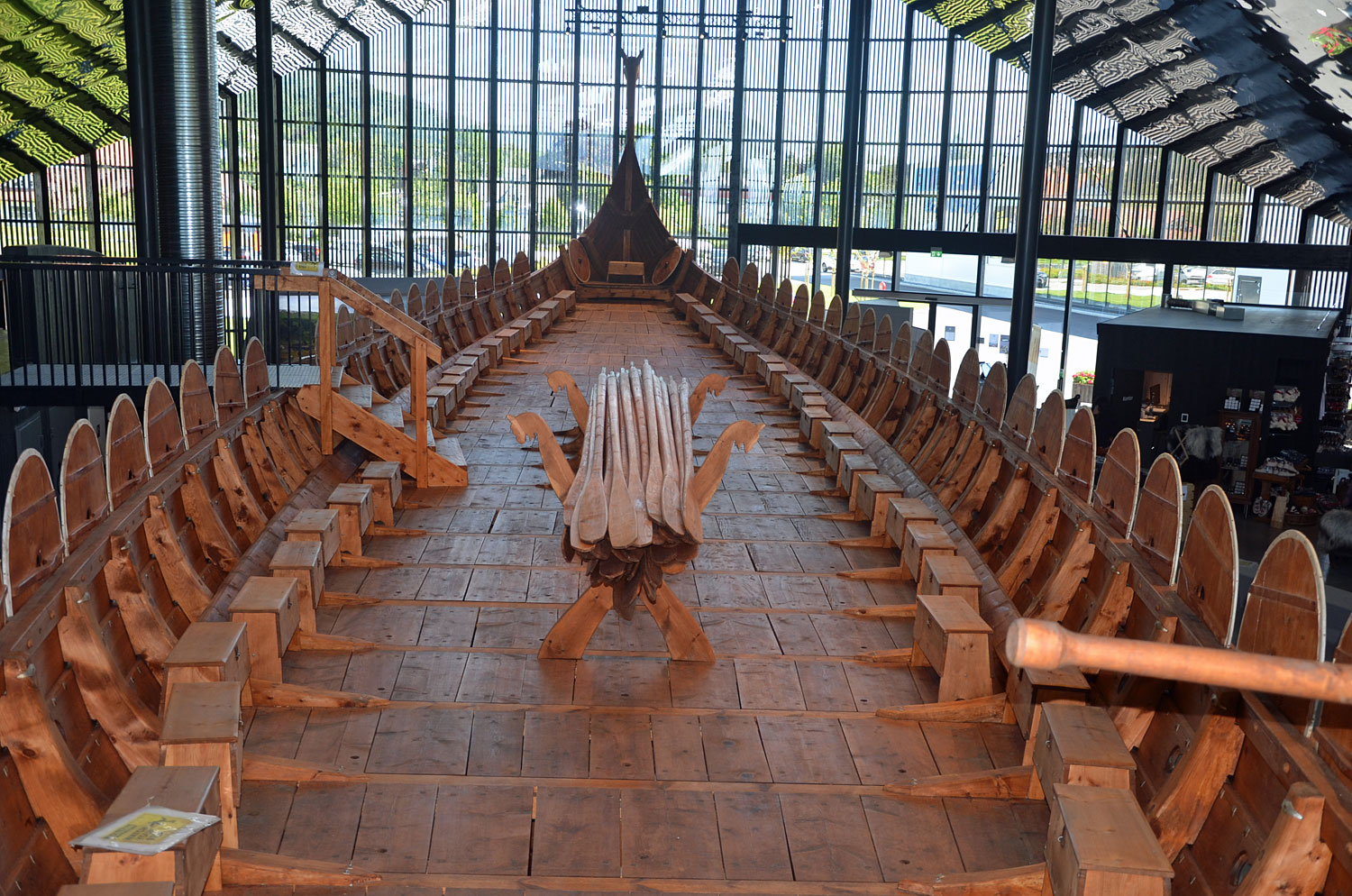
The ship is 30 meters long, and you can walk its full length. That alone would make Sagastad Viking Center remarkable, but the deeper surprise is what the ship represents: a reconstruction built not from preserved timbers but from absence. The Myklebust ship was cremated during a Viking burial ritual around the year 870, leaving behind only ash, rivets, and nail lengths that hinted at its enormous scale. From those fragments, shipbuilders recreated what is believed to be the largest Viking vessel ever discovered in Norway. Sagastad, which opened in 2019 in the town of Nordfjordeid on Norway's western coast, exists to tell that story, and to let visitors stand on the deck of a ship that was never meant to survive.
Rebuilding from Fire
The Myklebust ship was found in 1874 by Anders Lorange, the first archaeologist at the University of Bergen, inside a burial mound on the Myklebust farm. Because the ship had been burned as part of the funeral, it existed only as a massive coal layer and roughly 750 iron rivets. The nail lengths indicated a vessel larger than both the Gokstad ship, found in 1880, and the Oseberg ship, excavated in 1904, though those ships survive intact and the Myklebust does not. The reconstruction at Sagastad was built using historical shipbuilding techniques informed by the archaeological evidence, and the result dominates the center's interior. Visitors board from a ramp and walk the full deck. At the rear of the building, large doors open onto a slipway that descends to the fjord, and on special occasions the ship is launched onto the Eidsfjord.
The King Who May Rest Nearby
Sagastad's exhibition claims that the man buried with the Myklebust ship was King Audbjorn of Firda, a ruler mentioned in Snorri Sturluson's saga of Harald Fairhair. Audbjorn reportedly died at the battle of Solskjel in 870, and the artifacts from the burial mound date to the late ninth century. Nordfjordeid was the center of power in the old kingdom of Firda during this period. The grave goods found by Lorange, including 44 shield bosses, swords, spears, and an enamelled bronze vessel containing the cremated remains of a man between 30 and 35, rank among the richest ever recovered in Norway. The exhibition walks visitors through this evidence, connecting the ship's scale to the status of its owner and the rituals that accompanied a chieftain's death.
Where Fjord Meets Museum
The Sagastad building sits on the shore of Nordfjordeid's town center, next to the Sagapark, roughly 250 meters from the Myklebust burial mound itself. Cruise tourists disembark at a port 1.1 kilometers away and can reach the center by foot or by zero-emission electric bus. The closest airport is Sandane Airport, Anda. Inside, beyond the ship, the center divides its interactive exhibition into three sections: Nordfjordeid in the Viking Age, the findings of the Myklebust excavation, and the construction methods behind longships. Research backing the exhibition comes through collaboration with the University of Bergen, grounding the displays in archaeological evidence rather than saga romance.
Stepping Into the Ninth Century
Since 2020, Sagastad has offered a virtual reality experience that drops visitors into a three-dimensional recreation of Nordfjordeid as it appeared during the ninth century. Guests teleport through a Viking village, examine artifacts, and test their archery. Audio guides are available in French, Mandarin, Spanish, and German. The center also serves as a cultural venue, hosting concerts and events beyond its museum function. When it opened in 2019, the Minister of Research and Higher Education, Iselin Nybo, presided over the ceremony, while the Minister of Culture, Trine Skei Grande, christened the reconstructed ship on the Eidsfjord. For a town of modest size, Sagastad has become the most visited attraction in the area and, by one measure, the most followed attraction in Norway on Instagram. Its appeal is straightforward: it gives tangible form to something that fire tried to erase.
From the Air
Located at 61.91N, 5.98E in Nordfjordeid, at the head of the Eidsfjord in western Norway. The Sagastad building is visible on the town's waterfront, identifiable by its modern architecture and fjord-side slipway. Best viewed below 3,000 ft. Nearest airport: ENSD (Sandane Airport, Anda, approximately 15 nm northeast). Terrain includes steep fjord walls and variable winds. In clear weather, the town center and waterfront complex are easily spotted from above.