Sagrada Familia
Construction began on March 19, 1882, and the building is still not finished. That single fact tells you almost everything you need to know about the Sagrada Familia -- a basilica so ambitious in its engineering, so radical in its geometry, and so dependent on the patience of generations that it has outlived its architect by a century. Antoni Gaudi took over the project in 1883 at age thirty-one and spent the last twelve years of his life working on it exclusively, sleeping in his workshop on site. On June 7, 1926, he was struck by a tram and died three days later, on June 10. The church he left behind was barely a quarter complete.
A Cathedral Grown from Nature
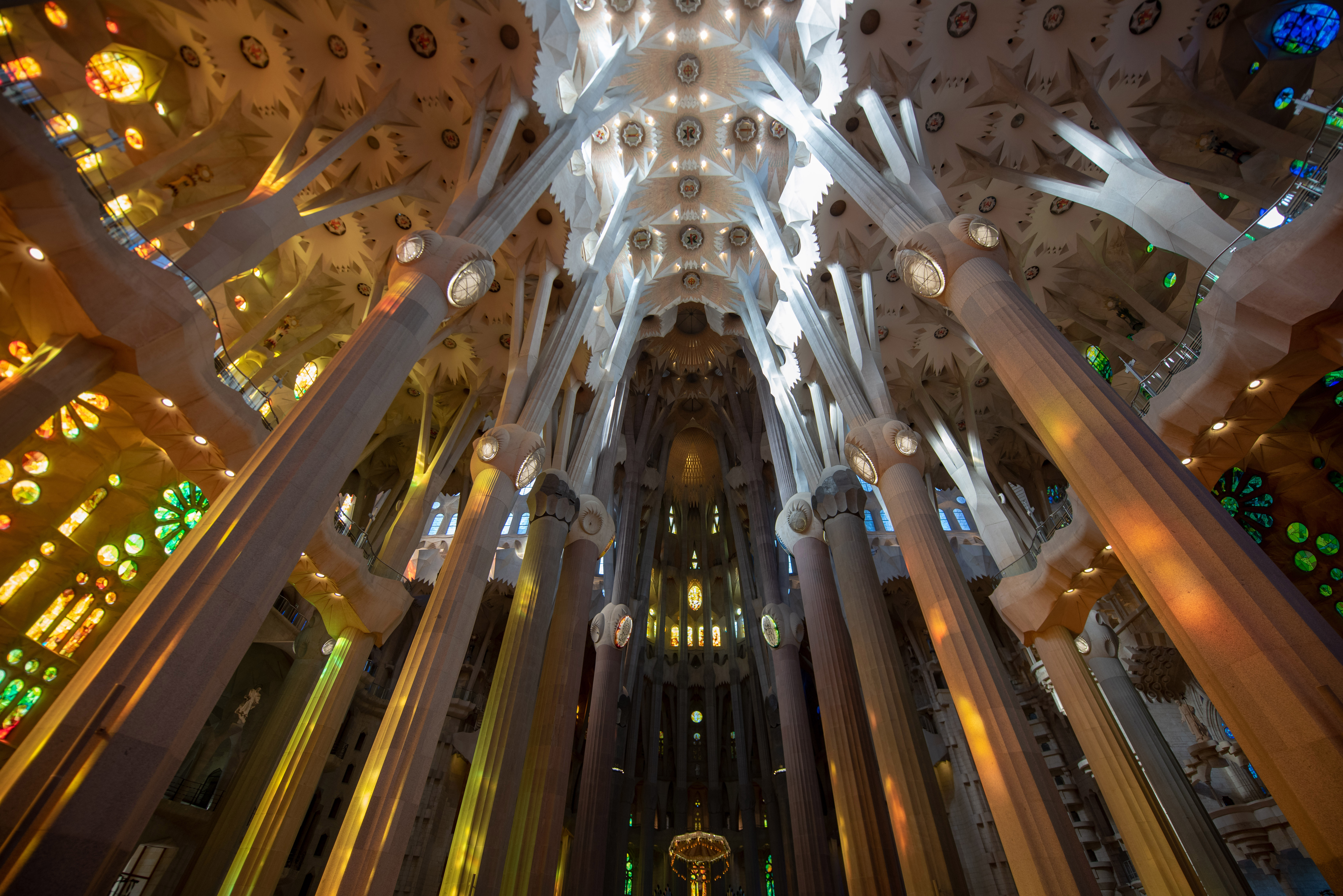
Gaudi's design for the Sagrada Familia draws not from classical or Gothic precedent but from the geometry of the natural world. The interior columns branch like trees, splitting at calculated angles to distribute the weight of the vaults above. Hyperboloid and paraboloid surfaces replace the pointed arches and flying buttresses of traditional cathedrals -- Gaudi considered Gothic structure 'imperfect' because it required external supports. His solution was a system of inclined columns and ruled surfaces that channel forces directly to the ground, making buttresses unnecessary. The effect inside is of standing in a stone forest, with light filtering through stained glass by Joan Vila-Grau in shifting colors that move from cool blues and greens on the northeast Nativity facade to warm reds and oranges on the southwest Passion facade. Art critic Rainer Zerbst called it 'the most extraordinary personal interpretation of Gothic architecture since the Middle Ages.'
Three Facades, Three Stories
The basilica tells its narrative through three monumental facades. The Nativity facade, the only one substantially completed during Gaudi's lifetime, faces northeast and catches the morning sun -- deliberately, since it depicts the birth and early life of Christ. Its surfaces erupt with naturalistic sculpture: turtles support columns, stone icicles drip from archways, and a cypress tree crowned with doves rises above the central portal. The Passion facade, facing southwest into the afternoon light, is starkly different. Begun in 1954 based on Gaudi's designs but executed by sculptor Josep Maria Subirachs, it uses angular, stripped-down forms to convey suffering and sacrifice. The Glory facade, still under construction, will be the largest and most complex, facing south toward the Mediterranean, with a monumental stairway and a colonnade representing the path from death through judgment to glory.
Towers That Reach and a Spire That Waits
When complete, the Sagrada Familia will have eighteen towers. Twelve represent the Apostles, four the Evangelists, one the Virgin Mary, and the tallest -- the Tower of Jesus Christ -- will rise 172.5 meters, deliberately one meter shorter than Montjuic hill because Gaudi believed human creation should not surpass God's. Eight of the Apostle towers now stand, four on each of the completed facades, their parabolic profiles tapering to mosaic-encrusted pinnacles. The Evangelist towers and the Mary tower are in various stages of completion. Gaudi knew he would never see the building finished. 'My client is not in a hurry,' he reportedly said, referring to God.
A Century of Interrupted Construction
After Gaudi's death, work continued slowly under a succession of architects. The Spanish Civil War brought destruction along with delay: in 1936, anarchists broke into Gaudi's workshop and destroyed his original models, drawings, and plaster casts. Architect Francesc de Paula Quintana painstakingly reconstructed what he could from fragments, published plans, and photographs, and construction resumed with intermittent progress in the 1950s. The project accelerated dramatically with computer-aided design and CNC stone-cutting technology, which could interpret Gaudi's complex ruled surfaces far more efficiently than hand methods. Construction passed the midpoint in 2010. Pope Benedict XVI consecrated the building as a basilica on November 7, 2010. On February 20, 2026 -- the centenary year of Gaudi's death -- the cross was installed atop the Tower of Jesus Christ, bringing the basilica to its full height of 172.5 meters and completing its exterior structure. Interior work and decorative details are expected to continue into the 2030s.
The Architect's Tomb
Gaudi is buried in the crypt chapel, directly beneath the nave he spent forty-three years designing. The crypt, completed before Gaudi took charge, is the work of the original architect Francisco de Paula del Villar and is the most conventionally Gothic part of the building. Gaudi's tomb sits among those of other notable Barcelonans, but his is the one visitors seek out. The UNESCO World Heritage designation, added in 2005 to the existing 'Works of Antoni Gaudi' listing from 1984, recognizes the Sagrada Familia as an exceptional creative achievement -- a building that, even unfinished, changed the possibilities of what architecture could be.
From the Air
Located at 41.404N, 2.174E in Barcelona's Eixample district. The Sagrada Familia is unmistakable from the air: its cluster of tall, organic-shaped towers rises dramatically above the uniform grid of the Eixample blocks. The building is the tallest structure in central Barcelona and is visible from considerable distance. Nearest airport is Barcelona-El Prat (LEBL), 14 km southwest. Best viewed at 3,000-5,000 feet AGL from any direction, though approaching from the southeast provides a view of all three facades and the full tower cluster against the backdrop of Tibidabo mountain.