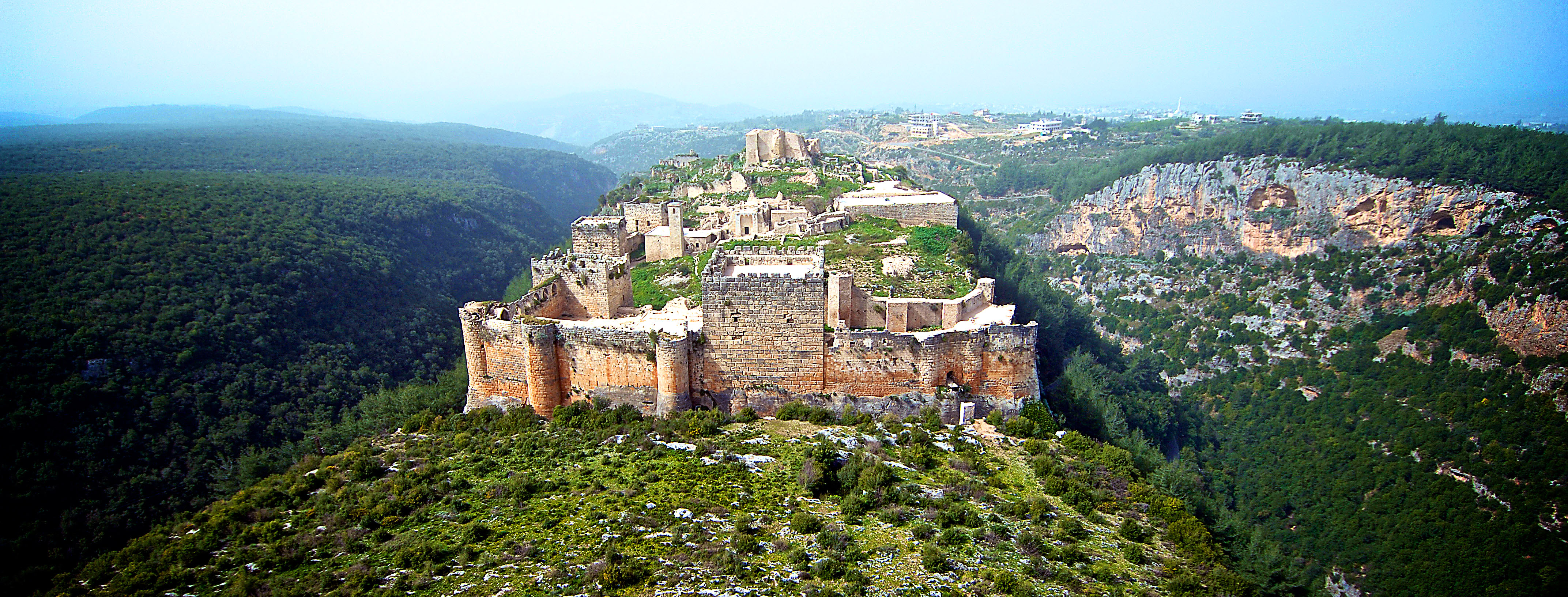
Sahyun Castle
T. E. Lawrence -- the man who would become Lawrence of Arabia -- was not easily impressed by castles. He had spent years studying Crusader fortifications across the Levant for his Oxford thesis, cataloging keeps and curtain walls with a scholar's detached eye. But when he reached the ridge above Al-Haffah in northwestern Syria and saw what the Byzantines, Crusaders, and Muslims had built there over the centuries, his composure broke. He called Sahyun "the most sensational thing in castle building I have ever seen."
A Fortress Born of Geography
Sahyun Castle sits on a narrow ridge roughly 700 meters long, flanked by two plunging gorges that drop into forested ravines. The site lies 7 kilometers east of Al-Haffah and 30 kilometers east of the Mediterranean port of Latakia, high in the coastal mountains of Syria. Nature did most of the defensive work -- approach from the south, east, or west means climbing steep slopes through dense forest. The only vulnerable point is the eastern end, where the ridge connects to a plateau. Here, builders carved a monumental ditch: 156 meters long, 14 to 20 meters wide, cut straight through bedrock. Rising from the bottom of this ditch stands a single stone needle, 28 meters tall, left in place to support a drawbridge that once connected the castle to the outside world. That lonely pillar, still standing after nine centuries, remains the castle's most iconic feature.
Three Empires, One Ridge
The site has been fortified since at least the mid-tenth century, when the Byzantines knew it as Sigon. Emperor John I Tzimiskes captured it in 975 from its Hamdanid ruler, and Byzantine control lasted until around 1108. The Franks -- Crusaders who had carved out the Principality of Antioch after the First Crusade -- then took possession and renamed it Saone. The lords of Sahyun became among the most powerful nobles in the principality. Their building program gave the castle much of its present form: a massive keep with walls five meters thick, flanking towers studded along curtain walls, cisterns for water storage, stables, and a church adjoining Byzantine chapels that predated the Crusader occupation. Walking through the castle today means passing through centuries of construction layered one atop another.
Saladin's Three-Day Siege
In 1188, one year after his decisive victory at the Battle of Hattin, Saladin turned his attention to the Crusader strongholds of northern Syria. Sahyun fell after a siege of just three days -- remarkably brief for a fortress of its size and position, suggesting that the garrison was undermanned or the defenders' morale had already collapsed. Saladin granted the castle and nearby Bourzey to one of his emirs, Mankawar ibn Khumartigin. Under Muslim control, Sahyun gained new architectural layers: a mosque dating to the reign of Sultan Qalawun, a palace with baths featuring courtyards and iwans. The castle was besieged once more in 1287, this time in a conflict between rival Mamluk factions -- a reminder that possession of this ridge remained worth fighting over centuries after the Crusaders had gone.
Survival Against the Odds
In 2006, UNESCO recognized Sahyun Castle alongside Krak des Chevaliers as a World Heritage Site, honoring both fortresses as outstanding examples of the exchange of influences between Crusader and Islamic military architecture. When the Syrian Civil War erupted in 2011, UNESCO voiced urgent concerns about damage to cultural sites. Sahyun survived the conflict without significant harm -- a stroke of luck in a war that devastated much of Syria's heritage. Then came the February 2023 earthquake that struck Turkey and Syria, destroying one of the castle's fortified towers. The damage was a reminder that the forces threatening Sahyun are not limited to human conflict. Earthquakes, erosion, and the slow work of weather continue to reshape a site that has been continuously tested for more than a thousand years.
Reading the Stones
What makes Sahyun exceptional is not any single period of construction but the visible conversation between builders separated by centuries. Byzantine foundations support Crusader walls; Islamic arches open beside Christian chapels. The keep's five-meter-thick walls speak to Crusader anxiety about siege warfare, while the elegant palace baths added later reflect a confidence that the fortress had become a place of governance rather than last resort. At the center stands the Byzantine citadel, the oldest surviving structure, around which everything else was built and rebuilt. For Lawrence, the appeal was visceral -- the sheer drama of the setting, the ditch, the needle. For archaeologists, the value lies in having so many layers of Levantine military architecture preserved in a single, relatively intact site, each era's builders responding to the same strategic problem posed by the same narrow ridge.
From the Air
Located at 35.60N, 36.06E in the coastal mountains of northwestern Syria, approximately 30 km east of Latakia. The castle is visible from altitude as a long fortification on a narrow mountain ridge between two deep ravines, surrounded by dense forest. Nearest major airport is Bassel Al-Assad International Airport (OSLK) in Latakia, approximately 30 km to the west. The Mediterranean coastline is clearly visible to the west. The castle ridge runs roughly north-south, with the distinctive rock-cut ditch visible at the eastern end.