Sai-ji: The West Temple That Lost the Centuries
Kyoto was designed with perfect symmetry. When Emperor Kanmu moved Japan's capital from Nara to Heian-kyo in 794, he ordered two identical Buddhist temples built on either side of the grand Suzaku Avenue -- one to the east, one to the west -- just north of the great Rashomon gate at the city's southern entrance. Both were charged with praying for the protection of the nation and the imperial family. Both occupied square compounds roughly 300 meters on each side. Today, the eastern temple, To-ji, still stands, its five-story pagoda the tallest wooden tower in Japan and a UNESCO World Heritage landmark. The western temple, Sai-ji, is a public park with an explanatory placard. The divergence of these twin guardians is one of Kyoto's most revealing stories about how cities forget.
The Emperor's Firewall Against Buddhist Power
Emperor Kanmu had a specific reason for restricting all of Heian-kyo to just three Buddhist institutions: Sai-ji in the west, To-ji in the east, and Shingon-in within the imperial palace itself. During the preceding Nara period, Buddhist monasteries had accumulated enormous political influence, with powerful abbots routinely manipulating court affairs. Kanmu's new capital was, in part, an escape from that entanglement. By limiting temples to carefully controlled pairs flanking the ceremonial avenue, he kept religion visible but contained. Both Sai-ji and To-ji were state-supervised institutions, funded by the court and tasked with official prayers rather than independent theological ambitions. The system worked -- for a time. But in 823, Emperor Saga shattered the balance by granting To-ji to Kukai, the charismatic founder of Shingon Buddhism, giving it a powerful patron and a distinct sectarian identity that Sai-ji would never acquire.
A Rivalry Settled by Rain
When To-ji was bestowed upon Kukai in 823, Sai-ji was given to Shubin, a monk of the Sanron and Hosso sects and Kukai's fierce theological rival. The competition between the two men became the stuff of legend. According to tradition, a severe drought struck Kyoto in 824, and the imperial court summoned both monks to perform rain-making ceremonies at the Shinsenen imperial garden. Kukai succeeded; Shubin did not. The humiliation was so complete that Shubin, the story goes, shot an arrow at Kukai in a rage. Whether or not the tale is literally true, its survival in the historical record tells us something real: Sai-ji was losing the institutional contest from the start. Kukai's Shingon Buddhism attracted followers, wealth, and imperial favor. Sai-ji's sectarian identity remained diffuse, its patronage uncertain. The lecture hall was completed in 832, and the government office regulating Buddhist clergy was relocated to Sai-ji by 864, but these administrative functions could not substitute for the devoted following that Kukai had built at To-ji.
Death by Drainage
The reason Sai-ji disappeared while To-ji survived is, in the end, partly geographical. Western Kyoto suffered from poor drainage. As the centuries passed, flooding and marshy conditions made the area increasingly inhospitable. The western half of Heian-kyo was gradually abandoned during the late Heian period, its residents migrating eastward toward higher, drier ground. Sai-ji, stranded in a depopulating district without reliable imperial patronage, declined steadily. Fire struck in 990, but the temple was rebuilt. The warrior-monk Mongaku restored the pagoda during the 1190s, with the scholar Myoe supervising the work. That pagoda burned again in 1233 and was never rebuilt. The temple appears to have been abandoned around that time, leaving To-ji as the sole survivor of Kanmu's grand symmetrical vision.
Foundation Stones and School Playgrounds
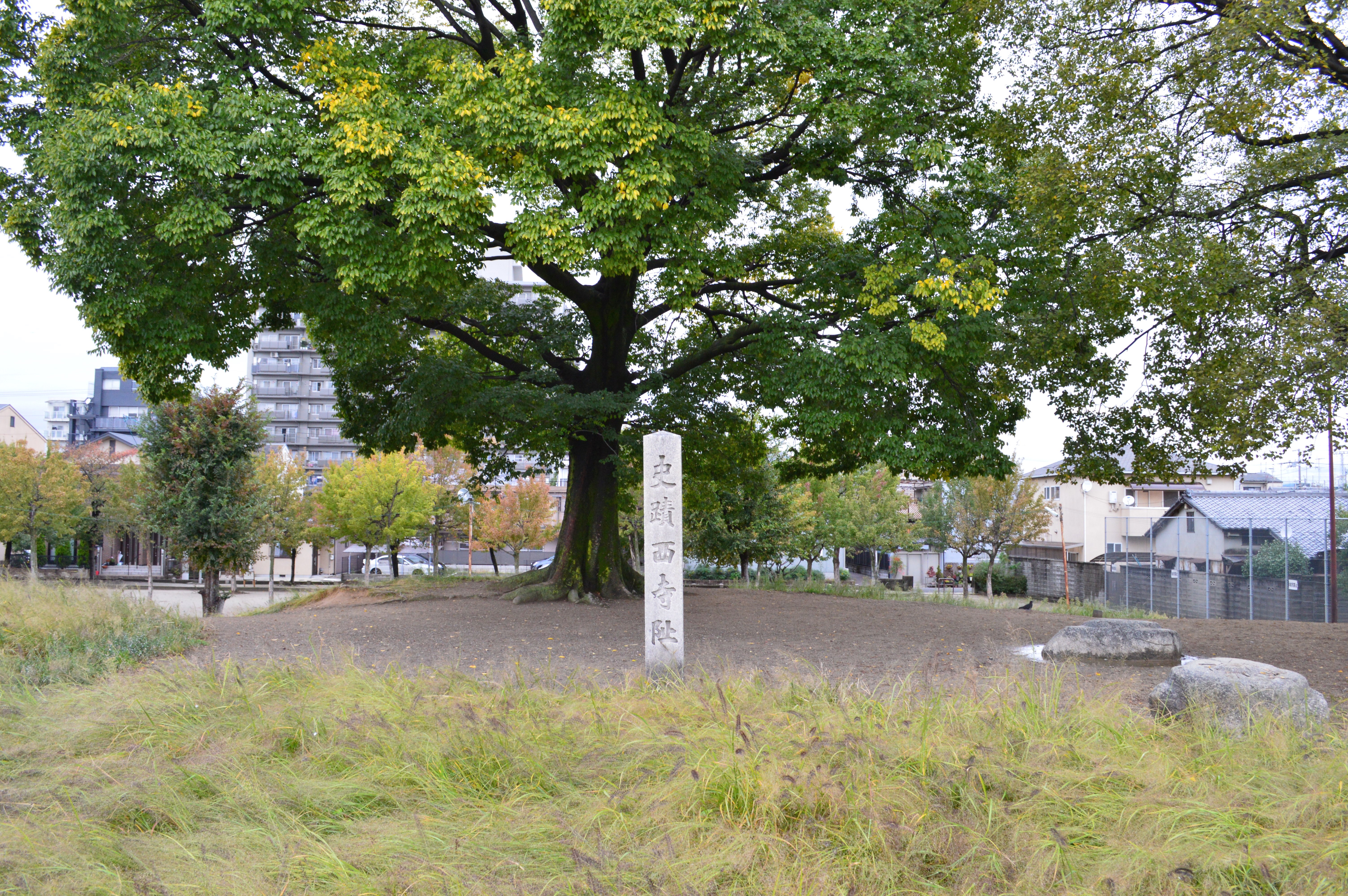
Sai-ji's ruins were designated a National Historic Site in 1921, with the protected area expanded in 1966. Archaeological excavations in 1959 confirmed the remains of the main hall, corridors, monks' quarters, dining hall, and south gate -- the full footprint of a major Buddhist complex lying beneath the modern neighborhood. The earthen platform that had prompted the original historic designation turned out to be the foundation of the lecture hall. Today that mound sits in Karahashi Saiji Park, marked by a stone monument. A portion of the main hall's foundation stones, unearthed during the digs, now rests in the grounds of Kyoto Municipal Karahashi Elementary School. The pagoda remains are believed to lie near the school as well, though it is unknown whether the foundation stones survive underground. A modern Jodo-shu temple nearby has claimed the name Sai-ji as its own, a successor in name if not in scale. The park is an eight-minute walk from Nishioji Station on the JR West Tokaido Main Line -- an easy detour for anyone curious about the temple that time chose to forget.
From the Air
Located at 34.981N, 135.738E in the Minami ward of southern Kyoto, west of Kyoto Station. From 3,000-5,000 feet AGL, the site is not visually distinctive -- it is now Karahashi Saiji Park, a small urban green space near an elementary school. To orient, look for the prominent five-story pagoda of To-ji approximately 800 meters to the east, one of the most recognizable landmarks in southern Kyoto. The two sites together mark the former southern gate of Heian-kyo. Nearest major airport is Osaka Itami (RJOO), about 22 nautical miles southwest. Kansai International (RJBB) lies approximately 48 nautical miles to the south. Kyoto Station, one of Japan's largest railway complexes, is visible just to the northeast.