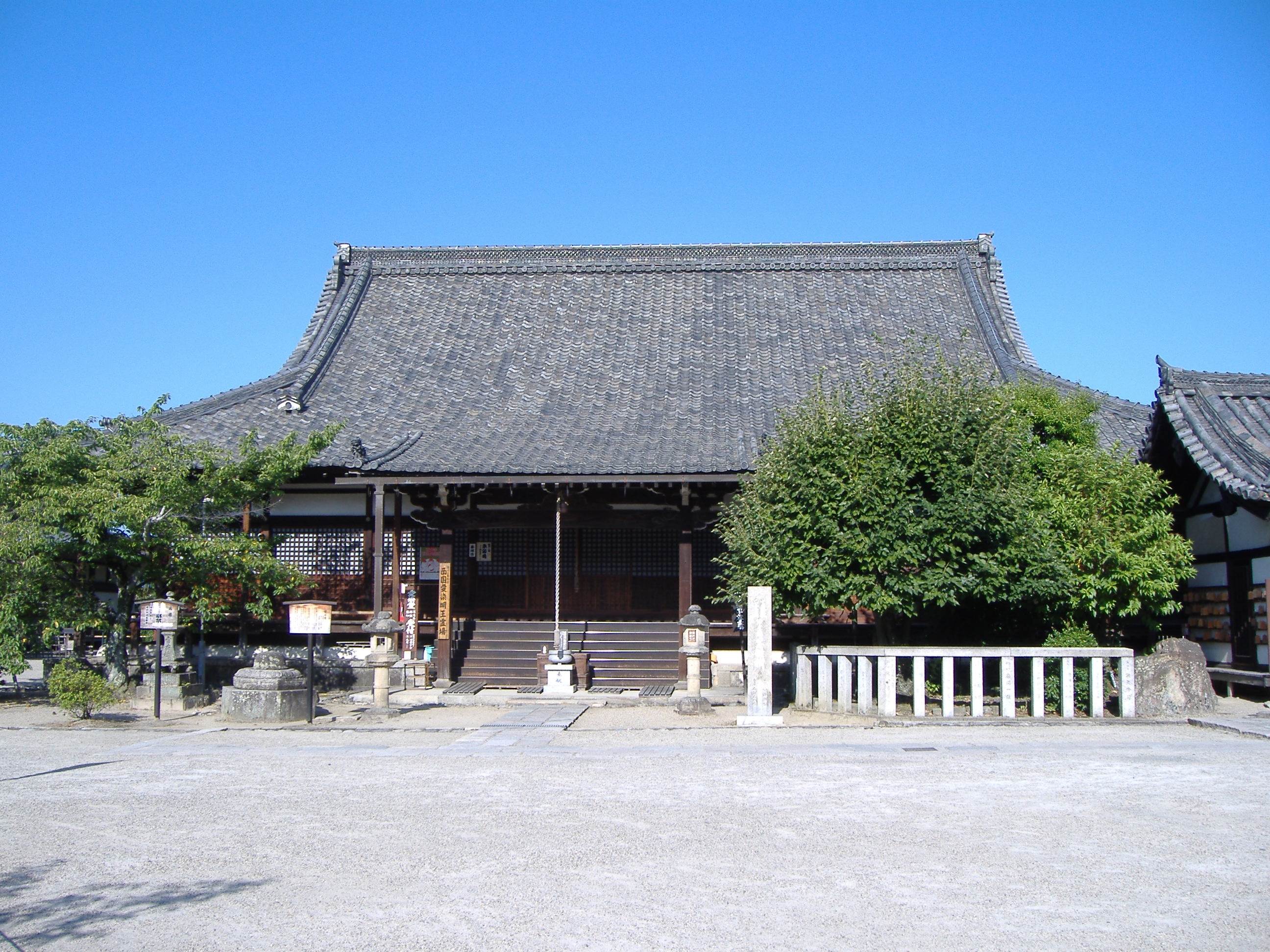
Saidai-ji: The Great Western Temple and Its Giant Tea Bowls
The tea bowls are forty centimeters across and weigh seven kilograms. To drink from one, you need the people sitting on either side of you to help steady it against your face. This is the Ochamori ceremony at Saidai-ji in Nara, a tradition born over 750 years ago when the monk Eison decided that tea, then a luxury reserved for aristocrats, should be shared with everyone. The common people had no proper tea bowls, so they drank from whatever oversized vessels they could find. The giant bowls stuck, and the ceremony endures -- a fitting legacy for a temple whose entire story is about falling from greatness and finding something more enduring in its place.
The Mirror of Todai-ji
Empress Shotoku ordered construction of Saidai-ji in 765, intending it as the western counterpart to Todai-ji, the Great Eastern Temple that her father Emperor Shomu had commissioned to house the Great Buddha of Nara. The name says it plainly: Saidai-ji means "Great Western Temple." The ambition matched the title. Construction stretched across fifteen years until 780, and at its peak the complex sprawled across roughly 48 hectares with around 110 buildings, including two magnificent pagodas. Saidai-ji was counted among the Nanto Shichi Daiji -- the Seven Great Temples of Nara -- alongside Todai-ji, Yakushi-ji, Horyu-ji, Kofuku-ji, Gango-ji, and Daian-ji. For a brief period, the twin temples anchored the eastern and western horizons of Japan's ancient capital.
Decline and the Arrival of Eison
When the imperial capital moved from Nara to Kyoto in 794, the great temples of Nara lost their political patrons. Saidai-ji declined more dramatically than most. Fires consumed buildings that were never rebuilt. The twin pagodas fell. By the Kamakura period, the once-grand complex had diminished to a shadow. Then in 1238, the Buddhist monk Eison took over administration and changed the temple's trajectory entirely. Eison was the founder of the Shingon Ritsu sect, and he made Saidai-ji its headquarters. Over fifty years of painstaking work, he restored the temple -- not to its former scale, but to a new purpose. Eison devoted himself to social welfare, caring for the poor and the sick, and transforming Saidai-ji into a center of compassion rather than imperial prestige. In 1249, he enshrined a statue of Shaka Nyorai as the temple's principal image.
Tea for the People
The Ochamori ceremony traces directly to Eison's democratic instincts. After offering tea at the nearby Hachiman Shrine, Eison insisted on sharing it with ordinary townspeople -- a radical act in an era when tea was the exclusive province of the nobility. The commoners had no fine tea bowls, so they used the largest cooking pots and vessels they could find. The tradition solidified into a formal ceremony using enormous specially made bowls, and for more than 750 years it has continued at Saidai-ji. Today the ceremony is held on the second Saturday and Sunday of April. Participants sit in rows, and the massive bowls are passed along, each drinker steadied by neighbors on both sides. Laughter is inevitable. The ceremony is joyful and communal, a living reminder that Eison valued generosity over exclusivity.
What Remains
The Saidai-ji that stands today is modest compared to its eighth-century incarnation, but what survives carries weight. The Main Hall, or Hondo, rebuilt in 1808, is designated an Important Cultural Property of Japan. The Shio-do, rebuilt in 1674, and the Aizen-do, reconstructed in 1762, round out the primary structures. Inside, the temple houses remarkable art, including a celebrated sculpture of Manjushri Bodhisattva riding a lion. The grounds are quiet, especially compared to the tourist density at Todai-ji a few kilometers east. Saidai-ji sits in its own neighborhood in western Nara, near the railway station that bears its name, and visitors who make the trip find a temple that has traded grandeur for something harder to achieve: a living connection between a medieval monk's ideals and the people who still gather to drink tea from absurdly large bowls in his memory.
From the Air
Located at 34.694N, 135.780E in western Nara, Japan. The temple grounds sit near Saidai-ji railway station and are distinguished from surrounding residential development by their tree cover and traditional rooflines. Todai-ji and its Great Buddha Hall are visible approximately 5 km to the east, providing orientation. Nearest airports: Osaka Itami (RJOO) approximately 40 km west, Kansai International (RJBB) approximately 80 km southwest. Best viewed at 2,000-3,000 feet AGL. The Heijo Palace ruins lie between Saidai-ji and the center of Nara, forming a large open rectangular area visible from altitude.