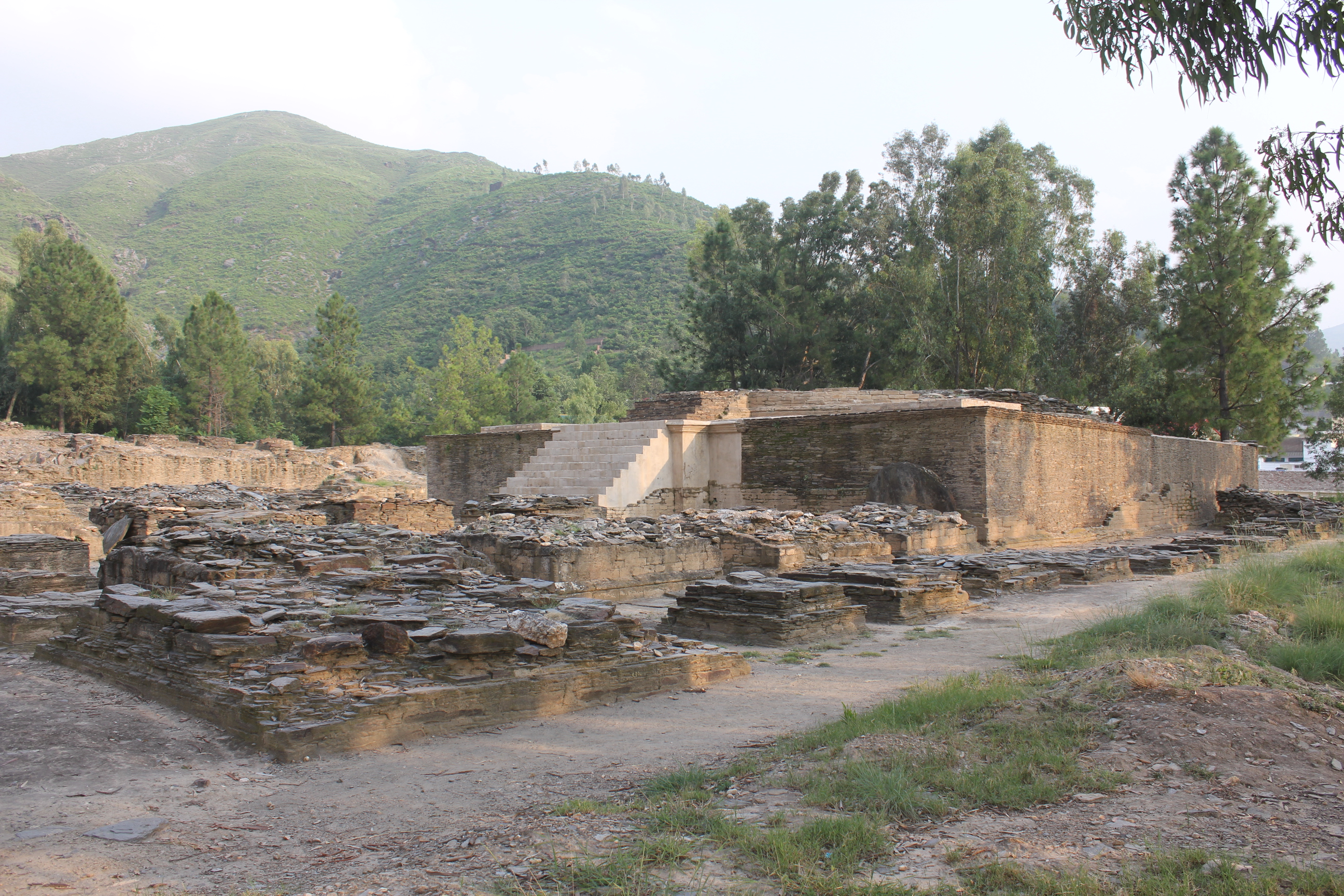
Saidu Sharif Stupa
At the foot of the mountains separating the Saidu and Jambil river valleys, someone cut into the hillside rock and built two terraces. On the lower terrace, they raised a stupa. On the upper terrace, a monastery. For roughly five centuries, from about 25 BCE to the 5th century CE, monks lived and worshipped here, enlarging the complex in prosperous times and watching it shrink in harder ones. The Saidu Sharif Stupa, excavated as Saidu Sharif I, is not the largest or most famous Buddhist site in the Swat Valley. But its layered construction is an unusually legible record of how a religious civilization grew, flourished, and faded.
Two Terraces Carved from a Hillside
The sacred area sits near the city of Saidu Sharif in the Swat District of Khyber Pakhtunkhwa, Pakistan. Its builders chose a slope and transformed it, cutting into the north face of the hill to create two level platforms. The lower terrace, which the excavators called the "Terrace of the Stupas," held the main stupa surrounded by smaller votive stupas, viharas, and columns. The main structure had a square base rising to a cylindrical body, with a stairway on the north side. At its four upper corners stood columns on pedestals, each crowned with a crouching lion. One of the cylindrical sections bore a figured frieze carved in green schist, the dark stone that Gandhara sculptors favored for its fine grain and the way it held detail. The upper terrace housed the monastery where the monks who tended the stupa lived and studied.
Three Acts in Stone
Italian archaeologists divided the site's life into three distinct periods, and the story they tell is one of expansion, crowding, and retreat. In the first phase, between roughly 25 BCE and the end of the 1st century CE, the monuments stood in symmetrical arrangement -- spare, orderly, reflecting a community confident enough to leave open space. During the second period, spanning the 2nd and 3rd centuries CE, the Terrace of the Stupas grew crowded with new votive monuments as the site's prestige drew more patrons and more pilgrims. The terrace itself was extended to accommodate the new construction. On the upper level, the monastery expanded in tandem. Then came the third period, the 4th and 5th centuries CE, when the trajectory reversed. The monastery shrank back to its original dimensions. The building campaign slowed and then stopped. Buddhism in Swat was entering its long decline.
Faccenna's Twenty-Year Dig
The Italian Archaeological Mission began excavating Saidu Sharif I in 1963 under the auspices of the Istituto Italiano per il Medio ed Estremo Oriente. The first campaign, running until 1966, uncovered the lower terrace and the main stupa. Then came an eleven-year pause. When work resumed in 1977, the team turned to the upper terrace and its monastery, completing the excavation in 1982. Domenico Faccenna, who also led the excavation of the nearby Butkara Stupa, directed the project, and Pierfrancesco Callieri published the definitive account of the monastery. Their work produced detailed records of each construction phase and recovered the figured green schist frieze from the main stupa -- a work of Gandhara art significant enough to inspire a 2002 exhibition in Rome titled "The Master of Saidu Sharif: At the Origins of Gandhara Art."
The View from Mingora
From the city of Mingora, the stupa's location is visible against the mountainside, a reminder that this valley was once one of the great centers of Buddhist civilization. The Swat Valley's Buddhist heritage is dense: Butkara lies nearby, and dozens of other monasteries and stupas dot the surrounding hills. Saidu Sharif I stands out for the clarity of its archaeological record. Where other sites were rebuilt or abandoned abruptly, this one shows a slow, legible arc -- the careful symmetry of a new foundation, the energetic crowding of a golden age, and the quiet contraction of an era ending. The fragments of the harmika and stone umbrellas found scattered near the stupa are all that remain of its upper structure. The lions have lost their perches. But the terraces the builders carved from the hillside remain, holding the shape of five centuries of devotion.
From the Air
Located at 34.76N, 72.36E near Saidu Sharif in the Swat Valley, Khyber Pakhtunkhwa, Pakistan. The site sits at the foot of mountains between the Saidu and Jambil river valleys. Saidu Sharif Airport (OPSS) is immediately adjacent, making this one of the most accessible archaeological sites from the air. Peshawar (OPPS) is the nearest major airport, approximately 160 km south. The Swat River valley is visible as a broad corridor flanked by mountains. Best viewed at 4,000-7,000 ft AGL, where the terraced hillside structure becomes apparent against the natural slope.