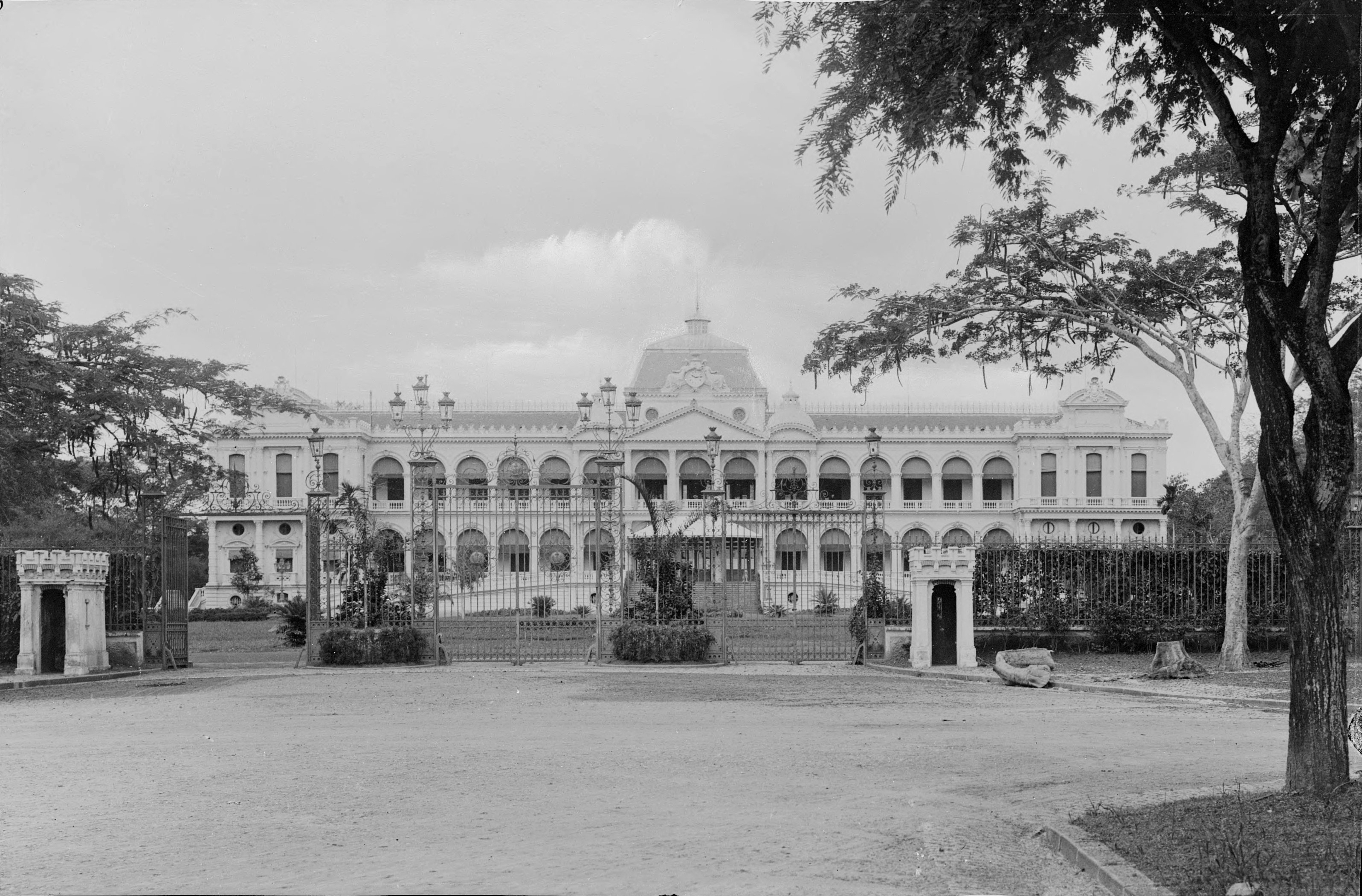
Saigon Governor's Palace
The cornerstone told a story the builders preferred to the truth. On 23 March 1868, Admiral Pierre-Paul de La Grandiere laid a block of blue granite from Bien Hoa into the foundation of Saigon's new Governor's Palace. Inside the stone sat a lead coffer containing freshly minted gold, silver, and copper coins of Napoleon III -- a time capsule of imperial confidence buried in soil that would spend the next century trying to swallow the building whole. The site was waterlogged from the start, and the foundations required constant repair to counteract subsidence throughout the palace's life. It was, in miniature, the story of French Cochinchina: grand ambitions planted in unstable ground.
Twelve Million Francs on a Swamp
The palace was the brainchild of architect Achille-Antoine Hermitte, who had been recommended to Governor La Grandiere by admirals who met him in Hong Kong. Hermitte's immediate priority was replacing the existing wooden governor's residence, which had fallen into disrepair. He brought in skilled workmen from Canton and Hong Kong to build a neo-Baroque monument meant to awe the people of Saigon with French power and wealth. The walls rose in yellow stucco on granite foundations imported from France. The facade was carved in smooth white stone, also shipped across oceans. Marble floors graced the central pavilion. The T-shaped building stretched 80 meters across its front, set within a 13-hectare park from which eight main roads radiated outward. Construction was celebrated informally on 25 September 1869 with a banquet and ball, but the formal opening waited until 1873 under Governor Marie Jules Dupre. Decorations were not complete until 1875. The total bill: 12 million francs -- over a quarter of the entire public works budget for Cochinchina.
A Palace Without a Purpose
The building's political relevance began evaporating almost as soon as the plaster dried. In October 1887, Cochinchina was absorbed into the Indo-Chinese Union, and the Governor of Cochinchina was demoted to lieutenant governor. The new lieutenant governor did not need or want so pretentious a residence; a nearby trade exhibition hall was adapted into a more modest mansion, completed in 1890. When Paul Doumer moved the seat of French Indochina's government to Hanoi in 1902, the palace lost its last administrative function. For the remaining decades of French colonial rule, it sat largely empty, used only for ceremonies and the occasional visit by a governor-general passing through Saigon. Meanwhile, the waterlogged foundations kept demanding expensive repairs. The central dome had to be replaced in 1893. The building had become what the French might call a white elephant -- monumental, beautiful, and purposeless, slowly sinking into the ground that was never suited to bear its weight.
From Norodom to Independence
The palace gained a new name -- Norodom Palace -- during its ceremonial years, and a new chapter when France's era in Indochina ended. On 7 September 1954, the French formally handed the building over to the South Vietnamese government. Renamed Independence Palace, it became the presidential residence of Ngo Dinh Diem. Diem moved in with his brother Ngo Dinh Nhu and sister-in-law Madame Nhu, and for a few years the old colonial showpiece served as the seat of a newly sovereign state. But the palace that had survived decades of subsidence could not survive the politics of the Republic of Vietnam. On 27 February 1962, two South Vietnamese Air Force pilots who opposed Diem's regime bombed the building, demolishing its left wing. Diem survived the attack, but the palace did not survive Diem's response: he ordered the entire structure razed.
Rubble and Replacement
The demolition of the Governor's Palace was thorough and deliberate. In its place rose the present Independence Palace, designed by Vietnamese architect Ngo Viet Thu in a modernist style that made no attempt to echo the neo-Baroque grandeur of its predecessor. The new building would become one of the most recognizable structures in Vietnamese history -- it was through its gates that a North Vietnamese tank crashed on 30 April 1975, marking the fall of Saigon. Nothing remains of Hermitte's original creation. The yellow stucco walls, the imported French granite, the marble floors, the arched windows looking out over the park -- all gone. What survives is the site itself, still at the center of Ho Chi Minh City, still anchoring the roads that radiate outward from it. The cornerstone with its lead coffer and Napoleon III coins has never been recovered. It may still be down there, beneath the modernist palace, beneath the waterlogged ground, a buried boast from an empire that could not hold what it built.
From the Air
Located at 10.7769N, 106.6953E in central Ho Chi Minh City. The site of the former Governor's Palace is now occupied by the Independence Palace (Reunification Palace), visible from the air as a large modernist building set within a tree-lined park at the intersection of several major boulevards. Nearest major airport is Tan Son Nhat International (ICAO: VVTS), approximately 5 km to the north-northwest. Best viewed at 1,500-2,500 ft AGL. The distinctive radiating road pattern from the park remains visible and aids identification.