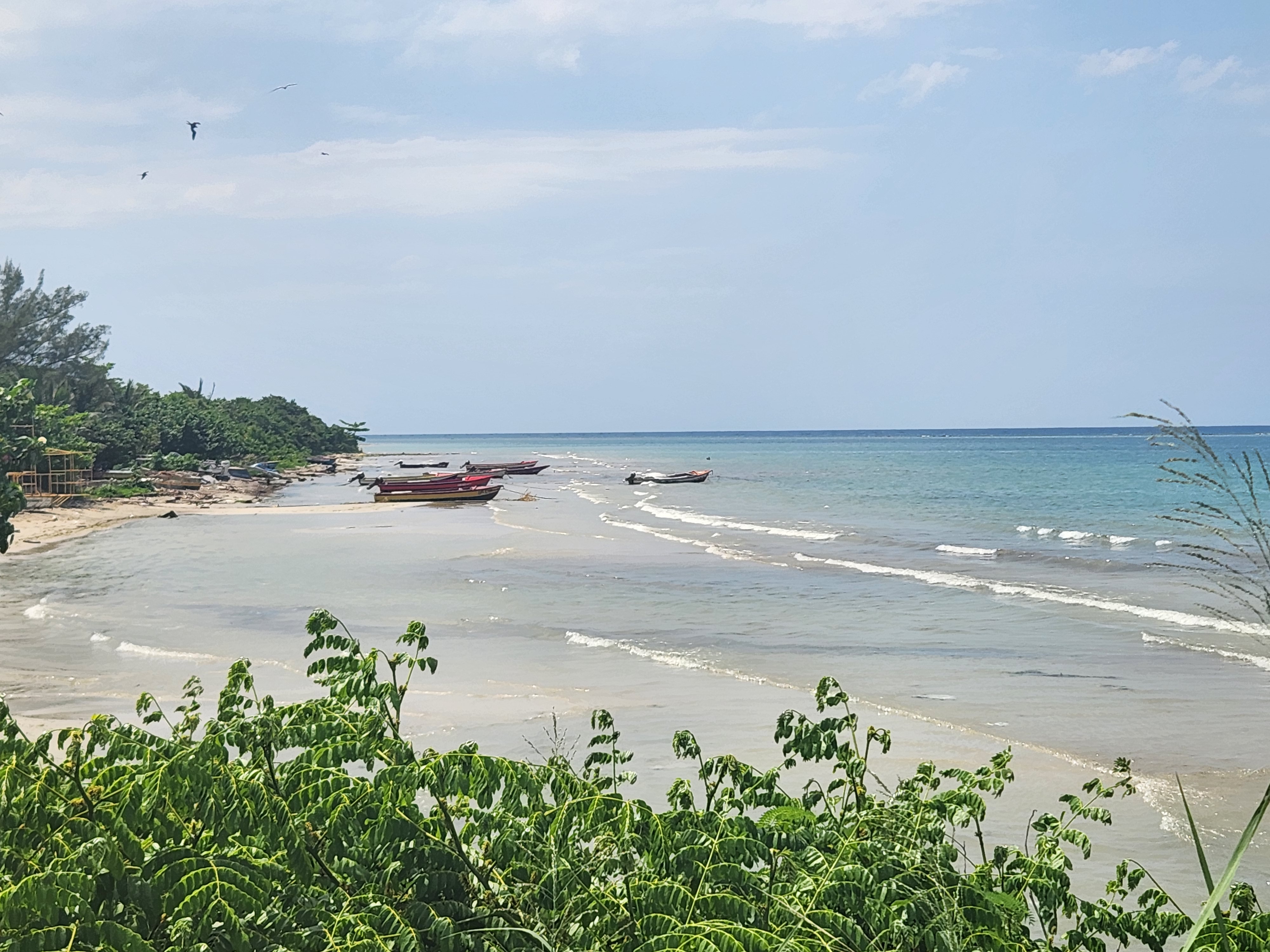
Saint Ann's Bay
Marcus Garvey left Saint Ann's Bay for Kingston in 1903, at the age of sixteen. He had grown up in this small harbor town on Jamaica's north coast, the son of a stonemason who owned a large library. Within two decades, the boy from Saint Ann's Bay would lead the largest organized mass movement in Black history, founding the Universal Negro Improvement Association and advocating for pan-African unity on a global stage. A statue stands in his honor outside the town library today. But Garvey is only the most recent layer in a place where history has been accumulating since before any European ship appeared on the Caribbean horizon.
Marooned at Santa Gloria
Christopher Columbus first reached Jamaica's north shore in 1494, landing somewhere in Saint Ann Parish. He returned on his fourth and final voyage, and this time he did not leave by choice. In June 1503, his ships were so riddled with shipworm that he was forced to beach them in the bay he called Santa Gloria. Columbus and his crew remained stranded there for an entire year, from June 1503 to June 1504, surviving through a combination of trade with the local Taino people and, when that relationship soured, manipulation -- Columbus famously used his knowledge of a coming lunar eclipse to convince the Taino that his God was angry with them. A statue of Columbus now stands near the town's main intersection, commemorating a visit that was less triumph than desperate survival.
Spain's Third Capital in the Americas
The first permanent Spanish settlement in Jamaica was established at Sevilla la Nueva, just west of Saint Ann's Bay, by Juan de Esquivel, the island's first Spanish governor. It became the third capital Spain founded in the Americas. The settlers built sugar mills there before 1526 -- among the earliest in the hemisphere. But Sevilla la Nueva was poorly situated. Sanitary problems plagued the settlement, and French filibusters raided it repeatedly in the decades that followed. The Spanish eventually abandoned it in favor of Santiago de la Vega, known today as Spanish Town, on the island's southern plain. When the English captured Jamaica in 1655, Saint Ann's Bay gradually reinvented itself as a fishing port, its harbor filling with warehouses and wharves. The parish itself was named for Lady Anne Hyde, first wife of King James II of England -- an English name layered over a Spanish foundation built on Taino land.
A Fort Becomes a Prison
The Old Jail in Saint Ann's Bay tells the town's colonial story in miniature. Originally built as a fort in 1750, when the English were still consolidating their hold on Jamaica, it was converted into a prison in 1795 -- Jamaica's first. The transformation from military outpost to carceral institution mirrors the island's own shift from contested territory to settled colony. Nearby, the St. Ann's Bay Courthouse, constructed in 1860, and the St. Ann Parish Church, built in 1871, anchor a cluster of well-maintained buildings in the early 20th-century Jamaican vernacular style. These structures give the town center a sense of civic permanence that contrasts with the resort development that has consumed neighboring Ocho Rios. Saint Ann's Bay remains the official capital of Saint Ann Parish, though Ocho Rios has long since surpassed it in population and tourist traffic.
Cardiff Hall and the Weight of History
West of town sits Cardiff Hall, a plantation house once owned by John Blagrove. Fifteen hundred enslaved Africans worked this single estate -- a number that suggests the scale of the plantation economy that shaped Jamaica's demographics and social structures for centuries. The 19th-century artist James Hakewill painted Cardiff Hall and described Blagrove as a kind master, noting that he left each enslaved person a dollar in his will. The detail says more about Hakewill's perspective than about Blagrove's character. A dollar per person does not redeem a system that treated human beings as property. Cardiff Hall stands as a reminder that Jamaica's beauty has always been entangled with its history of exploitation -- a history that Saint Ann's Bay, unlike some of its more tourist-polished neighbors, does not try to hide.
The Quieter Coast
Saint Ann's Bay earned its status as parish capital because of its harbor, which once shipped bananas and bauxite across the Atlantic. In recent decades, the economic center of gravity along this coast has shifted eastward to Ocho Rios, where cruise ships dock and resort complexes line the beach. But the visitors who do come to Saint Ann's Bay find something Ocho Rios cannot offer: a town that is still primarily a town, not a tourism product. Musicians Floyd Lloyd and Burning Spear were born here, alongside Garvey -- a concentration of cultural significance that would be remarkable for a city ten times its size. The harbor still catches the light in the late afternoon, the courthouse still keeps its hours, and the Garvey statue still faces the sea, as if watching for something on the horizon.
From the Air
Saint Ann's Bay is located at 18.44N, 77.20W on Jamaica's north coast, in Saint Ann Parish. From the air, the town sits on a sheltered bay backed by green hills, with a compact grid of streets visible around the harbor. Ocho Rios is approximately 15 km to the east along the coast road. Ian Fleming International Airport (MKBS) in Boscobel is about 20 km east. Sangster International Airport (MKJS) in Montego Bay is roughly 75 km to the west. The ruins of Sevilla la Nueva are just west of town, though they are not easily visible from altitude.