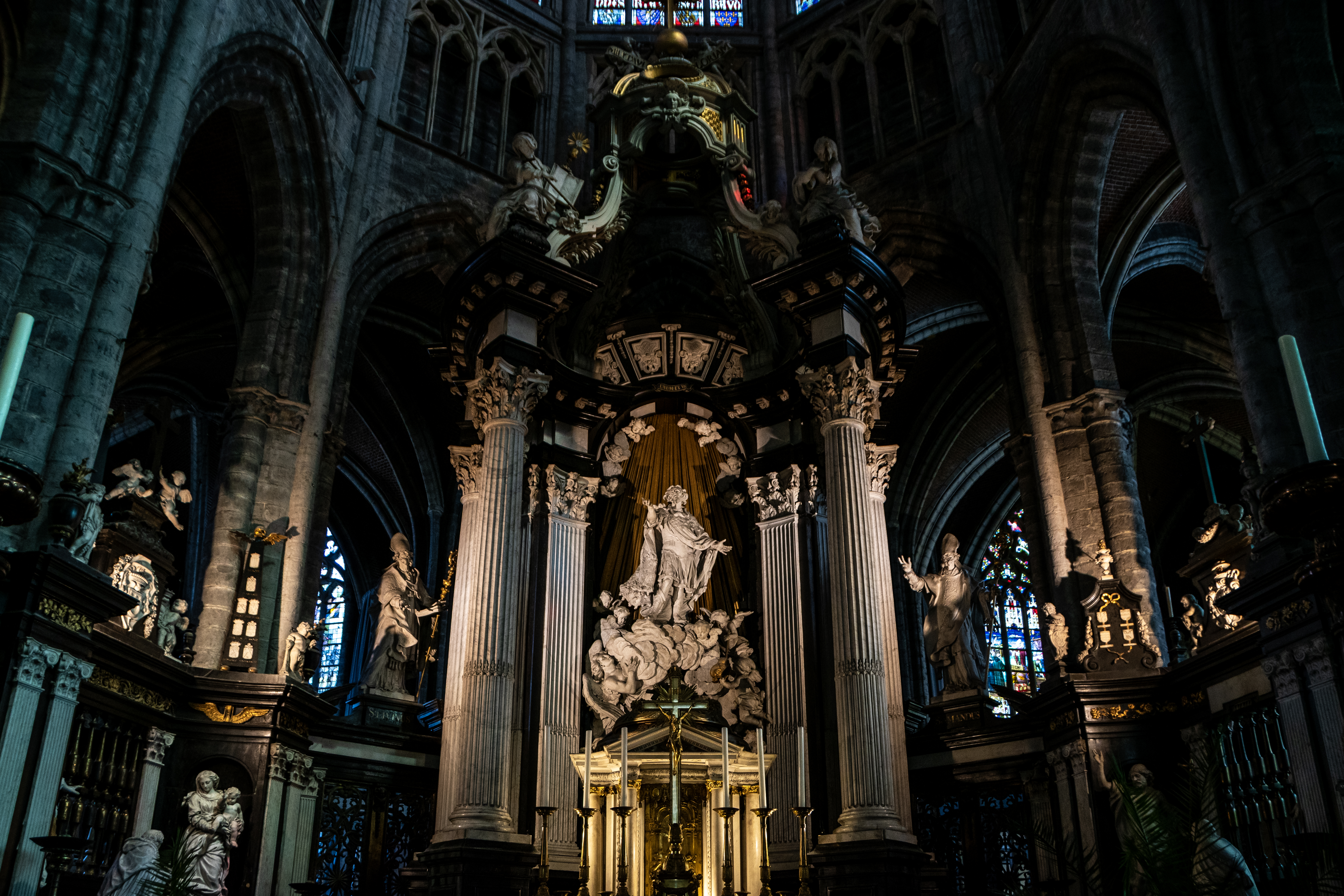
Saint Bavo's Cathedral, Ghent
On the night of April 10, 1934, someone slipped into Saint Bavo's Cathedral and pried out a panel of the Ghent Altarpiece. A note at the scene referenced the Treaty of Versailles; a ransom demand arrived nineteen days later. Then they returned half of what they had stolen, kept negotiating, and disappeared. The Just Judges panel has never been recovered. Nearly a century later, every detective in Belgium has a theory, and a 15th-century facsimile by the restorer Jef Van der Veken still stands in the painting's place. Visitors to the cathedral come for the building. They stay for the empty seat where the Judges used to sit.
Stones on Stones
What stands today at 89 meters above the Botermarkt began as a wooden chapel to John the Baptist, consecrated in 942. Beneath the choir, the Romanesque crypt still holds traces of an 11th-century rebuilding, frescoed and quiet. Gothic construction began around 1274 and continued, room by room and chapel by chapel, for almost three centuries. The choir went up first, then the radiating chapels, then the transepts, the chapter house, the nave aisles, and finally the single great western tower. Construction was declared complete on June 7, 1569. Ten years earlier, when the Diocese of Ghent had been founded, the church had been elevated to a cathedral. The building you walk into is a layer cake of medieval ambition - every century from the 10th to the 17th left its handwriting somewhere in the stone.
The Iconoclasts Came
In the summer of 1566, the Beeldenstorm swept across the Low Countries. Calvinist iconoclasts moved from church to church, smashing statues, shattering stained glass, and burning paintings they considered idolatrous. Saint Bavo's was on their list. Stained glass came down. Statues lost their heads. But the priests had been warned. Before the mob arrived, they took the Ghent Altarpiece apart and hid it in the cathedral tower. The Adoration of the Mystic Lamb - already considered the supreme masterpiece of Flemish painting - survived the storm intact. It would survive more storms after that. Napoleon hauled it to Paris in 1794. The German Empire took panels to Berlin in 1816. Hermann Goering's agents stole it for Hitler in 1942 and hid it in the salt mines of Altaussee, where the Monuments Men found it as the Reich collapsed.
The Lamb at the Center
Hubert van Eyck began the altarpiece. His brother Jan finished it in 1432. Twelve panels open in two layers, the outer wings depicting the Annunciation, the inner an entire theological universe: God the Father enthroned, Mary and John the Baptist beside him, choirs of angels, Adam and Eve in heart-stopping anatomical truth - the first nudes of the Northern Renaissance. The central lower panel gives the work its name. On an altar in a paradise meadow, a lamb bleeds into a chalice while pilgrims from every walk of medieval life kneel in adoration: prophets and patriarchs from the left, hermits and pilgrims from the right, knights and judges below. The painting is small enough to walk past quickly and dense enough to study for a lifetime. Restorers cleaning it in 2019 discovered something startling beneath centuries of overpaint: the lamb has an unsettlingly humanlike face, four ears, and eyes that meet yours directly. The Van Eycks painted it that way on purpose.
The Heist That Won't Resolve
Then there is the gap. The lower left panel, The Just Judges, was taken in April 1934 along with a second panel showing John the Baptist. John was returned within weeks, presumably as a sign of good faith during ransom negotiations. The Judges never came back. The case was officially closed in 1937, but the file is still open in the sense that Belgians cannot stop thinking about it. A stockbroker and church sexton named Arsene Goedertier confessed on his deathbed that he knew where the panel was hidden, and then died before saying exactly where. Theories have placed it in a confessional, in the cathedral itself, in a cellar of an Antwerp townhouse, under a paving stone. Detectives have followed every lead. None of them led anywhere. The facsimile that Jef Van der Veken painted in 1945 has hung in the original's place for eighty years.
What Else Is in the Room
It is easy to forget that Saint Bavo's contains other treasures, because the Lamb keeps pulling the eye back. The Rococo pulpit by Laurent Delvaux, carved between 1741 and 1745 in oak and white and black marble, spirals upward like sculpted smoke. The high Baroque altar in red, black, and white flamed marble took eighty years to complete. The main organ, installed from the 1935 Brussels world exhibition, contains over 6,000 pipes - the largest organ in the Low Countries. Peter Paul Rubens contributed a painting of Saint Bavo entering the convent at Ghent. Michelle of Valois, daughter of Charles VI of France and Duchess of Burgundy, is buried in the floor. The cathedral keeps a reliquary of Saint John the Baptist's head. After the Mystic Lamb, anything else might seem like an afterthought, until you look at it carefully, and remember that this is one of the great medieval reliquaries pretending to be a building.
From the Air
Located at 51.053 N, 3.727 E in the historic core of Ghent, the cathedral's 89-meter Gothic tower forms one corner of Ghent's famous triangle of towers along with the Belfry and Saint Nicholas. Best viewed from the air in clear conditions at 2,000-3,000 ft, where the three towers cluster in a tight line across less than half a kilometer. Closest international airport: Brussels (EBBR), 60 km southeast. Smaller airfields at Ursel (EBUL) and Wevelgem (EBKT) lie within 40 km.