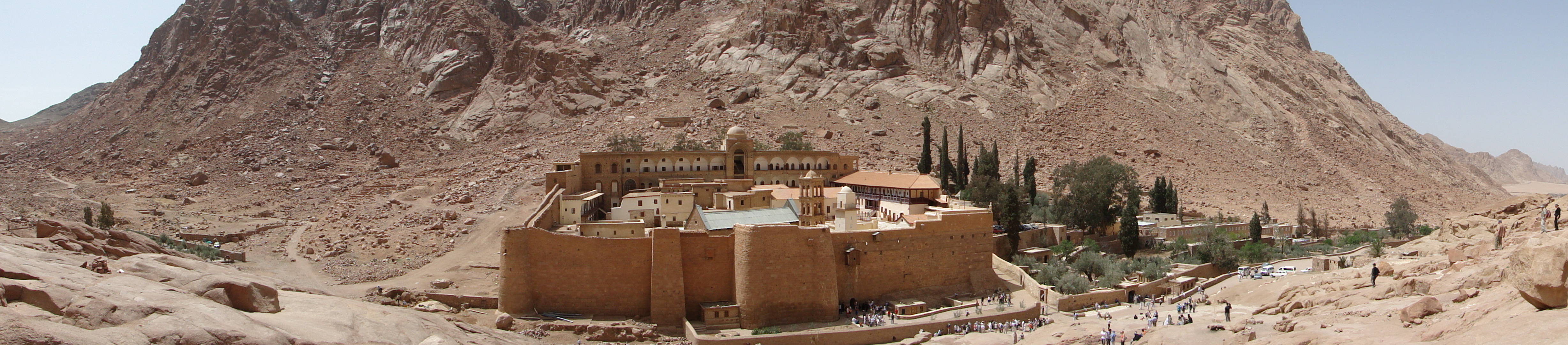
Saint Catherine's Monastery
The oldest known roof truss in the world holds up a building that has never been abandoned. Since the Byzantine emperor Justinian I ordered its construction between 548 and 565, Saint Catherine's Monastery has been continuously inhabited -- monks praying, copying manuscripts, tending gardens -- through the rise and fall of caliphates, the turmoil of Crusades, centuries of Ottoman rule, and modern conflict in the Sinai. A mosque built within its walls in 1106 still stands beside its churches. A bush in its courtyard is claimed to be the one Moses saw burning. The monastery's library, founded alongside the monastery itself, holds Guinness World Records recognition as the world's oldest continuously operating library.
Sacred Ground, Three Faiths Deep
The site's sanctity predates the monastery by millennia. Jewish, Christian, and Islamic traditions all locate the burning bush -- where God spoke to Moses -- in this valley at the foot of Mount Sinai. Emperor Justinian built the monastery around the Chapel of the Burning Bush, itself ordered by Empress Helena, mother of Constantine I. Beside the chapel is the Well of Moses, where tradition holds that Moses met his future wife, Zipporah; it remains one of the monastery's water sources to this day. Centuries later, the body of Saint Catherine of Alexandria was said to have been found in a cave nearby, and her relics drew a steady stream of pilgrims that continues into the present. The monastery also preserves a copy of the Ashtiname of Muhammad, in which the Prophet is said to have bestowed his personal protection on the community -- a document that reportedly helped shield it through centuries of Islamic rule.
A Library That Rewrites History
The monastery's second-largest treasure, after its unbroken continuity, is its manuscript collection -- the world's second largest collection of early codices, surpassed only by the Vatican Library. In 1844 and 1859, the scholar Constantin von Tischendorf discovered the Codex Sinaiticus here, a fourth-century manuscript that was then the oldest nearly complete Bible known. Its departure from the monastery for Russia became one of the great controversies of manuscript scholarship; Stalin later sold it to the British Museum in 1933 for 100,000 pounds. In 1892, Agnes Smith Lewis discovered the Syriac Sinaiticus, an early palimpsest Gospel text, in the same library. Modern multispectral imaging has since revealed hidden layers in the monastery's palimpsests -- texts erased and overwritten by monks who could not afford fresh parchment -- including previously unknown Greek poems and the oldest recipe attributed to Hippocrates.
Survival Through Adaptation
The monastery's longevity is not passive endurance but active adaptation. When the Fatimid Caliphate held power, an existing chapel was converted into a mosque -- a gesture of coexistence that kept the monastery safe. During the Crusades, it accepted patronage from both Byzantine emperors and the kings of Jerusalem simultaneously, threading the needle between warring Christian factions. Its monastic community was multiethnic for most of its history -- Arab, Greek, Syrian, Slavonic, and Georgian monks lived side by side through the Middle Ages. In the fifteenth century, Dominican theologian Felix Fabri described thriving gardens with "more than three thousand olive trees, many fig-trees and pomegranates." The monks produced olive oil for their lamps and kitchens. Even when the Mamluk Sultanate declined and Bedouin raids threatened the community -- culminating in the monastery being captured and sacked in 1505 -- the monks returned and rebuilt.
Parchment and Stainless Steel
Today, the monastery balances ancient vocation with modern preservation. Its library was extensively renovated and reopened at the end of 2017, with planning assistance from Ligatus, a research center at the University of the Arts London. The Saint Catherine Foundation is housing 2,187 parchment manuscripts in individual stainless steel cases -- chosen over wood because steel releases no acidic gases that might damage pH-sensitive pigments, resists insect attack, and is fireproof. Each case includes an oxygen starvation system for fire protection. Meanwhile, imaging scientists have used narrowband multispectral technology to recover texts invisible to the naked eye, revealing treasures in dead or rare languages like Caucasian Albanian and Christian Palestinian Aramaic. Greek Orthodox hermits lived among Petra's ruins and the monastery's outbuildings as recently as the late nineteenth century. The continuity is not metaphorical; it is a chain of human presence stretching back to Justinian, unbroken.
From the Air
Located at 28.5561N, 33.9757E at the foot of Mount Sinai (Jebel Musa) in Egypt's Sinai Peninsula. The monastery sits in a narrow valley at approximately 1,500 meters elevation, surrounded by rugged granite peaks. Nearest airport is Sharm el-Sheikh International (HESH), about 130 km to the south. The walled compound and adjacent gardens are visible from low altitude against the barren mountain terrain. Best viewed at 3,000-5,000 feet AGL, though the surrounding peaks rise to over 2,200 meters.