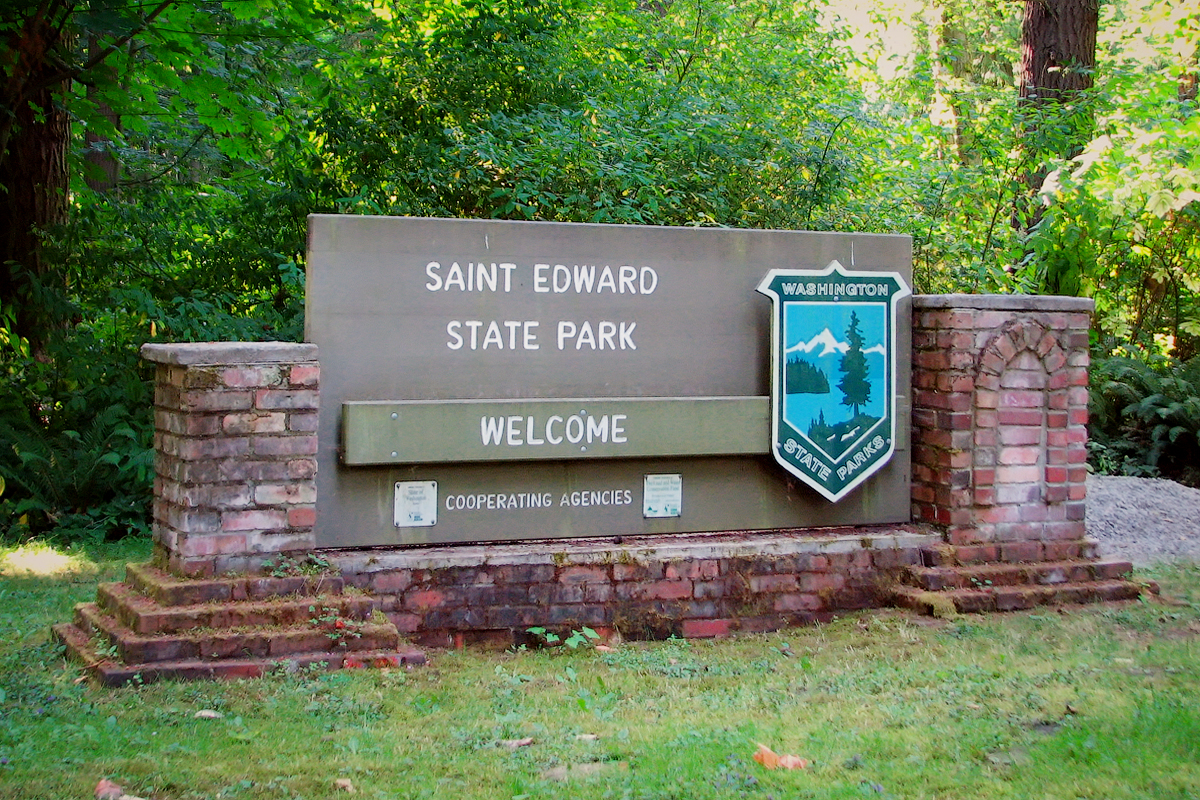
Saint Edward State Park
Walk through the main entrance of Saint Edward State Park and the suburbs disappear within fifty yards. Douglas firs and western redcedars close overhead, sword ferns crowd the trail margins, and the air takes on the damp, earthy coolness of a Pacific Northwest forest that has been growing largely undisturbed for a century. At the heart of this 326-acre woodland, an enormous brick seminary building rises among the trees like something out of a gothic novel. Built by the Sulpician Order in 1931, abandoned in 1977, left to decay for decades, the building was finally reopened in May 2021 as the Lodge at St. Edwards, an 84-room hotel that cost $57 million to create. The story of this park is the story of a place that keeps being claimed by someone new while the forest just keeps growing.
Loggers, Then Priests
The land was logged in the nineteenth century and again in the 1920s, stripping the hillside above Lake Washington down to stumps. In the 1920s, the Roman Catholic Archdiocese of Seattle acquired the property, and from 1931 the Sulpician Order developed it as the site of Saint Edward Seminary, a training ground for Catholic priests. The main seminary building, a grand brick structure set among the regrowing forest, was followed in 1958 by the Saint Thomas Seminary and in 1969 by a swimming pool. For nearly half a century, the seminary operated in relative seclusion, its grounds gradually returning to dense forest as the second-growth trees matured. By the time the seminaries closed in 1977, victim of declining enrollments across American Catholic institutions, the woods had grown thick enough to swallow most traces of the logging that preceded them.
The Forest Canopy
Today the park's canopy reads like a field guide to the Pacific Northwest. Coast Douglas-fir dominates the upper story, joined by western redcedar and western hemlock. Bigleaf maples spread their broad leaves through the middle canopy, and Pacific madrone clings to the drier slopes with its distinctive peeling bark. Beneath these trees, the forest floor is a dense carpet of western sword fern, shrubs, and mosses that muffles sound and softens light. Trails for hikers and mountain bikers wind through this understory, descending toward an undeveloped beach on Lake Washington's northeastern shore. The park sits at the boundary of Kenmore and Kirkland, and its forest feels incongruous with its suburban surroundings. Bastyr University, a school of naturopathic medicine, occupies the Saint Thomas Center within the park, its students walking to class through woods that feel several hours from any city.
Decades of Debate
After the Archdiocese transferred the property to Washington State Parks, the seminary building became the park's central problem. It was too significant to demolish and too expensive to maintain. The structure was listed on the Washington State Heritage Register in 1997 and added to the National Register of Historic Places in April 2007. McMenamins, the Portland-based brewpub and hotel chain known for repurposing historic buildings, proposed a conversion in 2007, but neighborhood opposition killed the plan. The state legislature allocated a million dollars to evaluate and maintain the building, and Bassetti Architects were hired to assess its condition. For years, the seminary sat behind chain-link fences, its hallways echoing, its roof leaking, while community groups debated its future. The Friends of Saint Edward State Park advocated for passive recreation. The Saint Edward Environmental Learning Center ran outdoor education programs. Everyone had a vision; no one had the funding.
The Lodge in the Woods
In 2017, Daniels Real Estate signed a 62-year lease with Washington State Parks to do what McMenamins had failed to accomplish. The deal included a creative land swap: Daniels purchased an adjacent waterfront property and transferred it to the state, expanding the park's Lake Washington shoreline. Construction transformed the seminary into the Lodge at St. Edwards, which opened in May 2021 with 84 guest rooms, event space, a restaurant, and two bars. The $57 million renovation preserved the building's historic character while making it structurally sound for the first time in decades. Guests now sleep in rooms where seminary students once studied theology, looking out windows that frame the same forest the Sulpician fathers planted themselves among nearly a century ago. The park around them remains day-use only, no camping permitted, dogs on leash. The forest does not care who occupies the building at its center. It just keeps growing.
From the Air
Saint Edward State Park covers 326 acres at 47.730N, 122.256W on the northeastern shore of Lake Washington, straddling the Kenmore-Kirkland boundary. From the air, the park is unmistakable as a large dark-green forested block surrounded by suburban development, with the seminary/hotel building visible as a large structure at the park's center. The undeveloped Lake Washington beach is visible along the western edge. Bastyr University's buildings are identifiable within the park grounds. Nearest airports: Kenmore Air Harbor (S60) 2nm north (floatplane base on the north end of Lake Washington), Boeing Field (KBFI) 11nm south, Renton Municipal (KRNT) 10nm southeast. Best viewed at 2,000-3,000 feet approaching from the east, where the contrast between the dark forest canopy and surrounding suburban rooftops is striking.