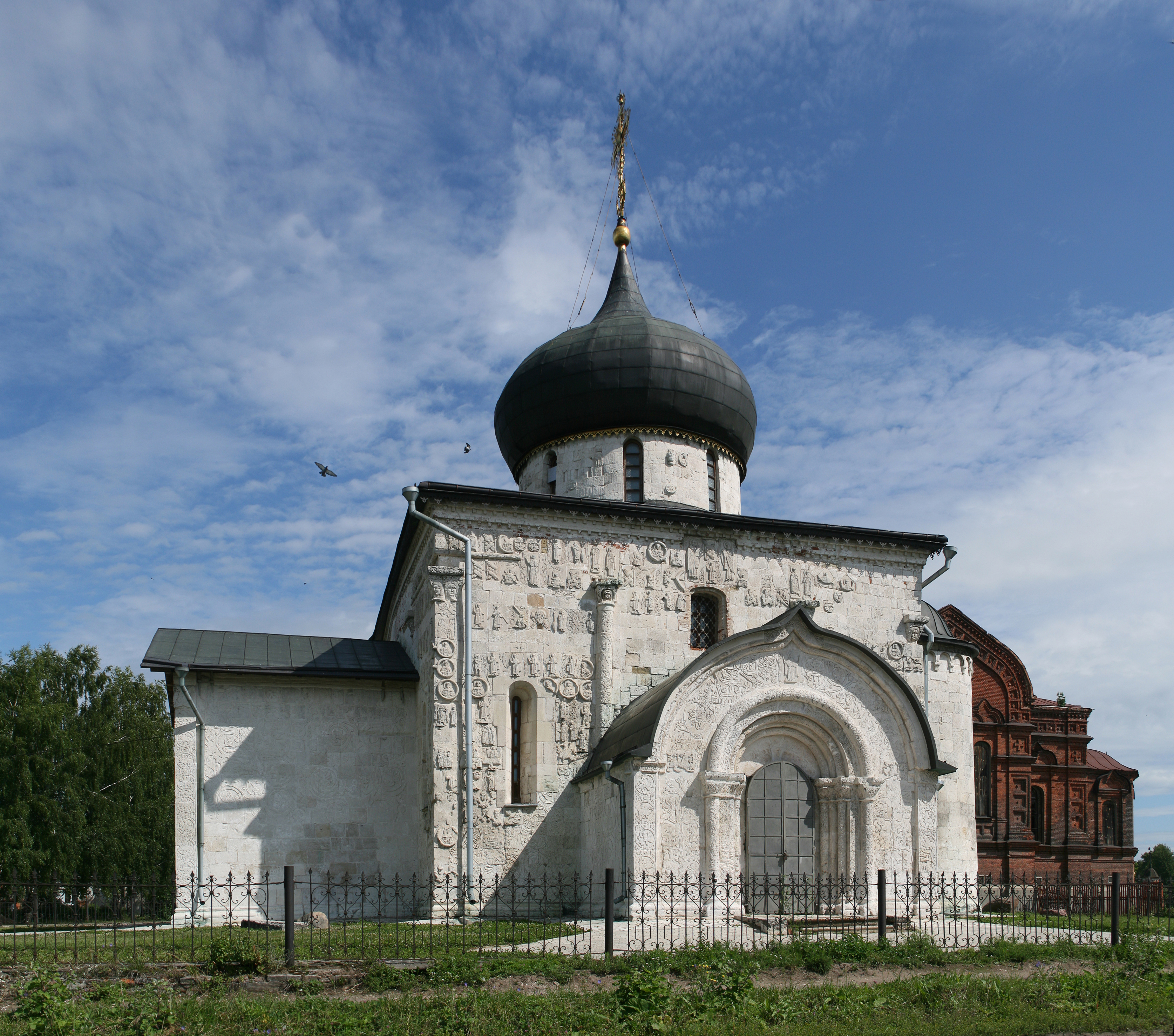
Saint George Cathedral, Yuryev-Polsky
Imagine a cathedral whose exterior was a single, continuous stone narrative -- saints, warriors, griffins, and vines carved across every surface -- and then imagine it collapsing into rubble. When Vasili Yermolin reassembled the walls of Saint George Cathedral in the 1460s, he worked like a man completing a puzzle without the picture on the box. He got many pieces wrong. Some carvings ended up buried inside the reconstructed walls. Others landed in neighboring farms. The result is a building that tells two stories at once: the original vision of Prince Sviatoslav, who completed it in 1234, and the imperfect rescue that followed two centuries later.
The Last Cathedral Before the Storm
In the twelfth century, the political center of Rus was shifting northeast, from Kiev toward Vladimir. Yuri Dolgorukiy, prince of Rostov and Suzdal, founded Yuryev-Polsky in 1152 and named it for his patron saint -- the Russian form of Yuri being a version of George. He built the first cathedral here, a structure thought to resemble the surviving churches at Pereslavl-Zalessky and Kideksha. When his grandson Sviatoslav, son of Vsevolod the Big Nest, inherited the town as center of his own principality in 1212, he found the old cathedral beyond repair. Between 1230 and 1234, Sviatoslav personally supervised the construction of its replacement. The new Saint George Cathedral was the last white-stone church built in the Vladimir-Suzdal principality before the Mongol invasion swept through in 1237, making it both a culmination and an ending.
A Cathedral Carved Like a Manuscript
What made the new cathedral extraordinary was its exterior. Two groups of artists covered the white limestone walls with carvings that combined human and animal figures, executed as reliefs, with dense floral ornamental patterns worked in fine detail. Scholars believe one team of roughly twelve artists handled the figurative reliefs while a larger group of eighteen to twenty-four carved the botanical motifs. The combination of sculptural figures and ornamental carving had appeared in frescoes elsewhere in Vladimir-Suzdal, but in stone it was unique in all of Rus. The effect was of a building wrapped in a continuous visual story, where saints and prophets emerged from tangles of vegetation and fantastical beasts. The cathedral served as an architectural model: when builders constructed the Assumption Cathedral in Moscow in 1326 -- the first stone building in the capital -- they looked to Sviatoslav's creation for inspiration.
Collapse and the Puzzle of Reconstruction
In the 1460s, the cathedral collapsed. Contemporary sources treated the event as a national disaster. The architect and restorer Vasili Yermolin was dispatched to Yuryev-Polsky to put the building back together, and he claimed to have restored it to its original form. He had not. Without complete records of the original arrangement, Yermolin reassembled the carved stones as best he could, but many reliefs ended up in the wrong positions. He managed to reunite the two stones forming the Holy Trinity image in the south portal, yet across the rest of the facade, stories were scrambled, figures placed beside unrelated ornaments, and some carved blocks turned inward, their surfaces hidden inside the walls. Other stones disappeared entirely into neighboring farms, where some were recovered centuries later by the Soviet-era conservator Pyotr Baranovsky.
A Meadow Cathedral
Later centuries added a tent-roofed bell tower in the seventeenth century and two extensions in the early nineteenth century, but all these additions were demolished in the twentieth century. Today the cathedral stands alone in the middle of a meadow, with panoramic views from every side -- a setting that was never part of the original plan but that reveals the building's compact, asymmetrical form with unusual clarity. The main volume is a square supported by four columns, square in cross-section, with an apse on the eastern side. The northern wall, which survived the collapse best, retains the most coherent sequence of original carvings. Walk around to the south, where the damage was worst, and the scrambled puzzle becomes evident: carvings that clearly belong to different narratives sit side by side, a visual record of Yermolin's impossible task.
The Incomplete Masterpiece
Unlike most of its contemporaries in the Vladimir-Suzdal group, Saint George Cathedral was not included in the UNESCO World Heritage designation for the White Monuments of Vladimir and Suzdal, a reflection perhaps of how thoroughly the collapse and reconstruction altered the original. It is, however, classified as an architectural monument of federal significance by the Russian government. Scholars have now reconstructed most of the original carving program on paper, piecing together photographs, measurements, and the stones Baranovsky retrieved. The cathedral remains a museum, open to visitors who can study the northern wall for the original vision and the southern wall for the story of what happens when centuries intervene between creation and preservation. Sviatoslav himself was buried here in 1252, fifteen years before the Mongol yoke would fully settle over Russian lands.
From the Air
Located at 56.50N, 39.68E in Vladimir Oblast, Russia. The cathedral sits within the old fortress area of Yuryev-Polsky, a small town on the flat agricultural plain northeast of Vladimir. From the air, look for the town center and the isolated white building in a green meadow. Nearest airports include Vladimir (no major ICAO) and Ivanovo-Yuzhny (UUBI), approximately 80 km to the northeast. Best viewed at 2,000-4,000 feet. The flat terrain of the Opolye region makes the town easily identifiable.