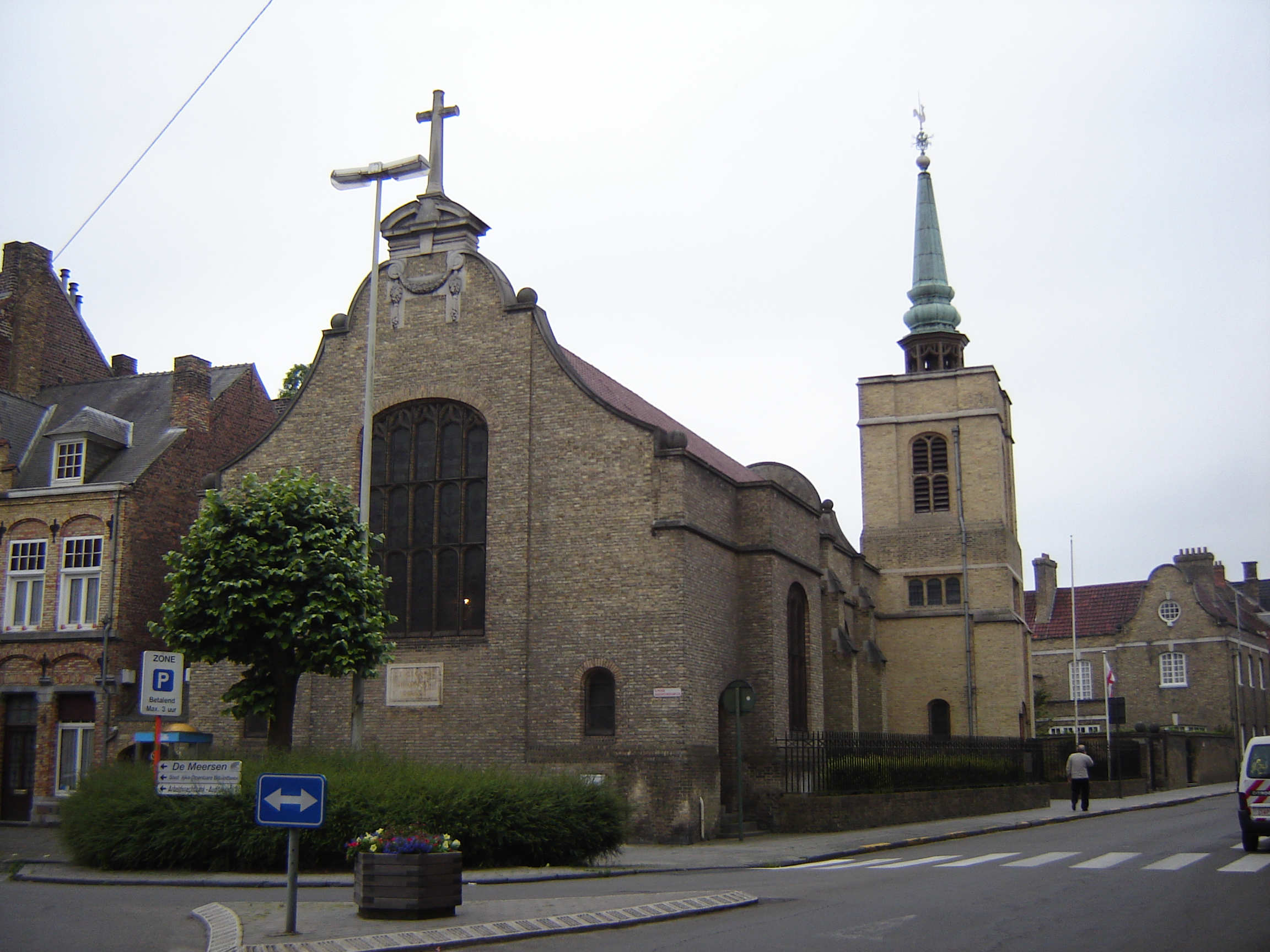
Saint George's Memorial Church, Ypres
It is easy to walk past Saint George's Memorial Church without noticing it. The brick building sits on a quiet side street in central Ypres, three minutes from the Grote Markt, with the small, square austerity of a 1920s English parish. There is nothing flamboyant about it. The plaques in the porch are the first hint of what is inside. Every chair has a brass plate. Every kneeler is embroidered with a regimental badge. Every stained-glass window was donated by a family, a school, a regiment, a town. Saint George's is not so much a church as a roll-call - a building made entirely out of the absence of half a million people, gathered into one small space and prayed for, every day, since 1929.
Sir John French's Idea
After the war, Field Marshal Sir John French - the BEF commander who had led the small British army to Ypres in 1914 and watched it die there - took on a second cause. He became president of The Ypres League, an association of veterans and bereaved families who wanted Britain to remember the salient as their generation had known it. He proposed a British memorial church in Ypres itself, an Anglican parish in the heart of the town that had cost so many British and Commonwealth lives. The town gave the land. The Ypres League raised the money. The architect was Sir Reginald Blomfield, who had already designed the Menin Gate around the corner. The foundation stone was laid by Field Marshal Lord Plumer on 24 July 1927 - the same day Plumer unveiled the Menin Gate itself - and the church was consecrated by the Bishop of Fulham on 24 March 1929. French did not live to see it open in service. He had died in 1925.
Built Out of Grief
Saint George's was paid for almost entirely by donations from families. The wealthy paid for windows; the less wealthy paid for furniture; almost everyone paid for a chair, with a brass plate carrying a soldier's name. The result is a parish church that doubles as a private archive of British and Commonwealth grief. Plaques cover the walls of the nave and aisles - regiments, schools, individual officers, individual privates. The stained glass commemorates units that fought across the salient: the Tank Corps, the Royal Air Force, the cavalry, the nurses. A pew was donated by Eton in memory of its boys who died here. Another bench remembers a young lieutenant by his college and his death date. The building is not large. The cumulative weight of so much specific mourning, packed into so small a space, is something you feel before you have read any of the names.
The Five Battles
The church was built to commemorate the half-million British and Commonwealth soldiers - the figure was reckoned at over 500,000 at the time of construction - who died in the battles fought for the Ypres Salient. The arithmetic varies depending on how you count, but the order of magnitude is right. Saint George's holds the memory of First Ypres in 1914, where the old British Regular Army was destroyed; Second Ypres in 1915, the gas attacks; Third Ypres at Passchendaele in 1917, the great mud offensive that produced nearly half a million casualties on all sides; the Fourth Battle, the Battle of the Lys in 1918; and the Fifth, the brief Allied advance of late September 1918 that finally freed the eastern hinterland. Five battles, five names, one small church. Each of them is in the stained glass and the regimental colours that hang from the rafters.
The Bells That Came Late
When Blomfield drew the original plans, the church was supposed to include a peal of bells. There was not enough money in 1929 and the bell tower stood silent for nearly ninety years. In 2016, during the centenary commemorations of the war, the parish launched an appeal to finish what had been started. By September 2017 the church had paid for eight new change-ringing bells, cast by John Taylor & Co of Loughborough - the same foundry that has cast English church bells since the seventeenth century. They are the first ring of English change-ringing bells anywhere in Belgium. On 10 January 2018, a team of eight British ringers rang the inaugural peal: 5,088 changes of Ypres Surprise Major, in two hours and forty-two minutes. It was the first full peal ever rung on church bells anywhere in continental Europe. The bells now sound regularly over the small square outside.
Open Every Day
The church is part of the Diocese in Europe of the Church of England - a chaplaincy serving British and Commonwealth visitors and the small permanent expatriate community of West Flanders. It is also a Belgian national monument, though the day-to-day life of the place is more parish than monument. The doors are open every day from half past eight in the morning until seven in the evening, six in winter. Anyone may come in. A book by the door records prayers and memories left by visitors; many are written by descendants of men named somewhere in the building. The Last Post still plays at the Menin Gate at eight every evening, three minutes' walk away. Saint George's keeps a quieter watch, the lights on for the families who keep finding their way here. There is no charge to enter. There is rarely a crowd. Most days, even in summer, you can sit alone among the names.
Why the Building Matters
There are larger and more famous memorials around Ypres - the Menin Gate with its 54,000 names, Tyne Cot Cemetery with nearly 12,000 graves and 35,000 more names on its wall, the Cloth Hall and its In Flanders Fields Museum. Saint George's is the smallest of the major sites and in some ways the most affecting, because it is the only one that is still a working church. People are baptised here. People are married here. The Anglican liturgy continues on Sunday mornings, said by a chaplain into a building furnished almost entirely with the dead. Most war memorials are silent. This one is not. The brass plates on the chairs are read out at services, the bells ring for weddings and funerals, and the names that fill the walls keep doing the work the church was built to do - keeping faith with men who did not come back from the fields outside town.
From the Air
Saint George's Memorial Church sits at 50.8522 N, 2.8831 E, two blocks west of the Cloth Hall in central Ypres. The church itself is small and difficult to identify from the air; use the Cloth Hall belfry (70 m, immediately to the east) and the Cathedral of St Martin as primary reference points. Approach Ypres from any direction at 1,500-2,500 ft AGL. The nearest civil airport is Wevelgem (EBKT), 25 km southeast; Ostend-Bruges (EBOS) is 50 km north and Lille-Lesquin (LFQQ) is 50 km south. The church can be visited daily; opening hours are 0830-1900 (1800 in winter). The Menin Gate, just east of the church, hosts the Last Post ceremony every evening at 2000 local time.