Saint Isaac's Cathedral
There is a Finnish phrase: rakentaa kuin Iisakin kirkkoa - to build like Saint Isaac's Church. It means a project that goes on so long it might never end, and the Finns have a particular right to the expression because the cathedral's 112 red granite columns were quarried in their territory and floated by barge across the Gulf of Finland to Saint Petersburg. Auguste de Montferrand was 32 when Tsar Alexander I commissioned him to build the cathedral in 1818. He was 72 and dying when it was consecrated in 1858. He had spent forty years on a single building, and the building was so heavy that engineers had first to drive 10,000 wooden tree trunks into the boggy Petersburg ground to keep it from sinking.
Forty Years and 100-Ton Columns
Each of those 112 Corinthian columns is a single piece of granite. The 48 ground-level columns are 17 meters tall and weigh roughly 114 tons each. They were cut at the Pyterlahti quarry in Virolahti, Finland, then dragged to the coast on rollers, loaded onto specially built barges, sailed across the gulf, and erected on the Petersburg site using massive wooden frameworks Montferrand designed for the purpose. The lifting was a public event - the first column went up in March 1828 in front of the imperial family and a crowd of thousands; the operation took 45 minutes. The 24 columns of the upper rotunda, hauled to a height of 43 meters, took longer. Watching the engineering happen became a Petersburg pastime for a generation. The dome rises to 101.5 meters - Russia's tallest cathedral, one of the tallest domes in the world - and is gilded with about 100 kilograms of pure gold.
An Engineer's Cathedral
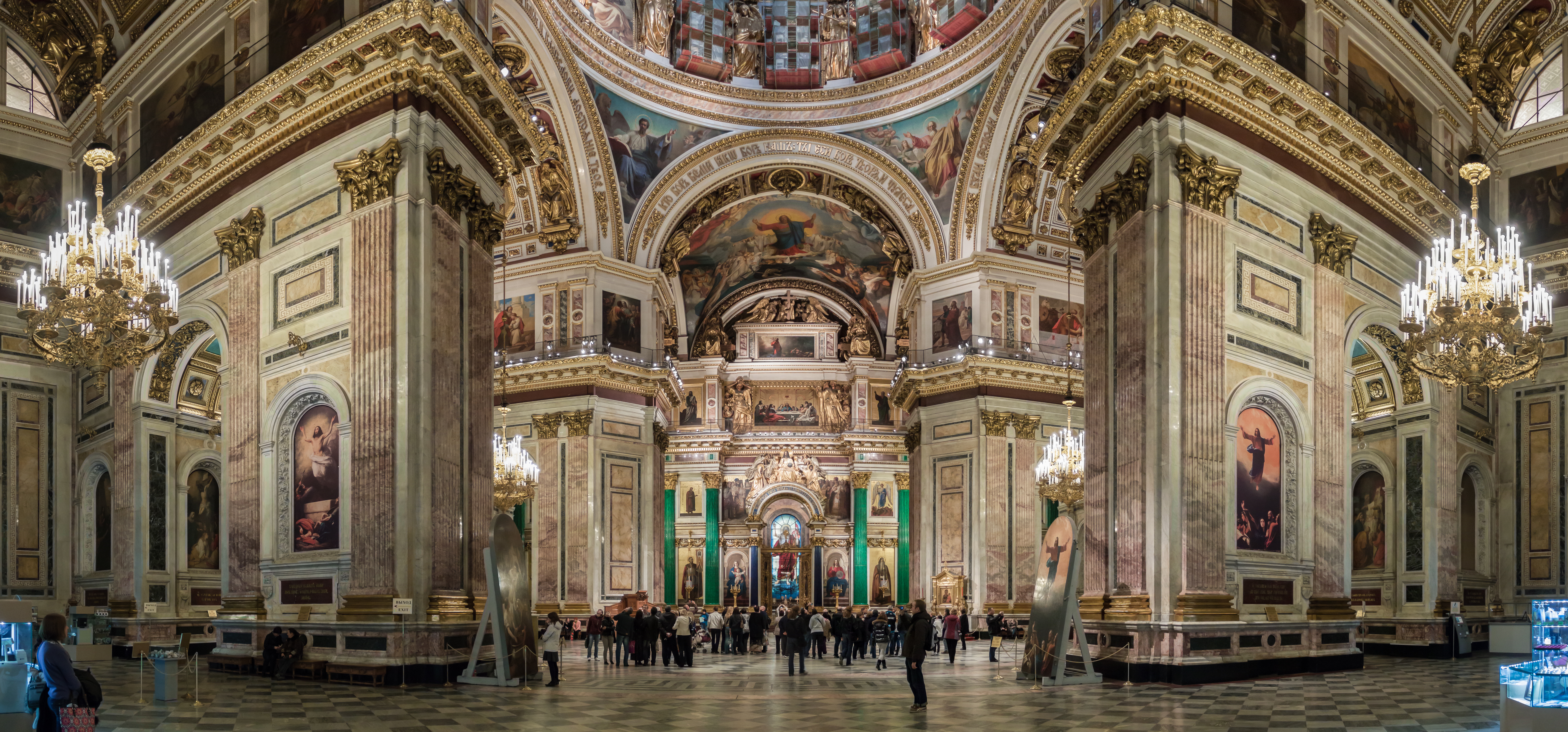
Saint Isaac's looks like a religious building because it is one - dedicated to Saint Isaac of Dalmatia, on whose feast day Peter the Great had been born. But its real distinction is technical. Montferrand's dome is built around a cast-iron supporting structure - only the third large cast-iron cupola ever built (after the Leaning Tower of Nevyansk in 1732 and Mainz Cathedral in 1826), and the largest of the three by far. The twelve six-meter-tall angel statues around the dome's interior were made by electrotyping - galvanic deposition of metal - rather than the traditional bronze casting, the first use of that technology in architecture. The interior columns and floor mix granites and marbles from across the empire: rose Karelian rhodonite, green Ural malachite, deep-blue lazurite from Lake Baikal. The iconostasis is framed by eight columns of semiprecious stone - six of malachite and two of lazurite - one of the most extravagant pieces of liturgical interior architecture anywhere.
The Foucault Pendulum and the Museum of Atheism
On April 12, 1931, the Soviet government conducted the first public demonstration of a Foucault pendulum inside Saint Isaac's. The gilded dove of the Holy Spirit suspended from the apex of the dome was removed; in its place, a 93-meter cable held a 54-kilogram bronze ball that swung slowly across the cathedral floor, demonstrating the rotation of the Earth. The pendulum stayed for 55 years. The cathedral itself became an Anti-Religious Museum, then in 1937 a museum of the cathedral building. During the siege of Leningrad in World War II, the dome was painted gray to confuse German artillery spotters; on top of the skylight, Soviet observers placed a geodesic intersection point to triangulate enemy gun positions. The pendulum was finally removed in 1986, after which the dove of the Holy Spirit was restored to its place under the dome.
Whose Cathedral?
After the Soviet collapse, the Russian Orthodox Church wanted Saint Isaac's back. The state declined, and the building remained a museum, with weekend church services held quietly in a side chapel. In January 2017 the Petersburg city government announced it would hand the building to the Church. The reaction was sharp: thousands of Petersburg residents protested, court cases were filed, the necessary paperwork was allowed to expire by December 2018, and no transfer happened. The dispute had less to do with religion than with money and access - the cathedral generates substantial museum revenue, and giving it back to the Church would close it to the casual ticket-buying tourist. As of now, Saint Isaac's remains a museum. Services happen on major feast days. In October 2021, Grand Duke George Mikhailovich of Russia and Victoria Bettarini married here - the first royal wedding in Russia since the abdication of Nicholas II in 1917.
Climbing the Colonnade
The single most striking thing you can do at Saint Isaac's is climb the dome. A long spiral staircase inside one of the four corner pillars takes you up 262 steps to the colonnade walkway that rings the rotunda - the same gallery whose 24 statues you can pick out from the street. From there the whole of central Petersburg unfolds: the Neva, the Hermitage and Winter Palace to the north, the spire of the Admiralty straight north below you, the Bronze Horseman on its granite plinth in Senate Square at your feet, and on a clear day the Gulf of Finland visible to the west. The wind at this height is constant. The view is what every panoramic photograph of Saint Petersburg ever taken from a tower has been - because most of those photographs were taken right here, from the colonnade Montferrand spent his life building.
From the Air
Saint Isaac's Cathedral stands at 59.93 degrees north, 30.31 east, on Saint Isaac's Square in central Saint Petersburg, two blocks south of the Neva river and the Senate building. From the air the gilded dome is one of the most unmistakable landmarks in the city - a single great gold disk visible in clear weather from 50+ kilometers, oriented on the same north-south axis as the Admiralty spire and the Peter and Paul Fortress steeple across the Neva. Cruising altitude over central Petersburg is restricted; Pulkovo (ULLI) is 17 km south. Best photographed during the white nights of June at low sun, when the dome catches a long warm light against the city's predominant blues and greens, or in clear winter when fresh snow on the surrounding rooftops sets off the gold.