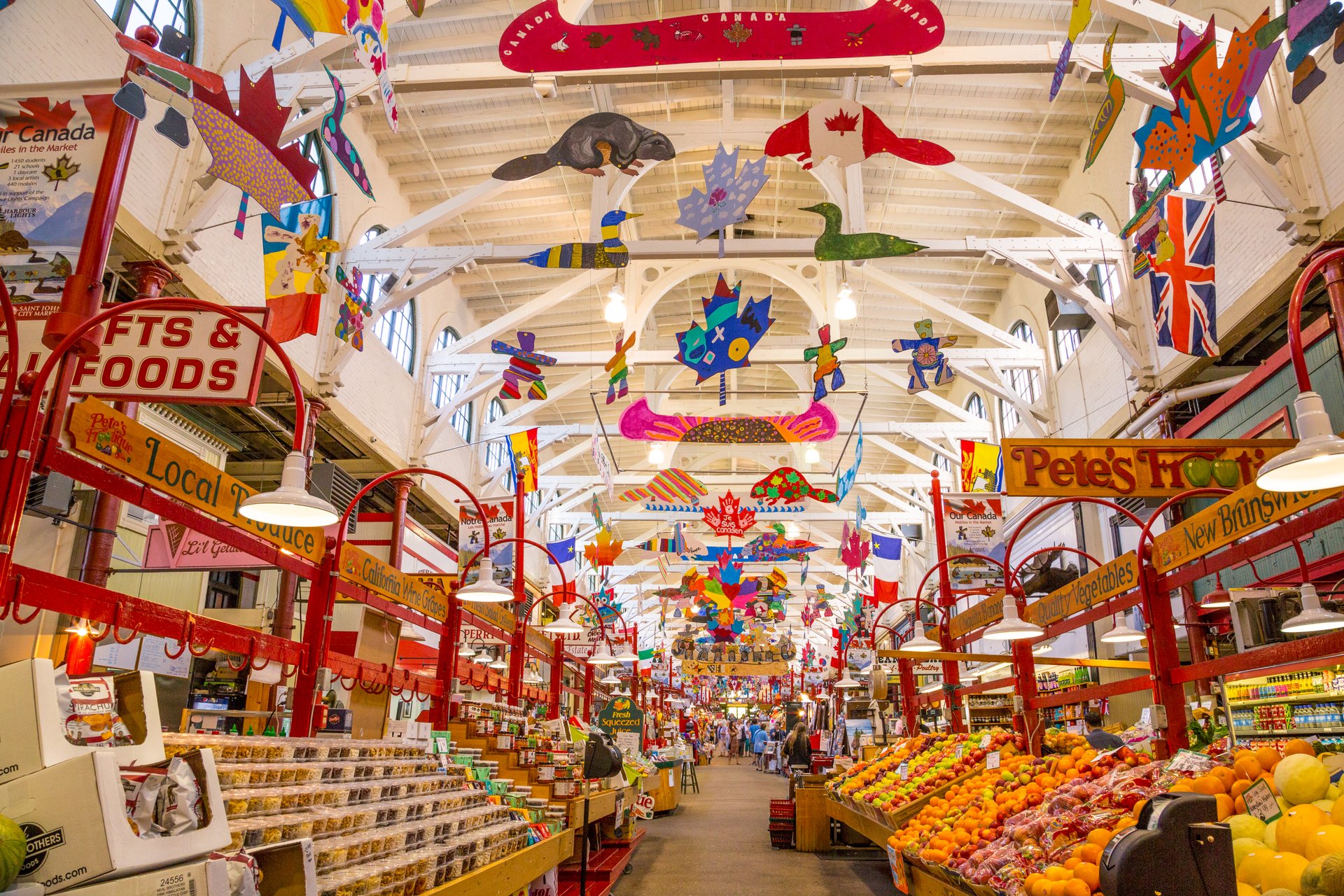
Saint John City Market
Look up inside the Saint John City Market and the ceiling tells you everything about the city that built it. The wooden trusses arch overhead in the unmistakable shape of an inverted ship's keel, crafted in 1876 by unemployed ship carpenters who applied the only engineering they knew to a landlocked problem. It is an accidental masterpiece, a reminder that Saint John was a shipbuilding city before it was anything else, and that the people who made it understood wood and water better than they understood architecture textbooks.
A Charter Older Than the Constitution
The market's charter dates to 1785, making it the oldest continuously operated farmer's market in Canada. That founding date places it just two years after the arrival of the Loyalists who built Saint John from scratch after the American Revolution. The market was not an afterthought. It was infrastructure, a declaration that this new settlement on the Bay of Fundy intended to feed itself properly. Before the current building existed, two earlier wooden structures housed the market, and both were destroyed by fire. The city kept rebuilding because a public market was not optional in a place where winter lasted half the year and the nearest supply line was a sailing ship.
Surviving the Great Fire
The current building, designed by architects J.T.C. McKean and G.E. Fairweather in the Second Empire style, was completed in 1876. Its timing was extraordinary. Just one year later, the Great Fire of 1877 swept through Saint John and destroyed roughly 40 percent of the city's buildings. The market survived. Whether by luck, firebreaks, or the sheer density of its masonry construction, it stood while block after block around it burned to the ground. That survival gave the building a status beyond its commercial function. It became proof that something in Saint John could endure, a fixed point in a city that had just watched its own skyline disappear.
Ship Carpenters and Sloping Floors
The roof is what visitors remember. The inverted keel structure was reportedly the work of local shipwrights whose industry had begun its long decline by the 1870s, as steam replaced sail and iron replaced wood. These were men who knew how to distribute weight across a curved frame, how to make a structure that could withstand lateral stress, and how to join timber without modern fasteners. They built the market roof the way they would have built a hull, and the result is a space that feels more like the interior of a vessel than a commercial building. Even the floor cooperates with the metaphor, sloping with the natural grade of the land rather than fighting it. Walking through the market, you descend gently from one end to the other, as if the whole building is settled into the hillside like a boat resting on a beach.
Centuries of Commerce
Some vendors in the market have been operating from the same stalls for more than a century. The continuity is remarkable. Families have handed down their positions inside the building the way other families hand down farmland, and the result is a market that does not need to manufacture authenticity. Facing onto Kings Square, the building connects to Saint John's indoor pedway system, an enclosed network of walkways that links downtown buildings against the realities of Maritime winters. The market was designated a National Historic Site of Canada in 1986, a recognition that acknowledged not just the architecture but the unbroken thread of commerce stretching back to the 18th century. On any given morning, the stalls carry local produce, fresh seafood from the Bay of Fundy, baked goods, and craft items from New Brunswick artisans.
From the Air
Located at 45.27N, 66.06W at 47 Charlotte Street in downtown Saint John, New Brunswick. The market building sits adjacent to Kings Square, identifiable from the air by its distinctive Second Empire roofline. Nearest airport is Saint John Airport (CYSJ), approximately 14 km east. The city occupies a peninsula where the Saint John River meets the Bay of Fundy, with the Reversing Falls visible to the northwest.