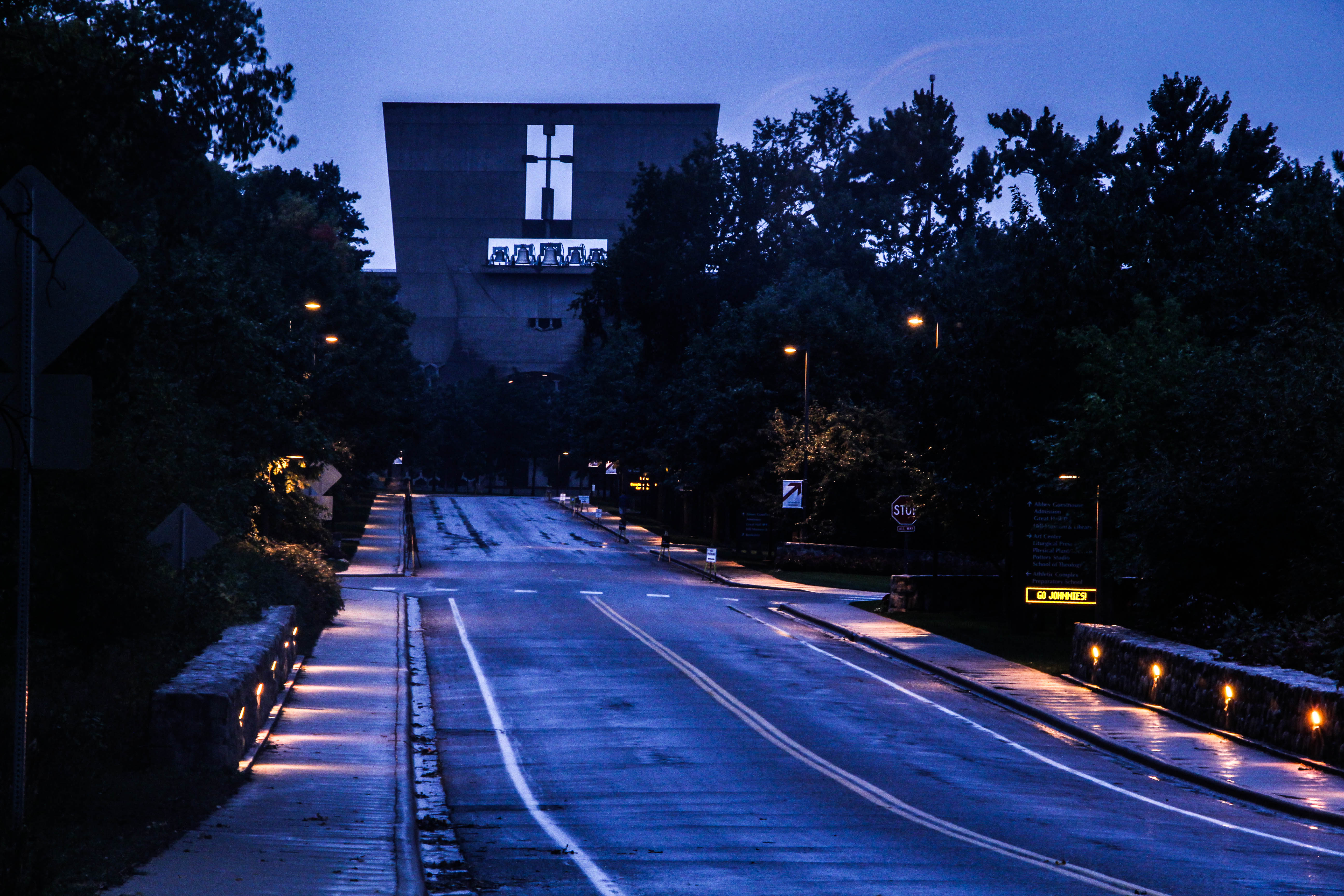
Saint John's Abbey, Collegeville
The concrete bell banner rises 112 feet above the Minnesota prairie, a massive honeycomb of geometric voids holding five bells and framing the sky behind them. It stands apart from the church it announces, an architectural exclamation point that has divided opinion since the day it was unveiled. Marcel Breuer designed it that way -- provocative, unapologetic, modern. That a community of Benedictine monks living by a rule written in the sixth century would commission one of the twentieth century's boldest pieces of sacred architecture tells you something about Saint John's Abbey. Founded in 1856 by five monks from Pennsylvania, this monastery on the shores of Lake Sagatagan has grown into one of the largest Benedictine abbeys in the Western Hemisphere, with 110 professed monks, a university, a publishing house, and the first handwritten illuminated Bible commissioned by a monastery since Gutenberg changed everything.
Five Monks from Latrobe
In 1856, five monks from Saint Vincent Archabbey in Latrobe, Pennsylvania, arrived in St. Cloud, Minnesota, sent to serve the growing population of German immigrants in central Minnesota. They established a priory and almost immediately founded a school -- Saint John's College, which later became Saint John's Preparatory School. The community moved twice in search of a permanent home, settling on the wooded shores of Lake Sagatagan in 1865. The following year, the priory was elevated to an abbey, and Father Rupert Seidenbusch was elected as the first abbot. He would later be named Bishop of the Vicariate Apostolic of Northern Minnesota. The school the monks founded grew into Saint John's University in 1883. The abbey's Quadrangle, connecting the monastery to the university, was at the time of its construction the largest building west of the Mississippi River dedicated to education.
A Monument to the Service of God
By the early 1950s, the monastic community had grown to approximately 450 monks, and the original abbey church could no longer contain them. The monks were deeply engaged in the liturgical movement that would culminate in the Second Vatican Council, and they wanted a church designed with anticipated reforms in mind. They contacted twelve architects and asked for plans that would "be truly an architectural monument to the service of God." In 1954, they selected Marcel Breuer, the Hungarian-born Bauhaus architect. Breuer's design placed the traditional liturgical axis -- baptistery, nave, altar -- inside a dramatically modern concrete shell. The monastic choir stalls and abbot's throne curve in a semicircle around the main altar, drawing the congregation closer. So precisely did the design anticipate Vatican II's liturgical changes that almost no modifications were needed after the council. The upper church houses a Holtkamp Pasi organ with over 6,000 pipes.
Ink on Vellum
Inside Alcuin Library, visitors encounter something that seems to belong to another century entirely. The Saint John's Bible is the first completely handwritten and illuminated Bible to be commissioned by a Benedictine monastery since the invention of the printing press. Its creation was a deliberate act of devotion and craft in an age of mass production -- calligraphers working with quills on calfskin vellum, illuminators applying gold leaf and hand-ground pigments. The project took over a decade to complete. The finished work is cared for by the Hill Museum and Manuscript Library, an independent nonprofit on the Saint John's campus. The same grounds host the Collegeville Institute for Ecumenical and Cultural Research, the Episcopal House of Prayer, and the original Minnesota Public Radio studio. The abbey also operates the Liturgical Press, one of the foremost liturgical publishing houses in the United States.
Lake, Prairie, and Glacial Moraine
The abbey sits on grounds that encompass lakes, prairie, and hardwood forest spread across a rolling glacial moraine. These lands were formally designated the Saint John's Arboretum in 1997, covering more than 2,500 acres of oak savanna, wetlands, and mixed forest. Trails crisscross the property, groomed for Nordic skiing in winter and hiking the rest of the year. The abbey is also the site of one of the largest solar farms in Minnesota, originally built in 2009 as a 3.9-acre tracking panel installation and expanded in 2014 to produce over 600 kilowatts of electricity. A historic district of 17 buildings, constructed between 1868 and 1959, was listed on the National Register of Historic Places in 1979 for having national significance in architecture, community planning, education, and religion. Eleven abbots have led the community since 1866, with the Right Reverend Douglas Mullin, O.S.B., serving as the current and eleventh abbot.
Shadows and Reckoning
The abbey's history is not without darkness. Saint John's has been the subject of multiple child sexual abuse cases, with accounts stretching back to the 1970s. In 2011, the abbey released the names of 18 current or former monks against whom credible allegations of sexual abuse had been brought. In 2013, the abbey identified 23 monks who had "likely offended against minors" and released 18 names, a list distinct from the 2011 disclosure. The cases involved abuse at the preparatory school, at a St. John's-owned cabin near Bemidji, and at institutions in North Carolina and Puerto Rico. In April 2015, the abbey settled a Stearns County sex abuse suit, with settlement conditions requiring the release of documents related to 19 accused monks. The reckoning forced the community to confront a painful contradiction between its spiritual mission and the harm done by some of its members.
From the Air
Located at 45.58°N, 94.39°W in Collegeville Township, Stearns County, Minnesota, at approximately 1,200 feet MSL. Marcel Breuer's Abbey Church and its distinctive freestanding concrete bell banner are visible from the air as bold geometric forms amid the forested campus. Lake Sagatagan borders the grounds to the south and east. The 2,500-acre Saint John's Arboretum and the abbey's solar farm are also visible landmarks. St. Cloud Regional Airport (KSTC) is approximately 10 miles to the east. The campus sits in a rolling glacial moraine landscape. Best viewed at 3,000-5,000 feet AGL to appreciate the relationship between the Breuer buildings, the lake, and the surrounding arboretum.