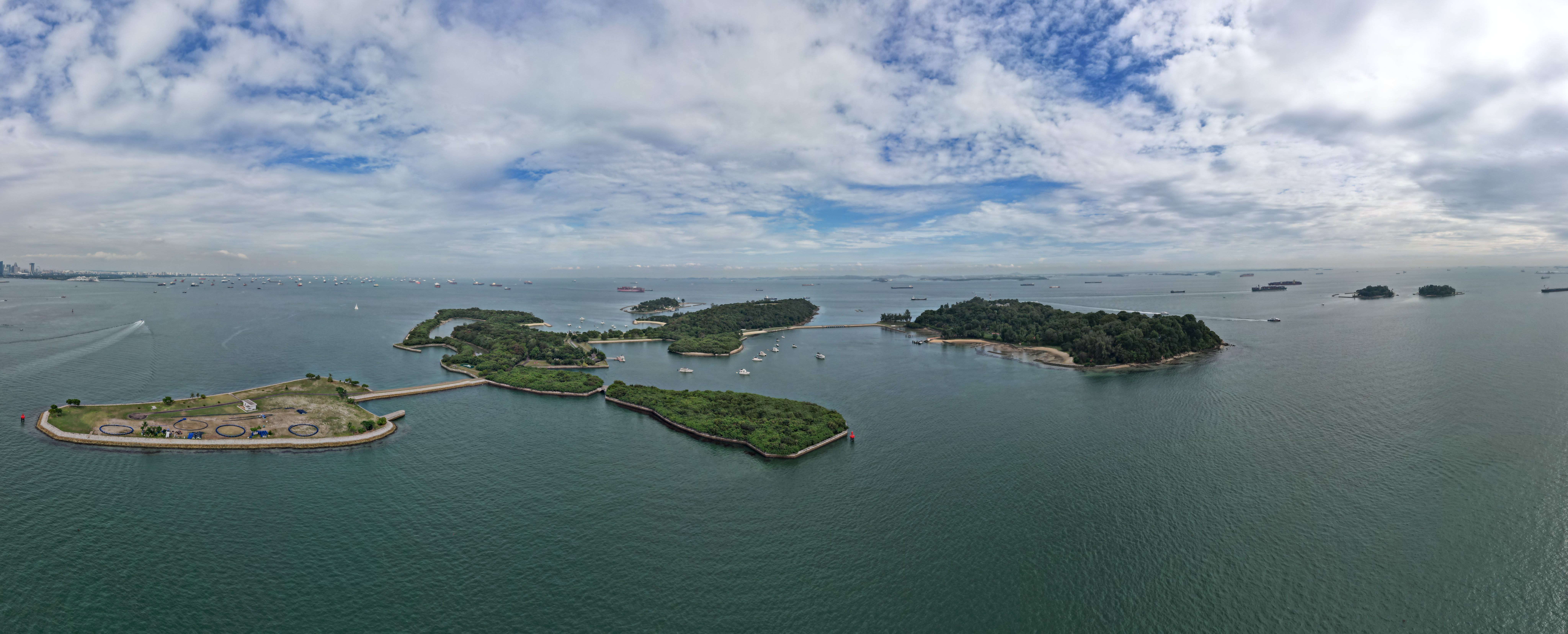
Saint John's Island
The name itself is a misunderstanding. When Stamford Raffles's delegation arrived to establish a trading port on Singapore in 1819, one of its members, John Crawfurd, misheard the island's local Malay name and wrote down "St John." The error stuck. Over the next two centuries, this small island 6.5 kilometers off Singapore's southern coast would accumulate more identities than a place its size should reasonably hold: quarantine station, internment camp, political prison, opium rehabilitation center, refugee settlement, marine laboratory. Today, Saint John's Island has no permanent residents at all. Its last four islanders left in 2017, and the only school ever built there closed in 1976. What remains is a landscape of tropical forest and coral reef layered over a history of confinement, control, and reinvention.
The Gatekeeper's Island
For over a century, Saint John's Island was the place where Singapore decided who could enter. The quarantine station opened in November 1874, initially a collection of attap huts, after a cholera epidemic the previous year killed 448 people in the colony. Its first month of operation set the tone: more than 1,000 Chinese passengers aboard the cholera-infected SS Milton, en route from Swatow to Penang, were diverted to the island for quarantine. Muslims returning from their Hajj pilgrimage to Mecca were quarantined there too. When the 1894 Hong Kong bubonic plague outbreak reached Southeast Asia, a plague hospital was hastily built on the island. By the early twentieth century, more than 300,000 dollars had been invested in the station's expansion, and it had grown into one of the largest quarantine operations in the British Empire. Not everyone received equal treatment. First- and second-class passengers were exempt from quarantine. Chinese coolies, by contrast, were allegedly given insufficient food, no bedding, and pressed into forced labor. The station closed on January 14, 1976, made obsolete by the age of air travel.
Walls Without Walls
Saint John's geography -- a small island surrounded by open water -- made it a natural prison, and the colonial authorities used it as one repeatedly. When World War I broke out in August 1914, most German men in Singapore were interned on the island. During World War II, the pattern repeated: foreign nationals, some of them Jews fleeing Nazism, were held there in 1940. When the Japanese took Malaya, Allied prisoners of war were detained on Saint John's. But the island's most politically charged chapter came after the war. In 1948, as the Malayan Emergency began, the British designated Saint John's as a detention center for suspected communists. Among those imprisoned without trial were future Singaporean political figures -- Devan Nair, Fong Swee Suan, and Lim Chin Siong, all members of the People's Action Party. In 1963, Operation Coldstore sent ninety-nine more detainees to the island, arrested for alleged political extremism under the Preservation of Public Security Ordinance. University students, teachers, and newspaper editors sat in cells surrounded by sea.
Rehabilitation and Refuge
In the 1950s, the island's purpose shifted again. The colonial government established an Opium Treatment Centre on Saint John's in 1954, its first attempt to rehabilitate addicts rather than simply imprison them. By 1966, more than 4,000 opium addicts had passed through the center -- though the program's success came with an asterisk: long-term addicts deemed incurable were denied treatment entirely. The island also became an occasional refuge for the displaced. In 1955, residents of neighboring Lazarus Island were housed at the quarantine station after a rare high tide destroyed their homes. In the mid-1970s, eighty-four Vietnamese war refugees were settled on Saint John's, the drug rehabilitation patients temporarily relocated to make room. A detention center was prepared for an expected wave of Indonesian refugees during the 1998 Asian financial crisis, but the influx never materialized. The facility stands abandoned.
An Island Emptied
Between 1976 and 1977, the government relocated the residents of Saint John's, Lazarus Island, and Seringat Island to the mainland. At its peak in the early 1960s, more than 400 people had lived on Saint John's. The island's only school shut down in 1976. Proposals to redevelop the island as a resort destination -- restaurants, golf courses, even an integrated casino -- fell through. What came instead was science. The National Marine Laboratory was established in 2002, followed by the Marine Aquaculture Centre, a hatchery completed in 2003. The island's tropical forest still shelters more than 258 species of vascular plants, including critically endangered sea teak and Xylocarpus rumphii. Coral reefs ring the shoreline. Crustaceans and cetaceans move through the surrounding waters of the Singapore Strait. Saint John's has become, after centuries of serving as Singapore's holding pen for the unwanted, a place where life is studied rather than contained.
From the Air
Located at 1.22N, 103.85E in the Straits of Singapore, approximately 6.5 km south of mainland Singapore. The island is clearly visible from low altitude as a forested landmass connected by causeway to neighboring Lazarus Island. Part of the Sisters' Islands Marine Park cluster. Overfly at 1,500-2,500 feet for views of the island group and surrounding coral reefs. Nearest airport: Singapore Changi (WSSS) approximately 15 km to the northeast. Sentosa Island and the Southern Ridges are visible to the north.