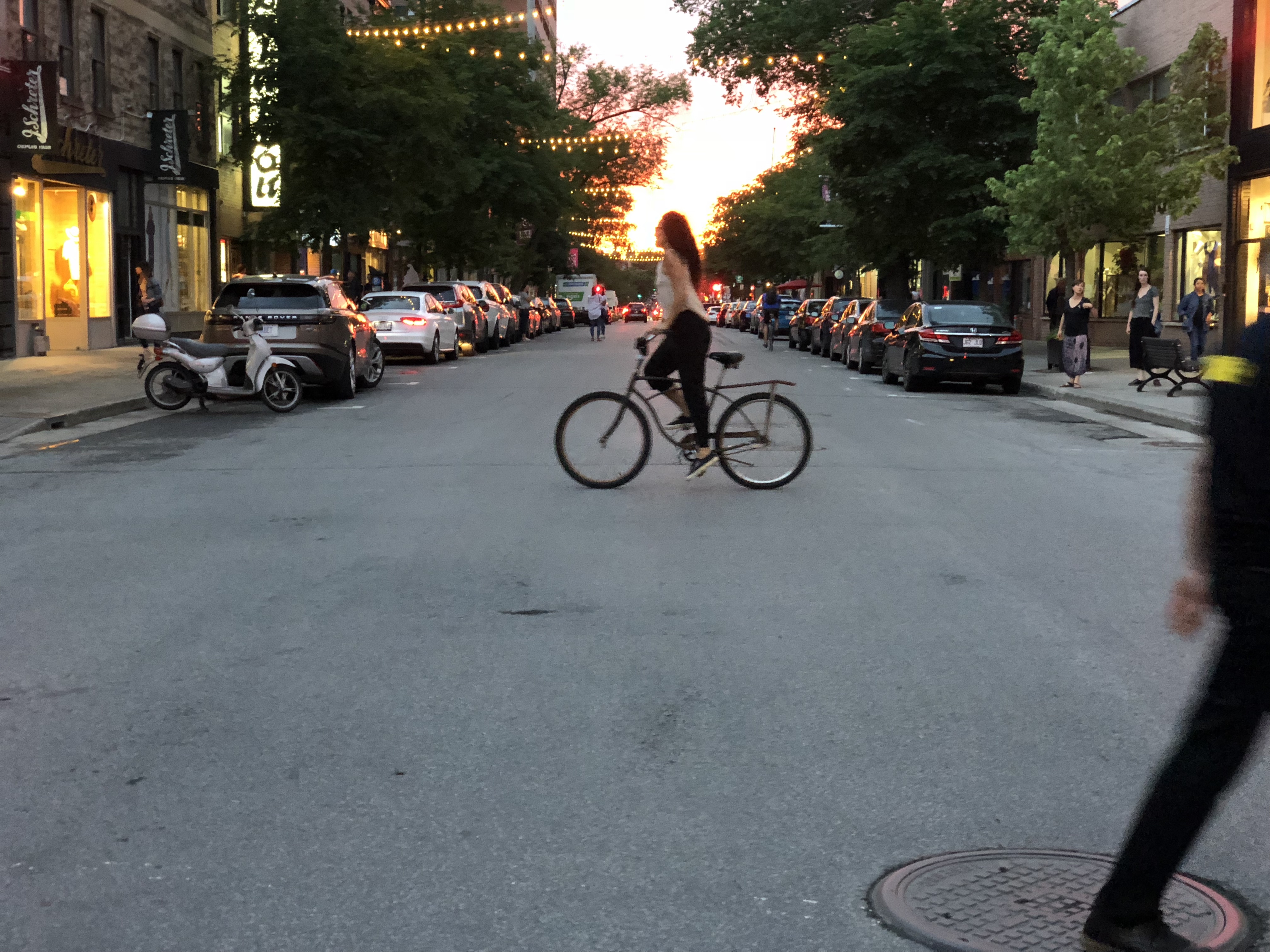
Saint Laurent Boulevard
Montrealers never call it by its full name. It is The Main, always The Main, and hearing that phrase instantly marks the speaker as someone who understands the city's deepest fault line. Since the Sulpician priests laid out a small perpendicular road they called Saint-Lambert in 1672, this single artery has defined Montreal's geography of belonging: English speakers to the west, French speakers to the east, and wave after wave of immigrants settling along the boulevard itself, right on the seam. Stretching 11.25 kilometers from the cobblestones of Old Montreal to the banks of the Riviere des Prairies, Saint Laurent Boulevard is not just a street. It is the story of a city that has always been two cities, and the narrow corridor where they learned -- sometimes grudgingly -- to share the same sidewalk.
The Line That Split a City
The boulevard's role as Montreal's great divide is not metaphorical. Street numbers literally begin at Saint Laurent and count outward in both directions, with every cross-street suffixed Est or Ouest depending on which side of the line it falls. The Sulpicians drew this axis in the late 17th century, aligning the road with the setting sun on the summer solstice. Francois Dollier de Casson's 1672 plan shows the first stub of it. By the early 1700s, the lords of Montreal extended the little lane northward through farmland as a Chemin du Roi, a King's Way. It became a formal boulevard in 1905. But its deeper function -- as the psychological border between anglophone wealth and francophone neighborhoods -- was fixed well before any official redesignation. To cross The Main was to cross between worlds.
Sixty Thousand Voices in Yiddish
The most transformative chapter on The Main was written in Yiddish. Beginning in the late 1800s, Jewish immigrants from Eastern Europe settled along the lower boulevard, forming a dense, vibrant quarter that by 1930 held 60,000 Yiddish speakers -- making Montreal the fifth-largest center of Yiddish culture in the Americas, after New York, Philadelphia, Chicago, and Buenos Aires. Clothing factories hummed along the street, synagogues stood on every block, and the Monument-National theater hosted the second-largest Yiddish stage in North America. In 1907, a young Polish immigrant named Hirsch Wolofsky founded the Keneder Adler, a Yiddish daily newspaper that would publish for 70 years. The first Jewish educational institution, a Talmud Torah, opened as early as 1871 at Saint Urbain and De la Gauchetiere. From this quarter emerged some of Canada's greatest literary voices: Mordecai Richler, Leonard Cohen, Irving Layton, and A. M. Klein all drew from the textures of life along The Main.
Radicals, Spies, and Bathhouses
The Jewish quarter also produced a distinctly left-wing political culture. Fred Rose, who represented the Main's Cartier riding, became the only openly Communist member of Parliament in Canadian history -- a distinction the riding still holds. Rose was expelled from the House of Commons in 1947 after a controversial conviction for spying for the Soviet Union. City councillor Joseph Schubert, a Romanian Jew and self-declared admirer of Karl Marx, spent 15 years as Montreal City Council's most vocal advocate for workers' rights after his election in 1924. In 1931, Schubert built a public bathhouse at the corner of Bagg and Saint Laurent. The Bain Schubert still stands today, a tiled monument to an era when socialism and smoked meat coexisted on the same block.
A Corridor of Nations
Walking The Main from south to north is an act of geographic immigration. The journey begins in Old Montreal, passes through Chinatown's ornamental gate, skirts a surviving sliver of red-light district near the Monument-National, then enters the Quartier des Spectacles. Further north come the bar district between Sherbrooke and Duluth, Little Portugal clustered around Rachel Street, the bohemian cafes of Mile End, and Little Italy between Saint-Zotique and Jean-Talon. Each neighborhood arrived in layers -- first Jewish, then Chinese and Italian, then Portuguese, Greek, Arab, and Haitian -- each group using The Main as a landing strip before fanning out across the city. In 2002, Parks Canada recognized this layered history by designating Saint Laurent Boulevard as The Main National Historic Site of Canada, the first time a Canadian street earned that distinction as an immigrant corridor rather than for a single building or battle.
Where Cinema and Couriers Collide
The Main claims a startling footnote in film history: on June 27, 1896, the Edifice Robillard hosted the first movies screened in Canada, making it the continent's first cinema. The building survived until November 2016, when fire consumed it. That blend of cultural firsts and stubborn persistence defines the boulevard. Each June, the MURAL Festival transforms the stretch between Sherbrooke and Mount Royal into an open-air gallery that draws 800,000 visitors. And since 2003, bicycle couriers have staged an illegal time-trial race called Beat the Main, sprinting the full 11.5-kilometer length between Rue de la Commune and Boulevard Gouin while cheerfully ignoring traffic signals. Schwartz's deli still serves smoked meat at the same counter it has since 1928, and the Montreal Pool Room has been selling steamies since 1912. The Main does not preserve its history behind glass. It smokes it, paints it on walls, and races bicycles down the middle of it.
From the Air
Saint Laurent Boulevard runs roughly north-south through the Island of Montreal at 45.51N, 73.56W, stretching 11.25 km from the Old Port waterfront to the Riviere des Prairies. From 3,000-4,000 feet AGL, the boulevard is identifiable as a long arterial bisecting the city's dense urban grid. Key visual landmarks include Old Montreal's waterfront to the south, the distinctive green rooftops of Chinatown, and Mont Royal to the northwest. Montreal/Pierre Elliott Trudeau International Airport (CYUL) lies 12 nm west. Montreal/Saint-Hubert Airport (CYHU) is 10 nm southeast. Best viewed on a clear day when the contrast between the eastern and western neighborhoods is visible in the building patterns.